Apple Search Ads
Collect and view Apple Search Ads attribution in RevenueCat using AdServices



With our Apple Search Ads integration you can:
- Continue to follow your campaign's install base for months to understand the long-tail revenue generated from subscriptions, even without an app open.
- Filter and segment RevenueCat charts by Apple Search Ads campaigns or ad groups.
Integration at a glance
| Revenue support | Supports Negative Revenue | Sends Sandbox Events | Includes Customer Attributes | Sends Transfer Events | Optional Event Types |
|---|---|---|---|---|---|
| ✅ | ❌ | ❌ | ❌ | ❌ | ❌ |
Collecting Apple Search Ads data is a two part process:
- You must collect the user's attribution token and send it to RevenueCat
- With this token, RevenueCat will request attribution data from Apple directly within a 24 hour period
Once attribution data is collected from Apple, it will be available via Charts and other integrations.
For a cross-provider view of identifiers, revenue support, sandbox behavior, and attribution responsibilities, see the attribution provider comparison.
RevenueCat requests Apple Search Ads attribution data from Apple and stores the values Apple returns. Apple Search Ads owns campaign delivery and attribution eligibility.
Starting in September 2026, Apple's AdServices API returns attribution: false for installs from Apple Ads ad groups that use age or gender targeting. RevenueCat can't retrieve campaign, ad group, or keyword data for these installs, even when the integration is configured correctly.
To receive attribution data through AdServices, remove age and gender targeting from your Apple Ads ad groups.
1. Configure integration
Apple Search Ads offer two products, Search Ads Basic and Search Ads Advanced. The RevenueCat Apple Search Ads integration supports both Basic and Advanced.
Your RevenueCat configuration should match your Apple Search Ads solution. If you use Search Ads Advanced in Apple but enable Basic in RevenueCat, you won't have access to the full attribution data. Similarly, if you use Search Ads Basic in Apple but configure Advanced in RevenueCat, you'll still only receive basic attribution data.
Basic
- Navigate to your project in the RevenueCat dashboard and choose Apple AdServices from the Integrations menu.
- Click on Add Apple Search Ads integration to add the integration.
Please advance to step 2 to send the attribution token to RevenueCat. Without this step, RevenueCat will not be able to collect Apple Search Ads data.
Advanced
If you already have an Advanced integration set up using the legacy method (clientId, teamId, and keyId), your existing setup will continue working. We recommend anyway migrating to the new approach to align with current best practices.
- Navigate to your project in the RevenueCat dashboard and choose Apple AdServices from the Integrations menu.
- Click on Add Apple Search Ads integration to add the integration.
- Click Sign in with Apple button in the Advanced integration section.
- Sign in to Apple Search Ads and authorize RevenueCat access.
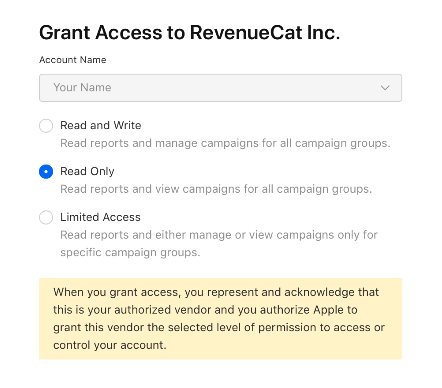
On Apple’s permission screen, these options are compatible:
- Read Only: ✅ Recommended. This is sufficient for RevenueCat and provides a reliable setup.
- Read and Write: ✅ Also compatible, but grants more access than RevenueCat needs.
- Limited Access: ⚠️ Compatible only if access includes all campaign groups RevenueCat needs. Otherwise, you may see partial data or authorization errors that can cause unexpected integration behavior.
The Apple Ads user granting third-party API access must be either an Account Admin or a Campaign Group Manager. Campaign Group Manager is chosen when inviting or editing a user in Apple Ads with Limited Access and assign one or more campaign groups; only the assigned campaign groups will be in scope for authorization.
More info about creating these users can be found here.
Please make sure you do not use an incognito window when creating a new Apple Account for the API user, as this has caused issues for other developers.
- Return to RevenueCat and confirm the integration is connected.
If access is revoked from Apple, you must reconnect in RevenueCat to resume data collection.
2. Send attribution token to RevenueCat
Using AdServices to collect Apple Search Ads data requires iOS 14.3+, and is not supported on earlier versions of iOS. If you need to continue collecting Apple Search Ads data for older versions of iOS, follow our legacy Apple Search Ads instructions.
Apple Search Ads provides Standard and Detailed attribution data. Standard data doesn't require App Tracking Transparency (ATT) consent. Detailed data requires ATT consent and can include an engagement timestamp that Standard data doesn't include:
clickDatefor click-through attributionimpressionDatefor view-through attribution
If the user doesn't grant tracking permission, RevenueCat can still collect Standard attribution data. This is the same Apple Search Ads data that RevenueCat can use for Charts and downstream integrations that receive Apple Search Ads context, like SplitMetrics Acquire.
For the full list of Apple source fields and how they're stored in RevenueCat customer data, see the Apple Search Ads attribution data reference.
Standard
The standard attribution data collection does not require user consent and can be enabled by calling Purchases.shared.attribution.enableAdServicesAttributionTokenCollection() after calling configure:
- Swift
- Obj-C
- Flutter
- React Native
- Cordova
func application(_ application: UIApplication,
                 didFinishLaunchingWithOptions launchOptions: [UIApplicationLaunchOptionsKey: Any]?) -> Bool {

    Purchases.configure(withAPIKey: "public_sdk_key", appUserID: "my_app_user_id")
    Purchases.shared.attribution.enableAdServicesAttributionTokenCollection()

    return true
}
- (BOOL)application:(UIApplication *)application
  didFinishLaunchingWithOptions:(NSDictionary *)launchOptions {

  RCPurchases *purchases = [RCPurchases configureWithAPIKey:@"public_sdk_key" appUserID:@"my_app_user_id"];
  [purchases.attribution enableAdServicesAttributionTokenCollection];

}
// ...
await Purchases.configure(PurchasesConfiguration(<public_api_key>));
// ...
await Purchases.enableAdServicesAttributionTokenCollection();
// ...
Purchases.configure({apiKey: <public_api_key>});
// ...
Purchases.enableAdServicesAttributionTokenCollection();
// ...
Purchases.configureWith({apiKey: <public_api_key>});
// ...
Purchases.enableAdServicesAttributionTokenCollection();
That's it! The Purchases SDK will collect the attribution token and send it to RevenueCat in the background.
Detailed
To collect Detailed attribution data, you'll need to first request consent from your users by using the App Tracking Transparency framework.
If the user rejects tracking, the Standard attribution data can still be collected.
To request consent from a user, implement the requestTrackingAuthorization method before enabling automatic collection:
- Swift
import AdServices

func application(_ application: UIApplication,
                 didFinishLaunchingWithOptions launchOptions: [UIApplicationLaunchOptionsKey: Any]?) -> Bool {

     Purchases.configure(withAPIKey: "public_sdk_key", appUserID: "my_app_user_id")

     if ATTrackingManager.trackingAuthorizationStatus != .notDetermined {
     // The user has previously seen a tracking request, so enable automatic collection
     // before configuring in order to to collect whichever token is available
     Purchases.shared.attribution.enableAdServicesAttributionTokenCollection()
    }

    return true
}

// Later in your app's lifecycle, ask consent for tracking
if ATTrackingManager.trackingAuthorizationStatus == .notDetermined {
    ATTrackingManager.requestTrackingAuthorization { _ in
        Purchases.shared.attribution.enableAdServicesAttributionTokenCollection()
    }
}
After automatic collection is enabled, Purchases will sync the attribution token with the RevenueCat backend. Please note that if you enable automatic collection before requesting authorization, the attribution token will only be valid for Standard and not Detailed attribution data.
3. View attribution data in RevenueCat
After the Purchases SDK has collected attribution for some users, you'll be able to use Charts to analyze your Apple Search Ads data.
View charts
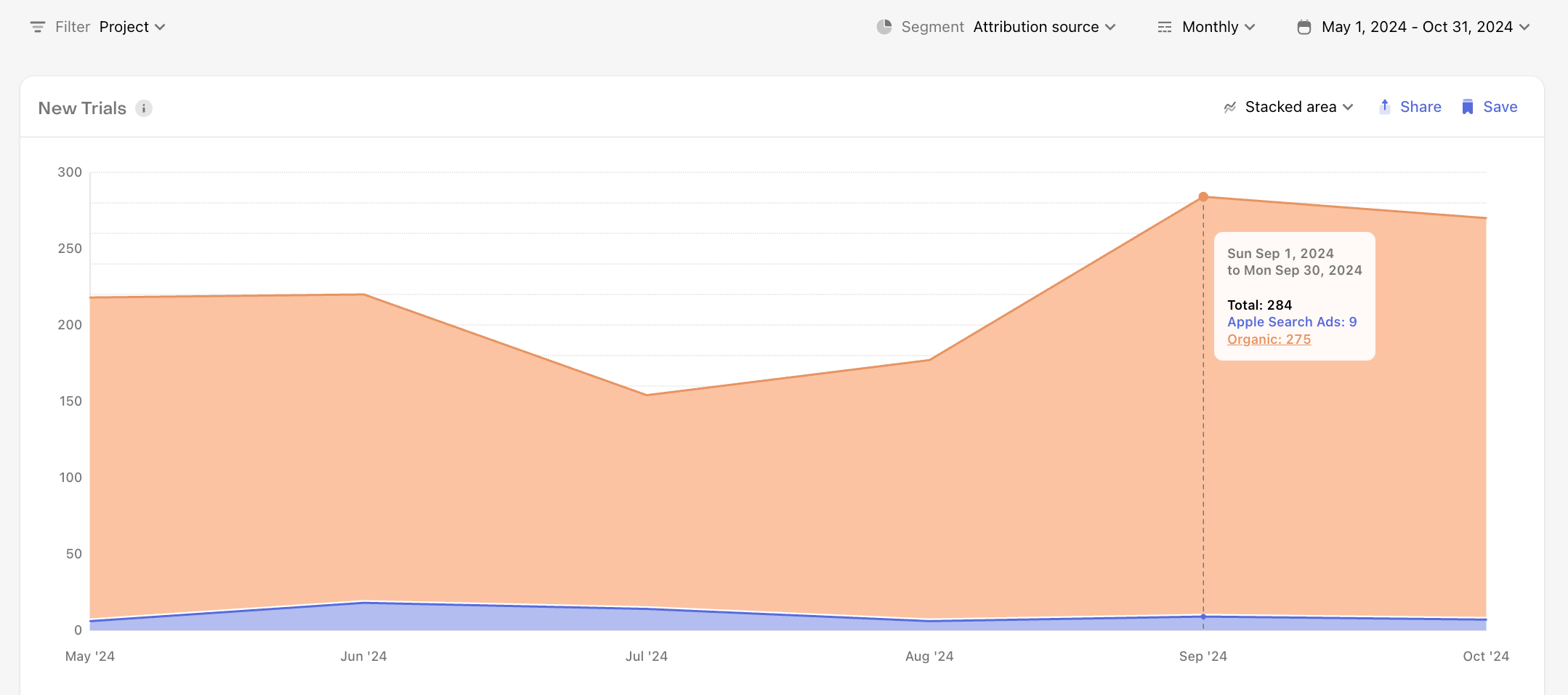
Apple Search Ad attribution is available as segments and filters in the vast majority of applicable charts that measure subscription, trial, revenue, lifetime value, and conversion data.
The charts without support for Apple Search Ads attribution are:
- Subscription Retention
- Customer Center Survey Responses
- Play Store Cancel Reasons
- Refund Requests Outcomes
Available filters/segments
We support the following filters and segments for Apple Search Ads:
Attribution source: Breakdown your measures byApple Search AdsorOrganic.Apple search ads campaign: Breakdown your measures by the campaign they derived from.Apple search ads group: Breakdown your measures by the ad group they derived from.Apple search ads keyword: Breakdown your measures by the keyword they derived from.Apple search ads claim type: Breakdown your measures by the claim type ofClickfor click-through attribution, orImpressionfor view-through attribution.

Filter chart to compare individual campaigns, ad groups, or keywords
Select and deselect rows to compare individual campaigns, ad sets, or keywords

The value of Unspecified is used to group transactions that are attributed to an Apple Search Ads ad, but do not have a specified Campaign Name, Ad Group Name, or Keyword.
This commonly occurs in two scenarios:
- The ad was delivered through an Apple Search Ads Basic account, where these fields are not provided by Apple.
- The attribution originates from a debug or TestFlight environment, where Apple may return placeholder or empty Apple Search Ads attribution data.
The value of Organic is used to group transactions that are not attributed to an Apple Search Ads campaign. This means it was an organic install or users with limit ad tracking enabled. To exclude organic installs from your charts, you can filter by Attribution source and select Apple Search Ads.
If your campaigns are new or you recently set up the Apple Search Ads integration, allow some time for RevenueCat to collect attribution and purchase data.