
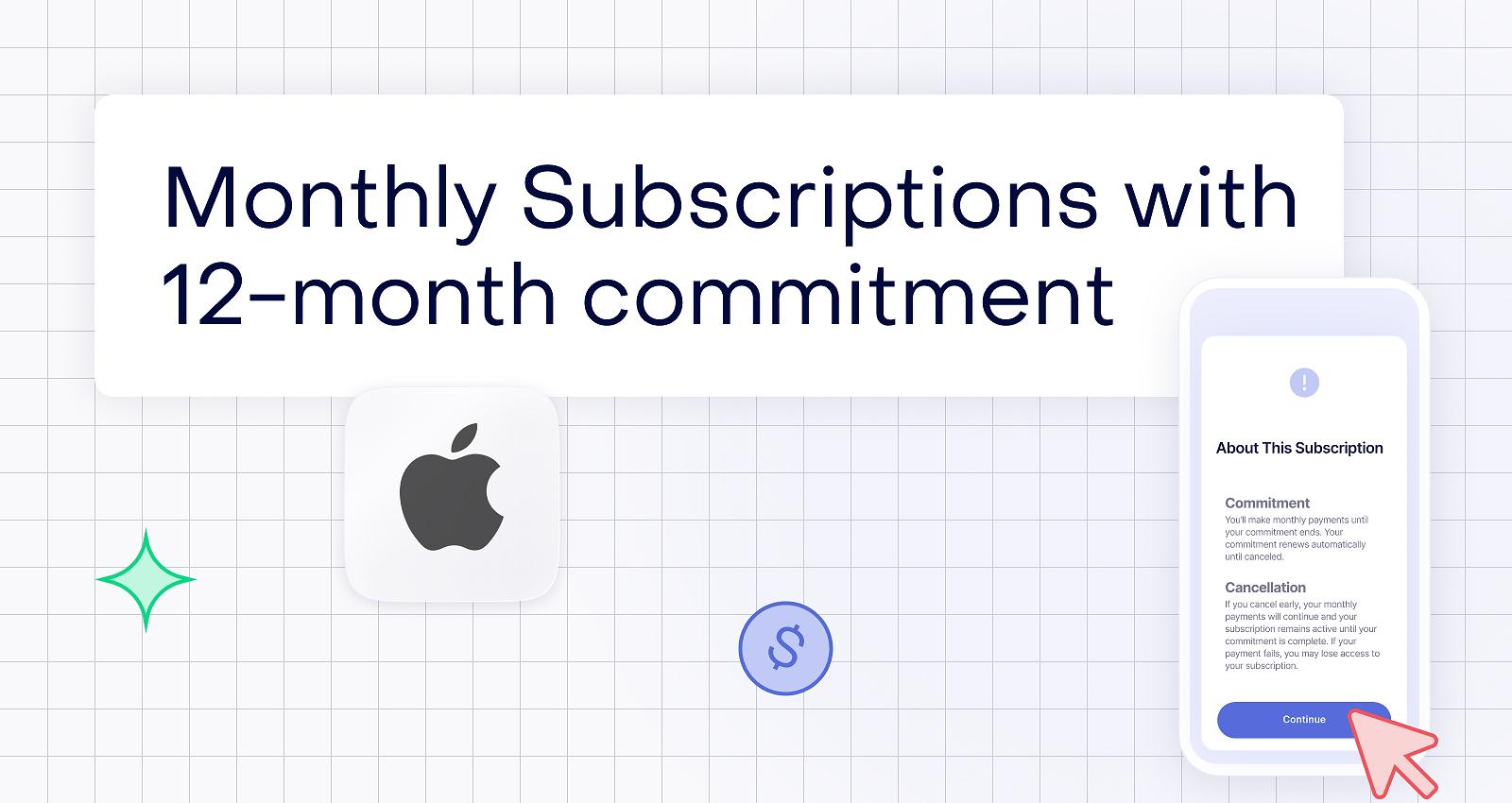

Apple has introduced monthly subscriptions with a 12-month commitment: an annual subscription that customers pay for month by month. Developers can configure and test them now, and Apple says they’ll be available to customers in May everywhere except the United States and Singapore.
This is a meaningful new pricing tool, especially for markets where paying a full year upfront is a real barrier. But it is probably not a new default subscription model for most apps. In fact, Google Play has worked similarly for a while, but is not wildly popular. The best use case is localized experimentation: making annual-style commitment more accessible without giving up the long-term retention benefits of a yearly plan.
What Apple announced
Apple’s new option lets developers offer an auto-renewable subscription that behaves like an annual commitment, but bills the customer monthly.
Instead of asking someone to pay, say, $59.99 today for a year of access, you can ask them to commit to 12 monthly payments. The customer can cancel at any time, but they will still be charged monthly for the remainder of their 12 month period. At the end of their commitment they will lose access to paid features and will no longer be charged.
Apple is also handling some of the customer-facing transparency. Customers can see completed and remaining payments in their Apple Account, and Apple says it will send email and push notifications before renewal.
The important availability note: Apple says this will be available worldwide except in the United States and Singapore.
This is not just “a monthly plan”
The implementation detail that matters is that Apple is modeling this as an annual subscription product with multiple billing plans.
In App Store Connect, developers create an annual auto-renewable subscription and choose between billing plan types, including “1 Year Upfront” and “Monthly With 12-Month Commitment.” Those billing plans can exist under the same product ID.
That means a single subscription product can now have multiple ways to pay:
- One annual price paid upfront
- One monthly price paid over a 12-month commitment
- Different intro, promo, win-back, or offer-code behavior per billing plan
The customer does not simply pick from an Apple-generated menu at random. Your app or paywall still needs to present the right option and initiate the purchase with the intended billing plan. Developers also need to clearly show both the monthly payment and the total commitment amount before purchase.
This is all very similar to Google Play’s installment base plan for subscriptions: one subscription concept, multiple purchasable configurations.
Why this probably won’t change everything
The obvious first reaction is: this is huge. Annual subscriptions, but paid monthly, should reduce friction and increase conversion.
Maybe. In some cases.
But Google Play has supported installment-style subscriptions for a while, and they have not become the default way most apps monetize. There is a reason for that: for many apps, the standard annual plan is still better.
A paid-upfront annual subscription gives the developer cash today. It improves short-term payback, reduces monthly billing failure risk, and creates cleaner revenue recognition for the business. If your audience can comfortably pay upfront, the traditional annual plan is still a very strong product.
Monthly annual commitments are different. They may lower the purchase barrier, but they do not give you all of the cash upfront. They also add complexity to pricing, paywall copy, analytics, support, and cancellation expectations.
So the goal should not be “replace annual subscriptions.” The goal should be “test whether this unlocks customers who wanted the annual value proposition but could not or would not pay the whole amount upfront.”
Where it gets interesting
The strongest opportunity is localization.
In many markets, the problem with annual subscriptions is not that users dislike commitment. It is that the upfront price is too high relative to local purchasing power. A $50 or $60 annual subscription can be a meaningful expense. Breaking that into monthly payments while preserving a yearly commitment changes the decision.
That makes this especially worth testing in markets where:
- Annual conversion is low, but monthly retention is healthy
- Users respond to annual discounts but hesitate at checkout
- Local purchasing power makes upfront annual pricing feel too steep
- You already localize pricing and paywall strategy by country
This is not currently useful for the US, especially because Apple is excluding the US (and Singapore) from launch. But that actually reinforces the point: this is less about a universal monetization shift and more about giving developers another regional pricing lever.
As of writing, Google Play only supports their installments based plans for subscriptions in Brazil, France, Italy, and Spain. This may be a good signal that these regions are more likely to be interested in these types of offers.
What not to use it for
This should not be used to cover up weak retention.
If users do not keep finding value in your app, putting them into a 12-month payment commitment is unlikely to create a better business. It may create more support tickets, more refund requests, more negative reviews, and more payment failures.
The right apps to test this are apps with proven long-term value. If users already stick around, but upfront annual pricing is the barrier, monthly commitments could help. If users churn because they stop using the product after two weeks, this won’t help.
What developers should watch
The obvious metric is conversion: does a monthly annual commitment convert better than a paid-upfront annual plan?
But that alone is not enough. Developers should also watch:
- Annual-plan cannibalization
- Payment failure and recovery rates
- Refund and support volume
- Renewal into the next 12-month commitment
- Subscriber sentiment in reviews and support conversations
- Net revenue by country compared with standard monthly and annual options
This is a pricing experiment, not just a checkout experiment. The upside is incremental revenue from users who would not have bought annual upfront. The downside is replacing high-quality upfront annual purchases with slower, riskier monthly payments.
How RevenueCat is thinking about support
Over here at RevenueCat we are, of course, all over this.
Early testing suggests these transactions can move through our systems, but full support requires some product changes our engineering team is already hard at work on.
Developers will need a clean way to understand which billing plans are available, present the right pricing terms, choose the intended billing plan at purchase time, and measure performance after launch. Paywalls will also need to account for regional availability, since the monthly commitment option is not available everywhere.
We’re actively looking at the right way to model and expose this so developers can take advantage of it without taking on all of the complexity themselves. More details will come as Apple’s rollout gets closer and we finalize support across the RevenueCat platform.
For now, the practical takeaway is simple: this is a useful new tool, especially for localized annual pricing. It is not a magic monetization switch. The apps that benefit most will be the ones that test it deliberately, explain it clearly, and already have the retention to make a 12-month commitment feel fair.