

Apple’s new EU App Store terms are now in effect, changing both the commission developers pay and the payment options they can offer. The update lowers the standard In-App Purchase (IAP) rate from 30% to 26% and allows developers to offer Apple checkout alongside third-party payments inside the app or links to web checkout.
For subscription teams, that opens up a practical choice: keep IAP and benefit from its lower standard rate, or add another checkout for further savings and more control over pricing and offers.
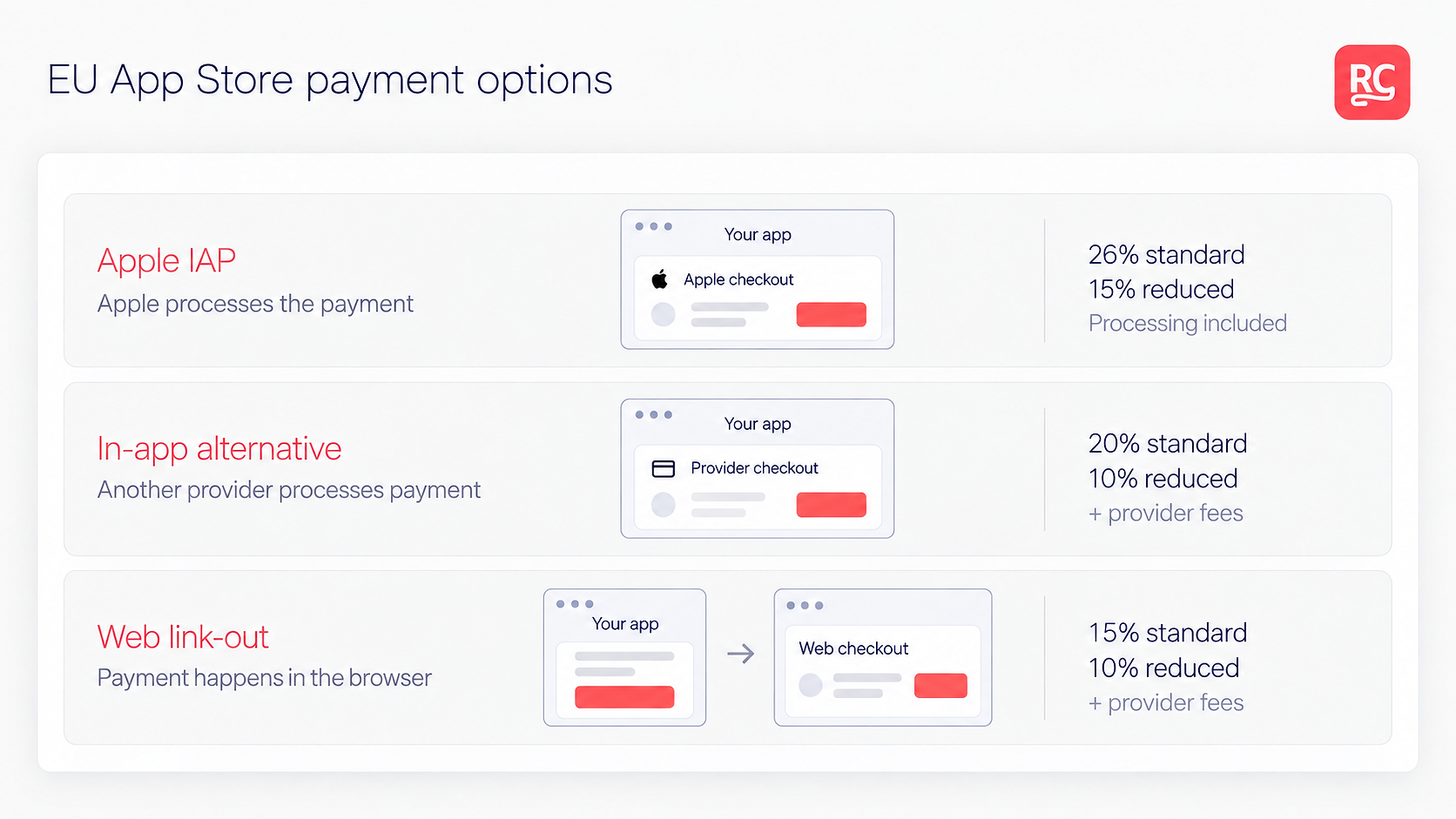
But the EU’s version of alternative payments comes with a substantial Apple commission. At standard rates, Apple charges 20% for third-party payments inside the app and 15% for linked web purchases, before your provider’s fees.
So what makes an alternative worth adding? We’ll look at the savings under the new rates, the value beyond fees, and the billing and reporting work that comes with taking payments elsewhere.
What changed in Apple’s EU App Store fees
The new terms change both what Apple charges and how you can combine payment options. They apply to sales on EU storefronts, wherever your company is based.
For apps distributed through the App Store, the commission depends on how the customer pays:
Apple’s IAP commission includes payment processing. With alternative payments, you pay Apple’s commission plus your payment provider’s fees, whether checkout happens inside your app or on the web.
Reduced rates apply to qualifying Small Business Program, Mini Apps Partner Program, and Video Partner Program transactions, and eligible auto-renewing subscriptions after their first paid year.
What would you pay for your app?
Use RevenueCat’s App Store fee calculator to compare your current payment mix with the new EU options.
Alternative payments appear alongside (or instead of) IAP in the EU
App developers selling on EU storefronts can now accept payments through another provider inside their app or direct customers to web checkout, whether or not they keep Apple IAP available. Apple still takes a commission on those purchases, though.
If you already sell subscriptions on the web, you can now bring those offers into your app without removing Apple checkout. For example, you could promote a discounted annual plan through web checkout while still offering the same plan through IAP.
The flexibility comes with conditions that affect how you design and support the purchase flow:
- Prominence: You can use alternative payments on their own, but if you offer them alongside IAP, IAP must always be shown and be at least as prominent. You can't make Apple checkout harder to find or use.
- 12-month lock: Whatever you choose, you're locked in for 12 months no matter how it performs. That's 12 months of billing, support, and reporting work, and no early exit if the revenue you lose to lower conversion ends up bigger than what you saved on fees.
- Younger users: Kids-category apps can't link to web purchases, and in-app alternative payments must sit behind a parental gate. In all apps, users under 13 can't be sent to web checkout, and in-app alternative payments need a parental gate. Users aged 13–17 need a parental gate for both options. Some storefronts set a higher age threshold.
What lower commissions mean for your take-home revenue
At standard EU rates, web link-outs offer the biggest potential fee savings. Your payment provider takes a share, though. And switching to a browser may put some customers off completing the purchase.
In some cases, those lost sales could outweigh the commission savings.
Suppose you process €100,000 in sales subject to Apple’s standard commissions, keeping prices and completed purchases the same.
- Apple IAP means €26,000 goes to Apple.
- Third-party checkout inside the app means €20,000 goes to Apple, leaving a €6,000 difference before provider fees and additional billing costs.
- Linked web checkout means €15,000 goes to Apple, leaving an €11,000 difference before those costs.
For qualifying program purchases and subscriptions after their first paid year, IAP is 15% and both alternatives are 10%. That leaves €5,000 on the same sales with either alternative.
However, your provider’s charges reduce those amounts from the start. Conversion is the less predictable part. Switching to a browser could lose customers who would have completed a purchase through Apple. In-app alternative checkout avoids that switch but carries a higher standard commission. (We’re setting up experiments to understand that trade-off.)
That makes fees alone a limited reason to change checkout in the EU. The stronger case may also involve more flexibility to test prices, run promotions, and bring subscribers back.
Why alternative payments matter beyond the fees
The focus on fees often overshadows other reasons to consider alternative payments: more flexibility in pricing and promotions, more control over checkout, and a closer connection between billing and your retention campaigns. All this could affect how many customers subscribe and renew, as well as how much you keep from each payment.
This flexibility could be useful when setting up:
- Pricing and promotions: You can typically manage web-specific prices and discounts through your billing provider. For example, a win-back campaign could send former subscribers to checkout with their offer already applied.
- Checkout: You can customize the purchase page and choose from your provider’s supported payment methods. That gives you more of the journey to test, from how you explain the subscription to how customers complete payment.
- Ongoing billing: Depending on your provider, you can configure failed-payment retries and reminders. That could help you recover a renewal.
- Lifecycle marketing: With customer consent and the right integrations, you can connect billing events to your email and CRM tools. This lets you tailor onboarding to the plan purchased, send renewal reminders, or follow up after cancellation.
The value depends partly on what you already have in place. A team with an established web business may already have tax handling, refund processes, and subscription support in place. A mobile-only team is taking on more new work for the same commission difference.
Apps installed outside the App Store move to a different fee model
Apple is also replacing its per-install Core Technology Fee with a 5% Core Technology Commission on digital transactions in alternatively distributed apps. This applies when customers download your app through another marketplace, such as the Epic Games Store, or directly from your website.
For example, an eligible fitness business could let customers download its app from its own website. The customer installs the app without using the App Store. Simply sending an App Store customer to your website to buy a subscription doesn’t qualify for this 5% rate.
Here’s what changes for those outside-App-Store installations:
That can lower costs for apps with many installs but few paying customers. However, apps below the old install threshold could now owe commission despite previously paying no Core Technology Fee.
Apple has also made it easier for companies to qualify to distribute apps this way, including through venture funding or a financial audit. Apps still need to pass Apple’s security and functionality review, called notarization.
Adding alternative payments with RevenueCat
With RevenueCat, you can add an alternative checkout and have RevenueCat handle Apple’s external-purchase reporting from October 1. That includes purchases, subscription lifecycle events, and even link-outs that don’t result in a sale.
Here’s how the pieces fit together:
- Choose where customers pay: Send them from your paywall to a hosted Web Purchase Link or your own checkout. The new bottom-sheet checkout supports Stripe and Paddle, so eligible customers can also pay without switching to a browser.
- Connect the purchase to app access: Link your web and App Store products to the same entitlement. Your app then unlocks the same paid features whether the customer uses Apple IAP or another provider.
- See what you keep: RevenueCat’s transaction breakdown separates Apple’s commission from your provider’s fees, helping you compare proceeds across payment options.
- Measure how customers respond: Run experiments and review web and mobile purchases together, including conversion, proceeds, and renewals. That helps you assess whether the additional checkout improves your subscription business beyond moving purchases from one payment route to another.
Start with your own numbers in the App Store fee calculator. If an alternative looks promising, test the offer and checkout together, then follow those subscribers through renewal.