

For years, app growth followed a relatively straightforward path:
Promise value → onboard users → prove value → present upgrade
You introduced users to your product, helped them experience an aha! moment, built trust, then asked them to pay. But today, many of the fastest-growing apps have flipped the last two steps of that model:
Promise value → onboard users → present upgrade → prove value
The change didn't happen overnight. As apps became better at contextual onboarding, personalization, and paywall optimization, they discovered users were often willing to purchase (or at least start a trial) before they had fully experienced the value being promised.
When Sean Ellis and I interviewed the co-founder of Noom on The Breakout Growth Podcast back in 2021, we were blown away by the app's 60-step onboarding flow. Today, 60 steps doesn't even sound that long.
And the data supports the shift: RevenueCat's State of Subscription Apps 2026 report found that hard paywalls outperform freemium by nearly 5x on conversion.
For developers, this creates incredible leverage. Faster payback periods mean better ROAS. Better ROAS means more dollars to reinvest in growth. Entire categories of apps are suddenly able to scale acquisition more aggressively.
But there’s a problem.
Hard paywalls and supersized expectations
When users pay before they experience meaningful value, the post-purchase user experience has to do much heavier lifting — and with a smaller margin for error to keep users from churning.
A simple switch in the acquisition flow means that early experience now has to:
- Validate the expectations created by your marketing
- Justify the purchase decision
- Create enough momentum for the user to return again
In other words, your app still has to build a habit and activate the user, but it needs to do this all while also proving it is worth their time at all.
AI is amplifying this challenge; they monetize incredibly well, but many AI-powered apps are struggling with long-term retention as their novelty fades. However, I don't think this is really an AI problem, I think it's a value problem. Building apps is getting easier, building durable growth is getting much harder.
When users buy before they've experienced meaningful value, identifying the experiences that will actually drive long-term retention becomes more challenging, just when it becomes more important. And, unfortunately, that's where many teams get stuck.
A few weeks ago, an app founder reached out to me after getting enough annual renewal data to realize his renewal numbers were way below expectation. They’ve cracked the code on acquisition — their onboarding is brilliant, with over a million downloads and ~30% month-over-month ARR growth — so they have a lot to celebrate. But not enough of the users they convert are sticking around. Solving this renewal curse is going to be crucial for their success.
This is where teams often struggle. On seeing those numbers, the immediate responses are often:
- Winback offers to salvage churned users
- Emails and notifications to engage users at funnel dropoff points
- New monetization tactics to get people paying longer
All good ideas, but none of them really address the underlying problem. And if these tactics quietly become the strategy, the team will never solve the value issues holding them back. The most successful growth teams I've worked with do something different. Before they jump into solutions, they work backwards, investing time into defining what success actually looks like.
Value isn't a moment, it's a journey
As humans, we are wired to solve problems at the point where they become visible. If retention is struggling, teams look at churn. If conversions are down, teams dive into paywall optimizations. If engagement is soft, we cue the comms team to add more emails and push notifications. The instinct makes sense; go where the pain is. But the cause of the pain isn’t always where you feel it.
Value isn't created in a single moment — it's built across the entire arc of the user experience. From the first ad someone sees, through onboarding and early use, to the first moment a user realizes this app meaningfully impacts their life. These steps are symbiotic..
Product-market fit is a try → use → love → keep using journey. Each step is deeply connected to the one before it, and a break anywhere in the chain can show up later as a retention problem.
Working backwards flips that. Instead of starting with the problem, you start with the desired outcome and ask: what journey creates that outcome?
Instead of asking "what does a successful user look like a year from now?" challenge your team to ask, "if a user loves this product a year from now, what happened along the way that made them love it?"
At each step:
- What did they discover?
- What did they feel?
- What did they start doing differently?
- What made them realize this app was actually going to meaningfully change or improve something for them?
Within the answers to those questions is your treasure map.
Why starting from the finish line works
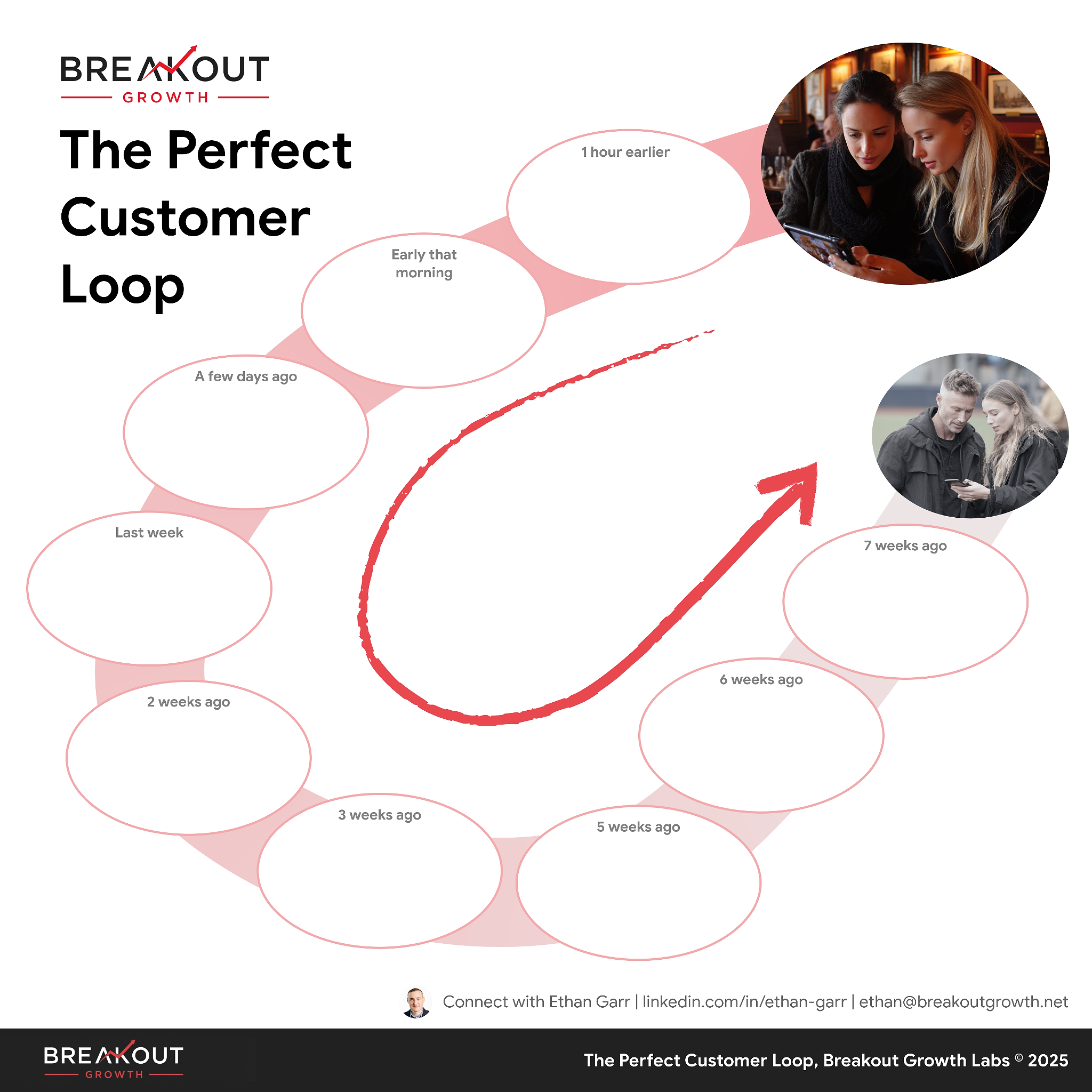
A few years ago, I started running a workshop exercise called the ‘Perfect Customer Loop’ with growth teams. The goal was to make working backwards easier and more concrete.
It starts by picturing a must-have user of your app. Let's call her Maggie. She loves your product so much that when a friend mentions a problem your app solves, Maggie lights up and says "you have got to try this". That moment of advocacy is your destination, and from there, the team works backwards.
In the exercise, we go around the room and ask questions like:
- What happened an hour before the conversation that reminded Maggie how much value she gets from your product?
- What occurred a week ago that deepened her emotional connection to it?
- What surprised her a month ago?
- When was the first moment she knew this was going to work?
The team works all the way back to the same "you have got to try this" moment where Maggie was introduced to the app by another must-have user.
The moments the team surfaces are informed hypotheses, and that's fine. The exercise isn't about getting it perfect, it's about creating a shared map of the value experience. You can validate the moments later through user interviews and retention data.
I've run this workshop at RevenueCat's App Growth Annual conference and with teams across industries and categories. It consistently surfaces the gaps between the value teams think their app is delivering and the value users are likely to actually experience. More importantly, it unlocks how your most successful users came to love your product — what they knew, what they felt, and what they experienced along the way. That's the treasure map. Find the success story, and recreate it.
A company I worked with connects entrepreneurs with domain experts for paid advisory sessions. The team had built their entire growth narrative around this value of access to experts, faster decisions, and better outcomes.
But when we ran the Perfect Customer Loop exercise, what kept surfacing wasn't any of that, it was confidence. Customers weren't coming back because they got good advice, they were coming back because the conversations made them feel like they could trust their own judgment.
That's a completely different product story compared to the value the growth team were selling.It informs everything from what your onboarding needs to communicate, to what your activation experience should feel like, to what your retention messaging should say.
The takeaway is this: you can't design for an outcome you haven't clearly defined, and working backwards forces you to define it. When teams follow this path, the conversation almost always arrives at activation, where promise and value delivery converge.
Activation is a story, not just a moment in time
Ask any growth team what the most important retention driver is and they'll likely land on activation.
They're right, but it's worth being precise about what activation actually means. There are real moments that matter, like the first time a user experiences genuine value, and the point where that value turns into habit, but activation isn't just a completed checklist, a logged workout, or an uploaded file. Those can be critical actions and aha! moments, but to me, activation is a story that often starts even before a user gets to the app store.
In Daphne Tideman’s blog Why most activation metrics don’t predict who will stay (and what to use instead), she does a great job of explaining how easy it is to optimize for the wrong thing. We often conflate engagement for activation, rather than focusing on metrics that actually indicate users moving toward becoming a long-term subscriber — like ‘time to first value’ and ‘time to core value’..
By the time a user hits whatever you've designated as your activation event, they've already been shaped by the recommendation of a friend, an ad, your App Store listing, the onboarding experience, and even your pricing and paywall. If activation feels underwhelming, the problem is often upstream. A promise that was too big, targeting that brought in the wrong people, onboarding that set the wrong expectation.
When you have a hard paywall, this gets amplified. You've asked users to pay before they've experienced meaningful value, which means the first motion where you deliver value really needs to land.
If you want to design that entire activation experience well, start working backwards from what your best users already know, feel, and do.
Find your must-have users, then follow them
Working backwards isn't something you do once in a workshop and check off the list. It's a way of operating. Here's where to start.
The first step is identifying your ‘must-have’ users. Not necessarily your most active users or your highest LTV segment, but the users who love your product and would be very disappointed if they couldn’t use it anymore.
Sean Ellis built his product-market fit survey to surface those users: respondents who would be ‘very disappointed’ to lose your app are the must-have users you want to make more of. They've already made the journey you're trying to design for everyone else, and the rest of the survey tells you why they feel the way they do.
The second step is understanding what actually happens to them along the way. This is where the work pays off. Identify the must-have users and dig into the journey that creates them. Talk to them. Survey them. Find out what they knew, what they felt, and what they did in the early days that set them up for success.
The Perfect Customer Loop is designed to help you do this. Sean and I wrote a guide to using the PMF survey and the PCL together if you are looking for a deeper playbook.
The third step is the gap analysis. Not "where are users dropping off?" but "where does our current experience fall short of the journey that creates must-have users?" That question points you toward the moments that actually determine whether users succeed, long before a retention metric surfaces the problem.
Working backwards scales
Retention is the obvious place to apply this mindset, but the approach is transferable across your entire growth engine:
For onboarding: instead of asking "how do we reduce drop-off in step three?" ask "what does a new user need to know, feel, and believe by the end of onboarding to be set up for their first real value moment?" The answer often lives earlier in the journey than you'd expect.
On churn, instead of building winback campaigns that depend on discounts to claw back lost users, ask "what moment in the journey would have changed this outcome?" Churn analysis done this way becomes an onboarding and activation roadmap, not a rescue operation.
On features, before building anything, ask "does this move more users toward the must-have experience, or does it move us sideways?"
The teams that build long-term growth aren't better at reacting to problems. They're better at defining success before they start designing journeys to get there.
Building has never been faster or easier, but the foundation hasn't changed. Users have to try your product, use it, love it, and keep using it. Working backwards from that outcome and understanding deeply who your best users are, what made them that way, and how to design more of that journey is how you turn fast growth into sustainable growth.