

One in four subscription apps on the App Store and Google Play is now AI-powered, per our State of Subscription Apps report. They also monetize better than the rest of the market: 41% more revenue per payer in the first year ($30.16 vs. $21.37 median Y1 LTV).
The honeymoon doesn't last, though. AI apps churn at 30% higher rates than traditional subscription apps. The novelty that converts so well wears off just as fast.
Or is there more to it?
The category average doesn't tell us the whole story. Plenty of AI apps are actually retaining at the level of non-AI subscription businesses.
So we went looking for what separates that group from the rest.
The gap between the retention groups
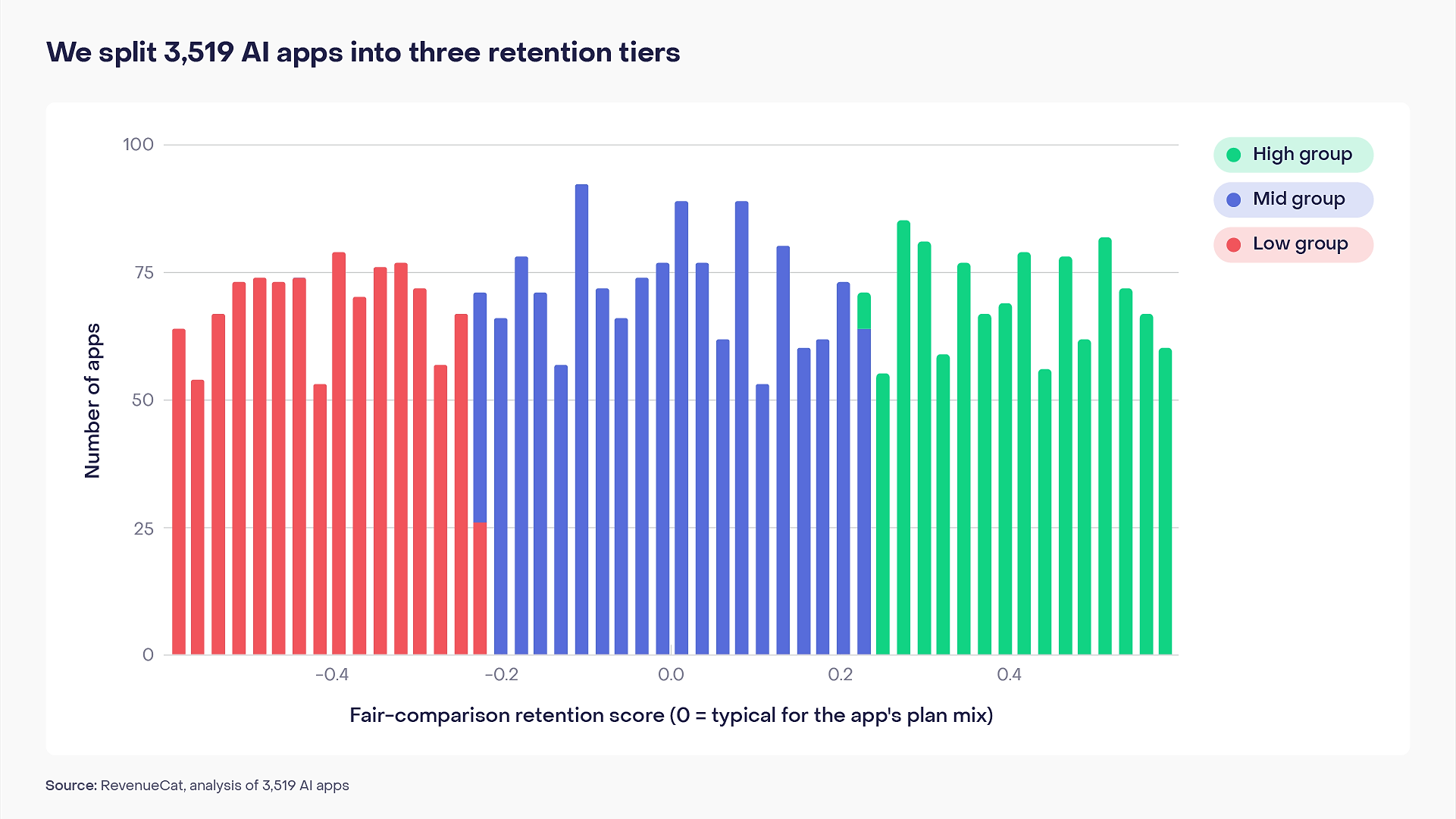
We analyzed 3,519 AI-powered apps using RevenueCat's subscription data and ranked them by how well they retain paying subscribers a year in. We then grouped them into three retention categories: high-, mid-, and low-retention.
→ Here's how we identified and grouped the apps.
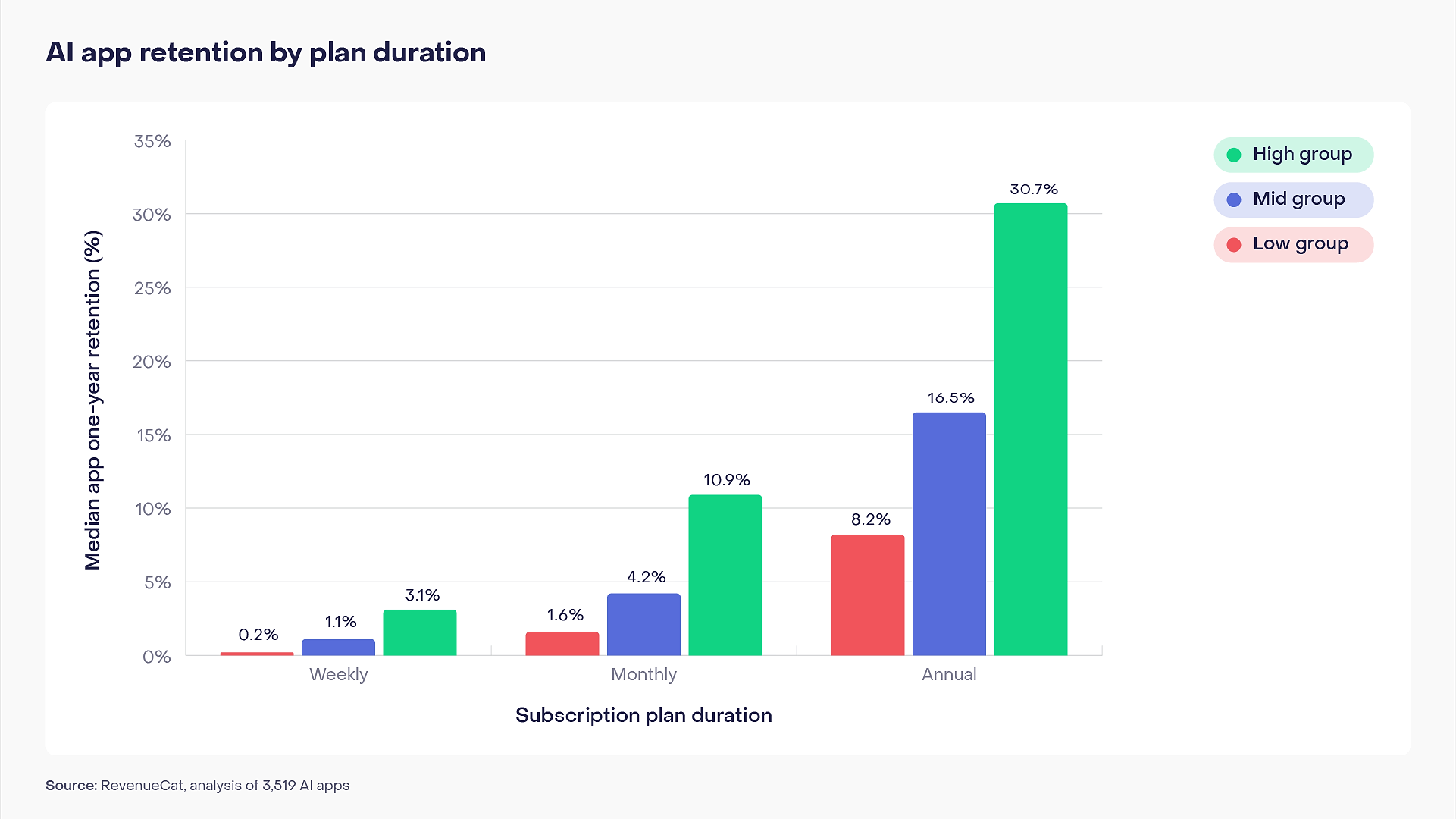
High-retention AI apps keep 13.9% of paid subscriptions active after a year, at the median. Mid-retention apps keep 5.3%. Low-retention apps keep 1.4%, a tenth of the top group.
The same ranking holds across all plan lengths:
- On monthly plans, the high group retains 10.9%, compared with an AI-app average of 6.1% and a non-AI average of 9.5%.
- On annual plans, it retains 30.7%, exactly matching the non-AI benchmark and far above the 21.1% AI average.
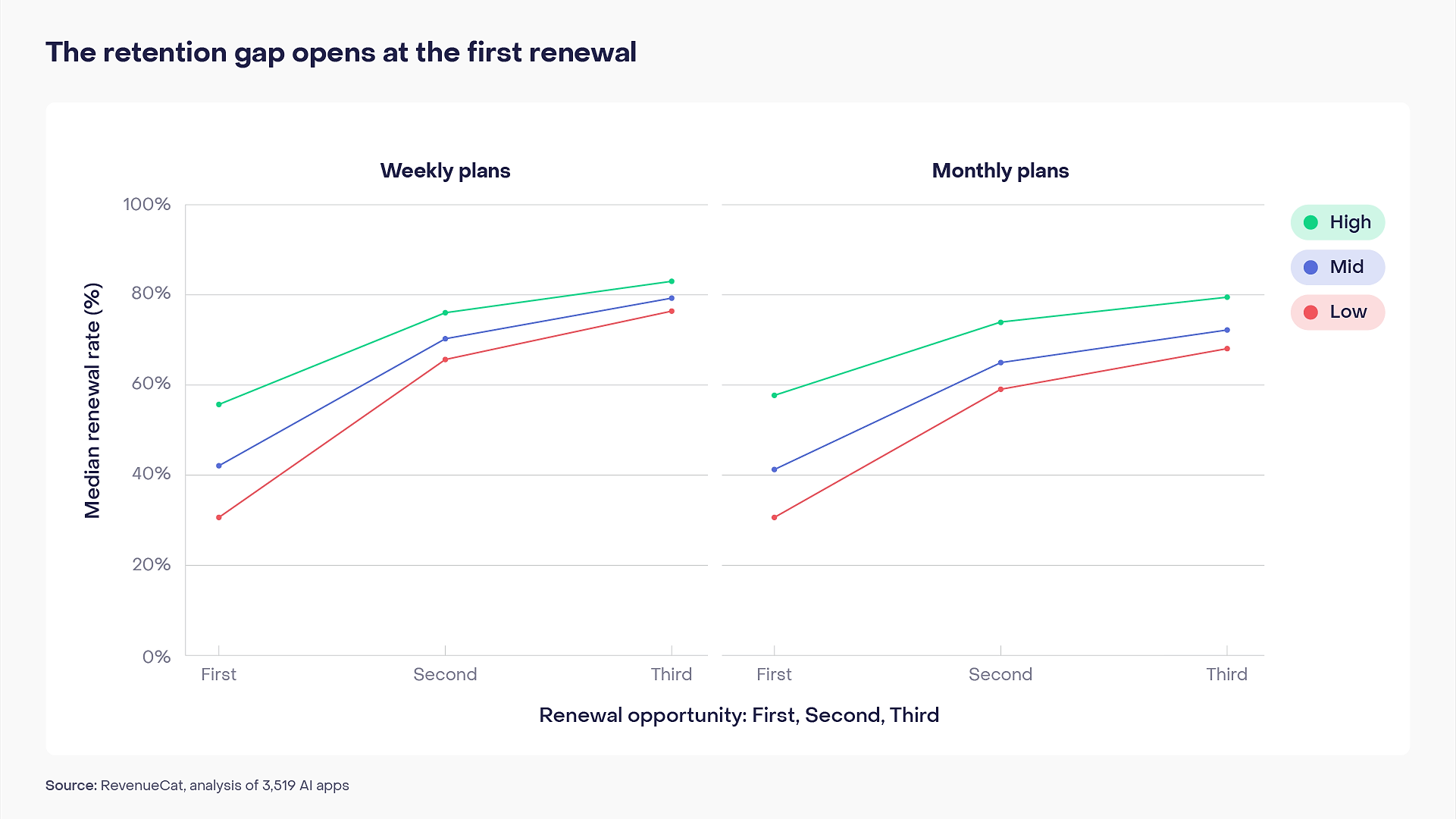
So, where in the year does that gap build up? Mostly at the first renewal.
On monthly plans, 57.9% of subscribers at high-retention apps renew the first time; at low-retention apps, it's only 30.2%. Later renewals narrow the gap — 79.5% versus 68.5% by the third month.
What separates high- and low-retention AI apps
Here's every trait we measured, ranked by how much more common it is in the high-retention group than the low-retention group:
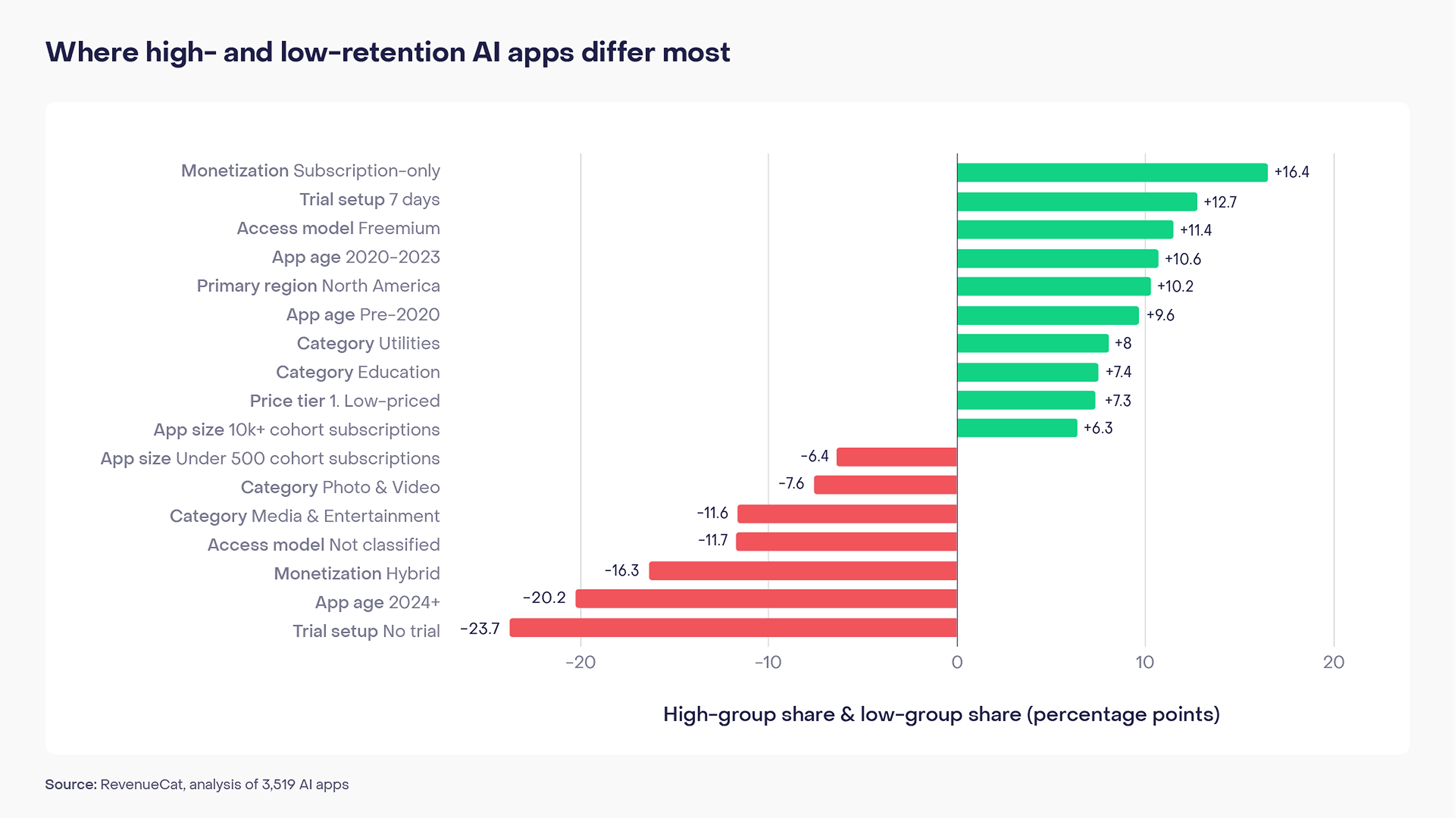
- Monetization structure: Subscription-only apps are 16.4 percentage points more common among high retainers, while hybrid monetization is 16.3 points more common among low retainers. But a quarter of the best-retaining AI apps still sell consumables alongside a subscription.
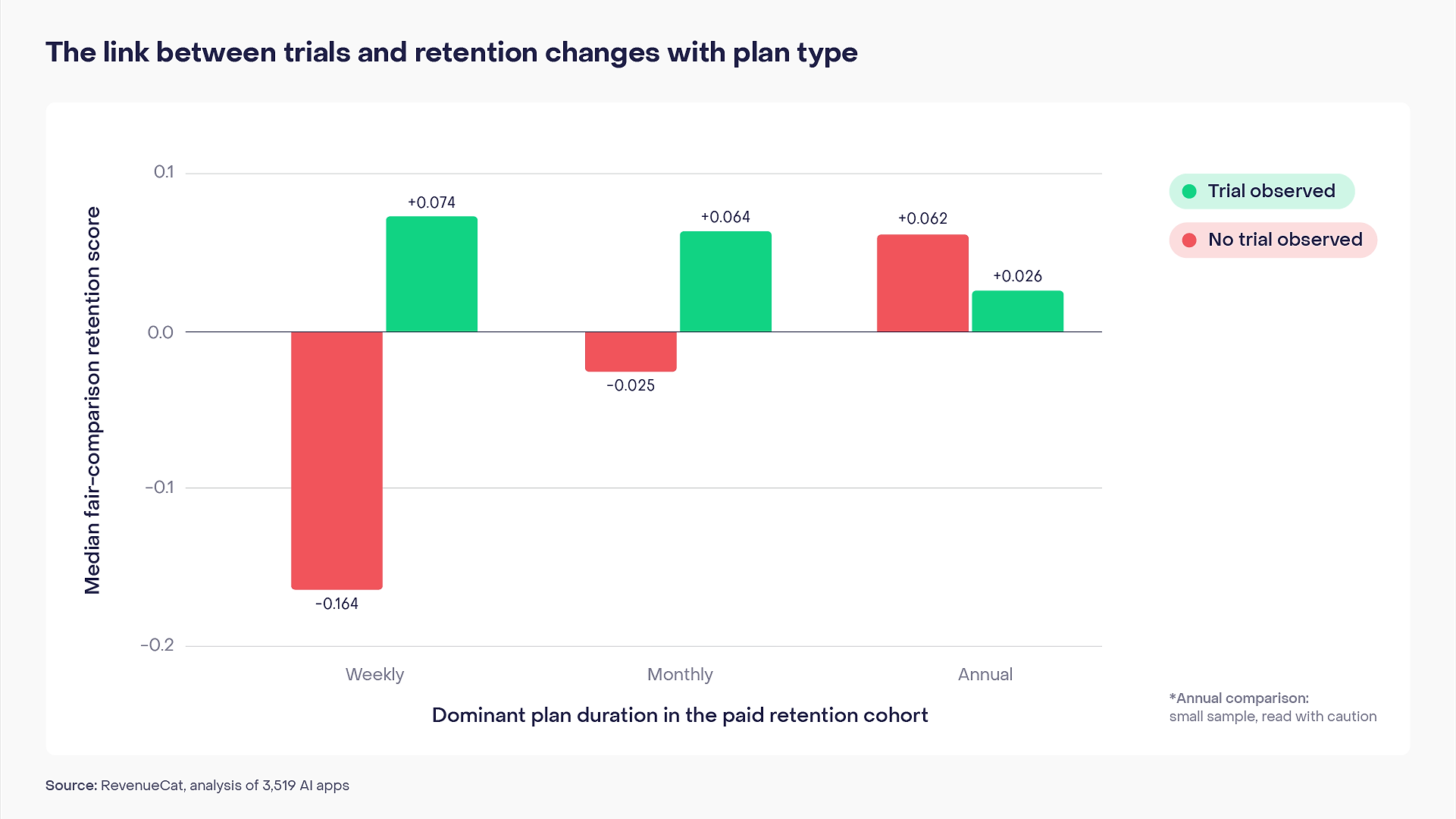
- Trials: A 7-day trial runs 12.7 points more common among high retainers; no trial at all runs 23.7 points more common among low retainers. But the value of a trial depends on plan length: it favors trials strongly for weekly plans, mildly for monthly, and much less so for annual.
- Access model: Freemium runs 11.4 points more common among high retainers (66.8% versus 55.4%). That said, hard paywalls are rare among all AI apps, at under 2% of apps.
- Launch year: Apps launched between 2020 and 2023 are 10.6 percentage points more prevalent in the high-retention group. By contrast, apps launched in 2024 or later are 20.2 points more prevalent among low retainers. This could partly be due to the recent AI boom and the influx of new apps that came with it.
- Price: Cheaper subscriptions are 7.3 points more common among high retainers. AI apps in the lowest price band make up 15.6% of the high-retention group but only 8.3% of the low-retention group. One possible interpretation is that proving the value of AI features becomes harder as prices increase.
- Size: Small apps (under 500 paid subscriptions in the cohort) are 6.4 points more common in the low-retention group. But it isn't decisive: 44% of high-retention apps had fewer than 500 paid subscriptions in the retention cohort, and small apps are actually most common in the mid-retention group.
- Category: Utilities and Education lean toward high retention; Photo & Video and Media & Entertainment lean toward low. The likely reason is deeper than the category itself: how naturally the use case turns into a habit.
These are patterns, not proof of causation. Some may simply be consequences of stronger retention: an app that retains well, for example, may have more room to offer lower prices or generous trials.
But the low-retention profile is still striking: newer apps, no trials, weekly plans, and higher prices. It looks a lot like the playbook for turning a spike in attention into revenue quickly, without necessarily giving users a reason to stick around.
"Teams building AI-first apps often focus on improving conversion in onboarding and finding the perfect price, rather than on retention. Many of these apps are barely used long-term, because users came from a trending video showing one specific feature."
 David Vargas—App Growth Consultant
How to think about retention for your AI app
These findings don't provide a single formula for retention. Instead, they show what better-retaining AI apps have in common and where product and monetization choices may make a difference.
Three areas are worth focusing on: getting subscribers to a useful result fast, matching your trial to how quickly your product delivers value, and choosing a monetization model that fits your costs.
1. Make value land before the first renewal
AI apps often have a one-and-done problem. Many subscribers come for one impressive result — a selfie turned into a professional headshot, a room redesigned in one tap — get it, share it, and have no reason to come back.
The challenge is turning that first result into recurring value. Start with two questions:
- How quickly subscribers reach a meaningful result
- What gives them a reason to return before renewal
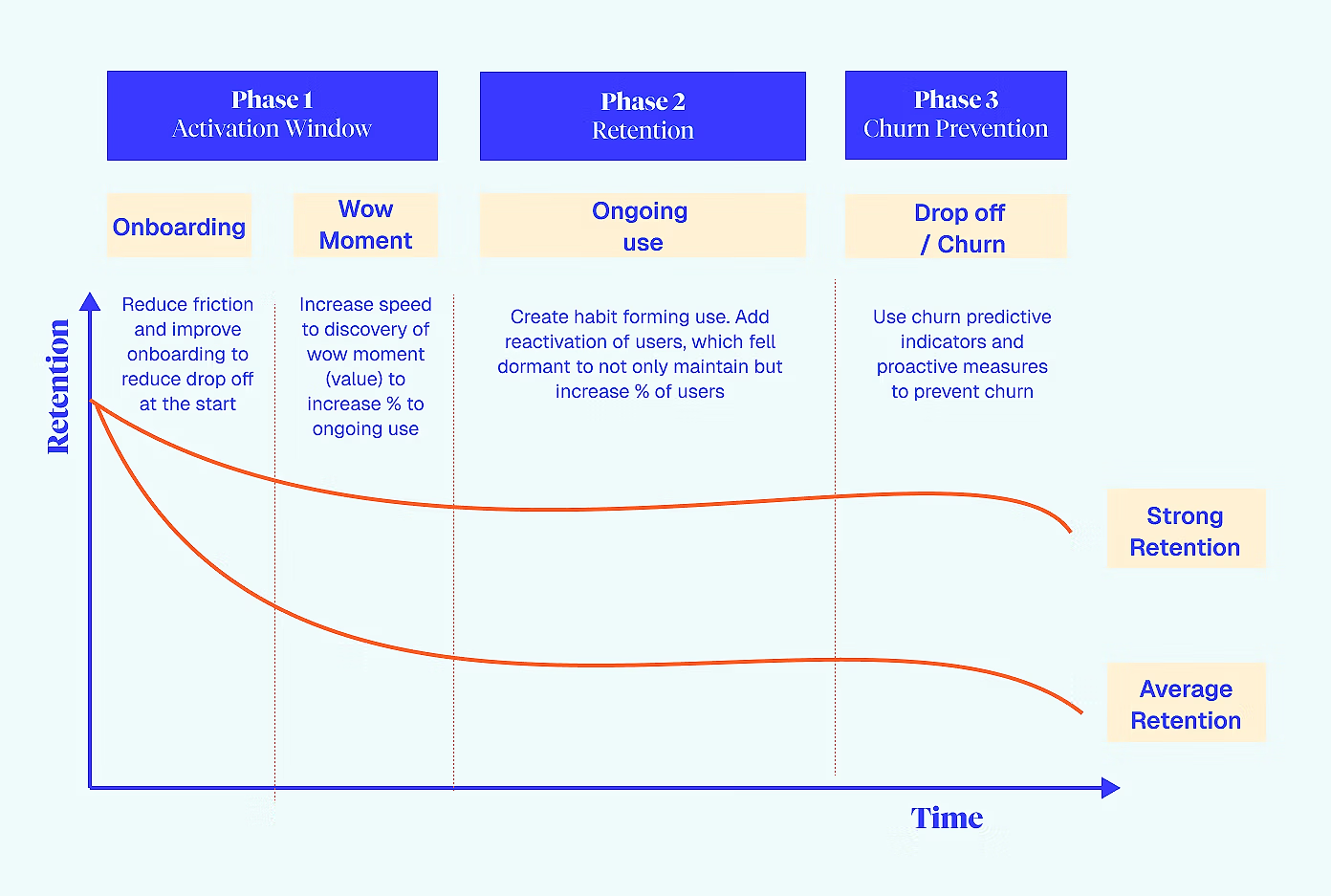
On the first, AI apps have an unusual advantage: they can generate a personalized result from the subscriber’s own photos, voice, or data within minutes. Design onboarding to get users to that first useful output as quickly as possible.
The second is harder: an impressive first result isn't always enough to bring users back. So you need to build reasons to return to the product:
- Outputs that improve as the model learns the subscriber
- Work that accumulates over time (projects, history, a library)
- External triggers like widgets or reminders
"The AI apps that retain do a lot of lifecycle marketing: email, push, special offers for existing users. And above all, organic content — users who enter through that channel arrive warm and already connected to the brand."
David Vargas—App Growth Consultant→ Your next step: Learn how subscription apps can become painkillers and how emotional value can strengthen retention.
2. Align your trial with your product's value cycle
Our data show that 7-day trials are more common among high-retention AI apps, whereas no trial is more common among low-retention apps.
But it also varies by subscription duration: offering trials is associated with better retention on weekly and monthly plans, while annual plans show the opposite pattern.
To find the right solution for your app, look at how your product delivers value:
- How quickly can someone reach a useful outcome?
- How many sessions does it take?
- Does the value improve through personalization, repeated input, or habit formation?
- What needs to happen before paying feels reasonable?
AI apps have another constraint: every generation costs money. If a longer trial gets expensive, limiting the number of generations can control costs while still giving users enough time to experience the product and come back.
→ Your next step: Read The 7-day trial, and other free trial myths to understand how to define a trial length around your product’s value cycle. Then, calculate the true cost of your AI features.
3. Optimize your monetization model
Subscription-only apps are more common among high retainers in our dataset, but that doesn't mean every AI app should rely on subscriptions alone. A quarter of the strongest-retaining AI apps also sell consumables.
For AI apps, the right model depends partly on how usage drives costs. A hybrid model can balance this by combining a subscription with extra charges for additional generations, credits, or premium features.
It also depends on the product itself and how users experience its core value.
“Fitness and education apps can often justify free trials because they’re closely tied to activation and long-term retention. Many AI apps have a different dynamic: inference costs make trials more expensive, while the core value is often much faster to experience. Generating a video or an image typically requires less commitment than completing a workout or a lesson, so the optimization focus shifts toward maximizing upper-funnel conversion and monetizing access to core actions, for example, charging for additional generations or premium capabilities.”
 Cristian Rotari—Product Growth Consultant
Whatever model you choose, evaluate its impact over multiple renewal cycles. A monetization change can increase short-term revenue while weakening long-term retention.
→ Your next step: Learn why hybrid monetization is becoming the default model for AI subscription apps and see how AI apps are adapting their pricing models.
Measure the long-term impact of monetization changes.
RevenueCat Charts helps you track retention, LTV, churn, and revenue across subscriber cohorts.
What’s next
This research shows that AI apps can both convert better than traditional subscription apps and achieve comparable long-term retention.
But we also want to dig even deeper into how they do it.
As our next step, we’ll talk to the teams behind some of the highest-retaining AI apps to understand what they're doing differently. We'll share what we learn along the way.
How we grouped and analyzed the AI apps
Because an annual subscriber renews once a year while a weekly subscriber renews 52 times, retention was compared within plan length: an app's weekly subscriptions were measured against other apps' weekly subscriptions, monthly against monthly, and annual against annual. Apps selling several plan lengths get one combined score across their qualifying durations.
We then split them into three groups:
- Low-retention group: The bottom 30% of the retention score (1,056 apps)
- Mid-retention group: The middle 40% (1,407 apps)
- High-retention group: The top 30% (1,056 apps)
Retention is based on paid subscriptions started between July 2024 and June 2025, tracked for a full year. That includes both direct purchases and converted trials.
- A subscription counts as retained if it completed every renewal in that year: one for annual plans, 12 for monthly, 52 for weekly.
- We measure at the subscription level, so a subscriber who switches to a different plan counts as a churned subscription.
We also verified that the trait patterns (trials, monetization, price, launch year) hold when comparing high- vs. low-retention apps within the six biggest categories. Health & Fitness is the one exception: there, trials and monetization barely separate high from low retainers. One plausible reason is that the habit is built into the use case itself.
Scope of the data:
- 3,519 AI app configurations (2,633 iOS, 886 Android)
- 'AI-powered' is a classification, and it spans very different products, from fitness coaches to video editors. Ranking apps only against the same plan length and checking the findings within categories addresses part of that mix, and the groups stay deliberately broad
- Paid subscriptions started between July 2024 and June 2025, including both direct purchases and converted trials
- Over 50 million paid subscriptions in the retention cohort
- 11 app categories, from Productivity to Photo & Video, across 7 global regions
- Every app has at least 100 eligible subscriptions, so no group is built on tiny samples