

Over four years of university, I noticed the same pattern again and again.
Week 1: The lecture hall was full. 400 eager students, all willing to give the subject (and the lecturer) a chance.
Then Week 2 arrived. The good intentions faded, and attendance dropped to maybe 300–350. Over the course of the term, that number would slowly whittle down to 200–250, depending on the lecturer and the topic. (Statistical modeling had a particularly brutal drop-off.)
But never did I turn up to Week 2 and find only 140 students left. A 65% drop-off in a single week.
Yet that's exactly what happens with weekly subscribers. By the first renewal, only 35–58% remain. That lecturer (your app) has to work far harder than any of mine ever did to get people back in the room. The first renewal isn't a billing event. It's the ultimate test of survival.
The first renewal drop-off in numbers
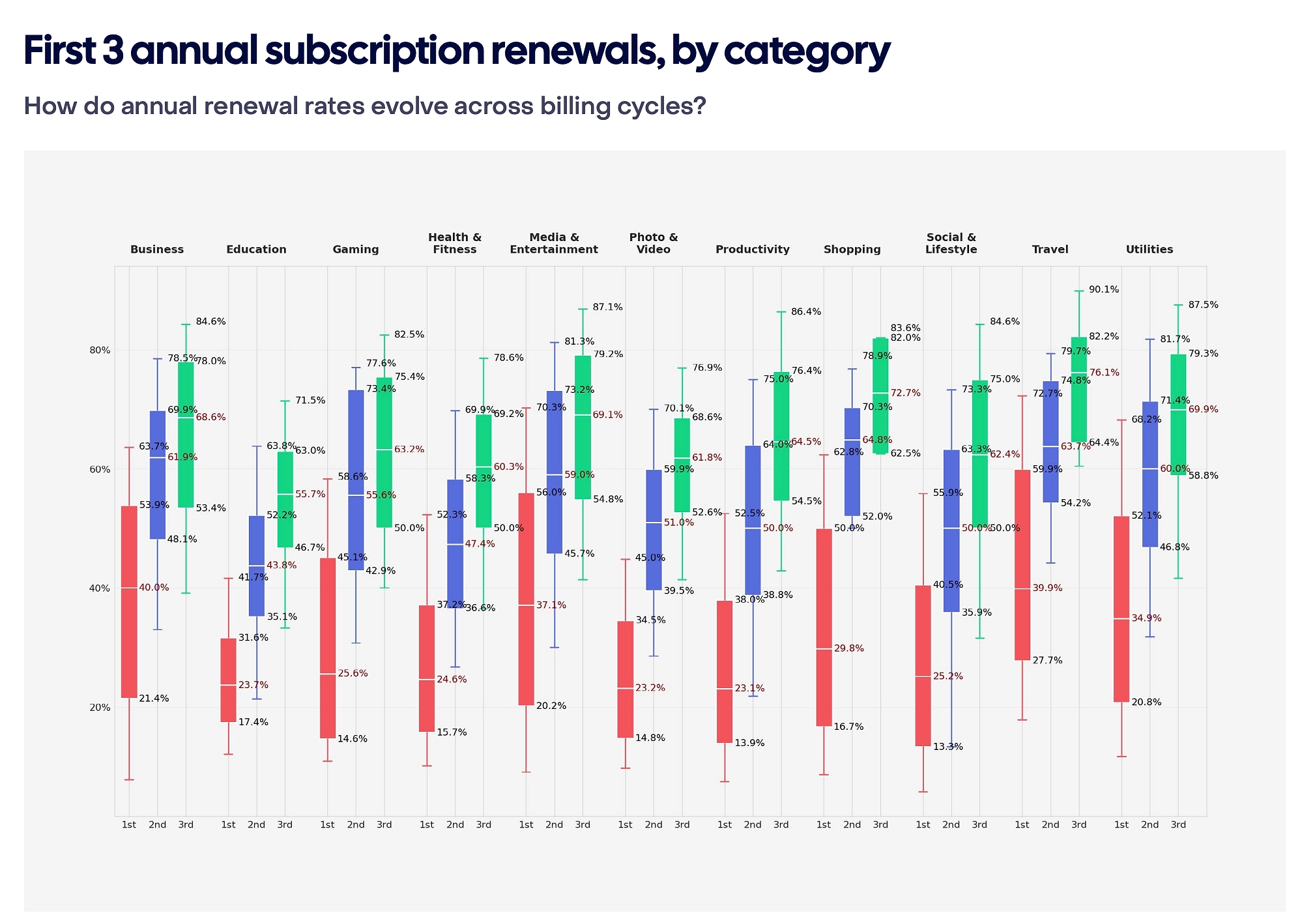
I’d love to say that monthly and annual subscriptions are less dramatic than weekly subscriptions, but they really aren't. Here’s the drop-off for first renewal by plan, from the State of Subscription Apps report 2026:
- Weekly subscriptions: 42–65%
- Monthly subscriptions: 39–58%
- Annual subscriptions: 60–77%
Ouch. Triple Ouch.
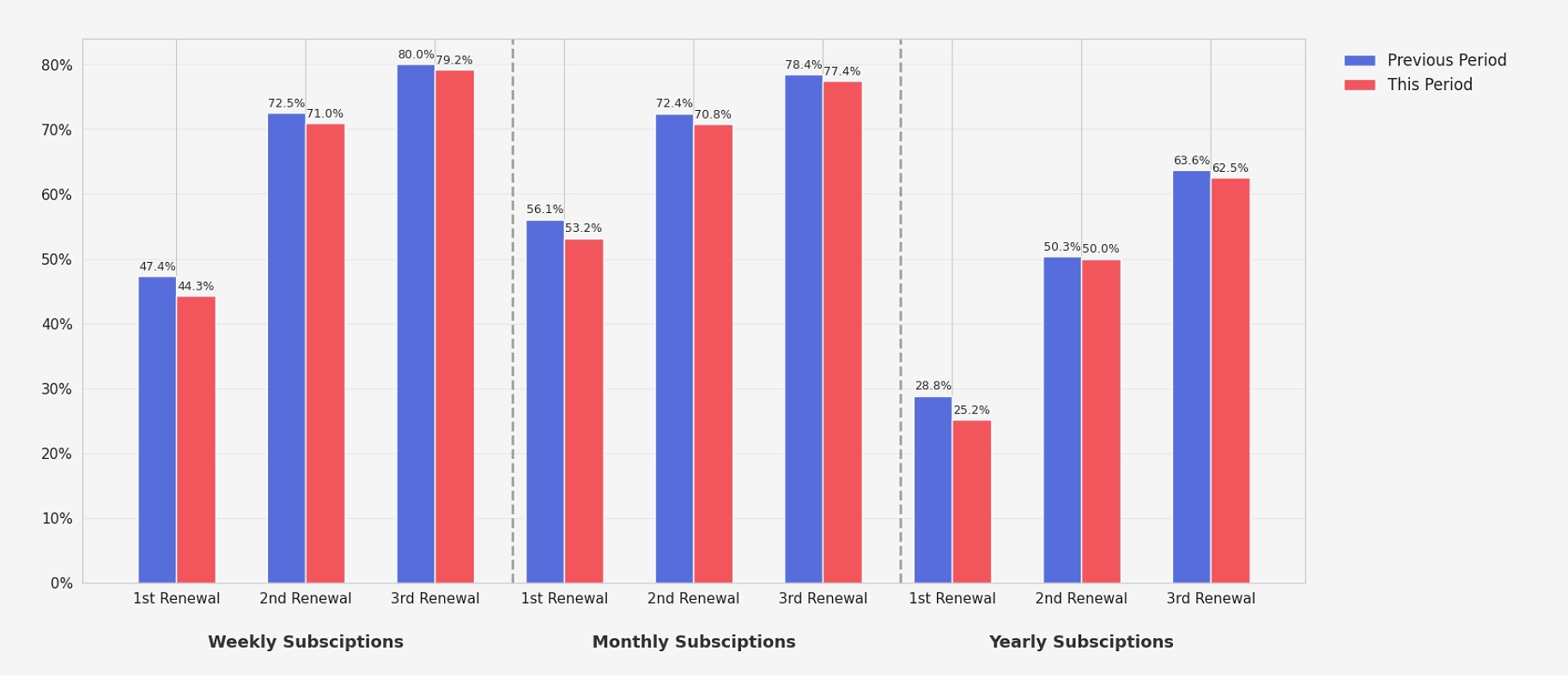
The durations differ, but the pattern is the same: the first renewal is where you lose the most subscribers.
The good news? Once someone gets past that point, the drop-off slows dramatically.
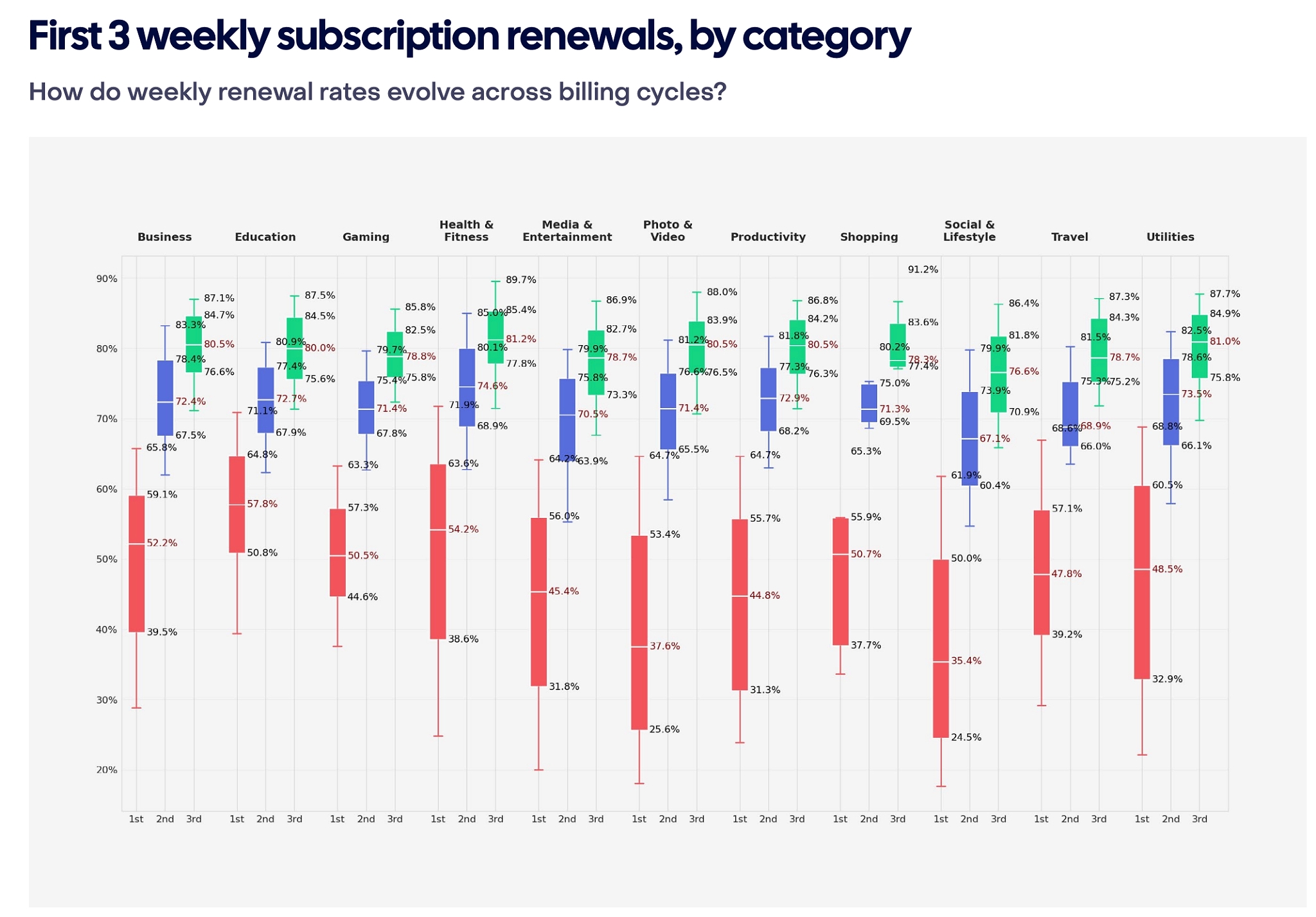
For weekly subscribers who make it to their second renewal, 74–91% will still be paying by their third. The same pattern applies to annual plans: get someone to year two, and they’re far more likely to stay for year three, and probably year four too.
So, how do you survive the survival test? And why is this one moment such a big deal? Here’s my theory.
You only have the activation window to convince subscribers to renew
Why didn't a user renew? Was your onboarding funnel not good enough? Urgh, it was that bug the app had last week, wasn't it?
Maybe, but those are often just symptoms. The real reason is usually that time-to-value wasn't reached within the activation window. Your app never truly became part of their life before the renewal moment.
Just like with trial lengths, different subscription durations give you different activation windows to prove your value. And no, the window isn't equal to your subscription length. I believe the most important activation periods are actually:
- Weekly: first five days
- Monthly: first two weeks
- Annual: first month
For weekly and monthly subscribers, the window closes when they start worrying about the next charge.
Annual subscriptions are different. With a whole year of runway, it feels like you have plenty of time… but you don’t. If someone hasn’t activated and experienced the value of your product by Month 3, once the embedding window closes, the odds of keeping them around drop significantly.
We see this when people actually cancel annual subscriptions:
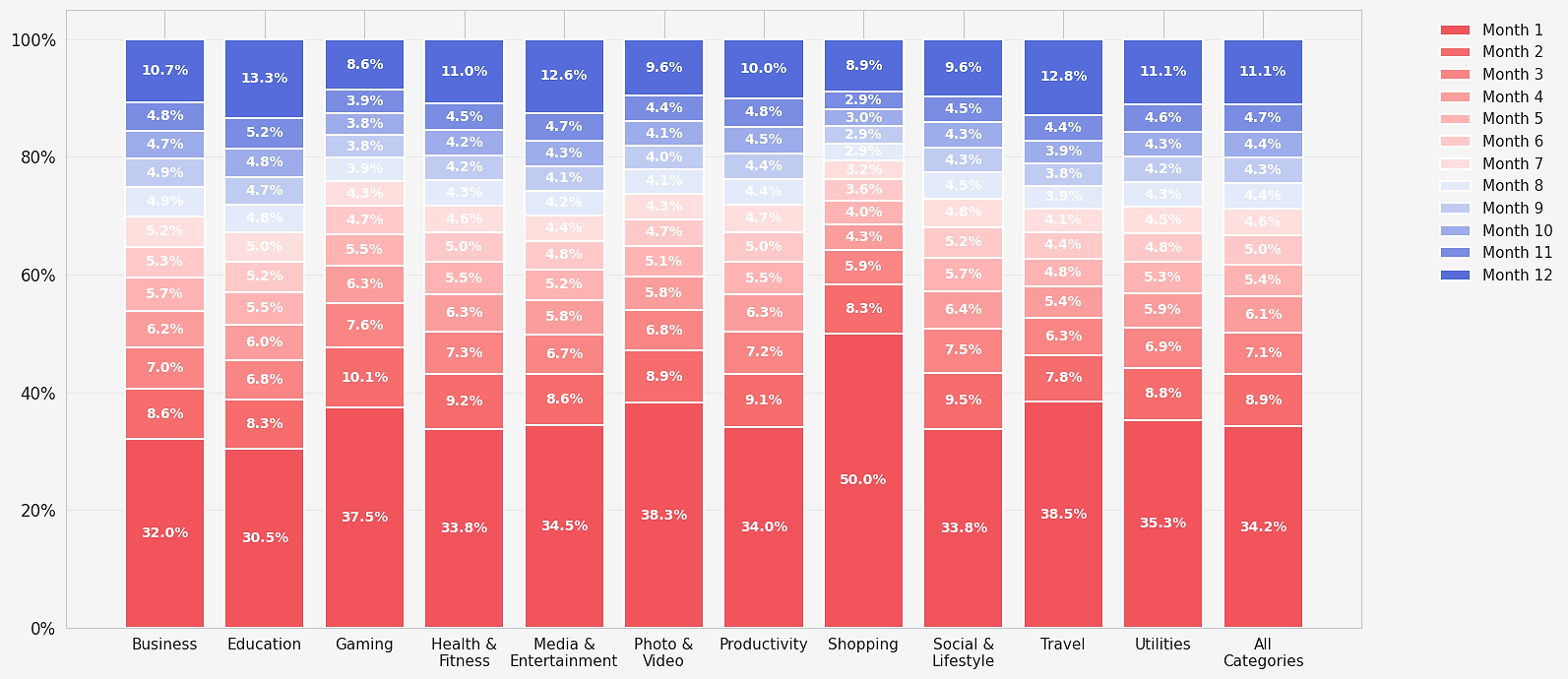
23–50% of annual subscribers who cancel do so in the first month, with another 8–10% dropping off in Month 2. Some of those are the “I’m scared I’ll forget to cancel” group (I’ve definitely done that). But a lot of them are simply people who were never convinced. They never reached the point where the value of the app outweighed the cost.
This matters because winning that first renewal looks completely different, depending on which subscription duration the user signed up for. Let’s run through how to beat the first renewal curse for each plan length.
The weekly subscriber: fast-tracking a habit
Let’s cut to it: 42–65% of weekly subscribers are gone after one billing cycle. (Again, ouch.)
As mentioned, those first five days are what matter. Time to love bomb (you have my permission). This is the moment to go all in, no playing hard to get.
Day 0: love bombing and driving action
It starts on Day 0 with a strong onboarding experience. You want users to get some kind of win, progress, or sense of achievement in that first session. Don’t make them wait to feel valued.
The first renewal isn’t won at renewal. It’s won before they even convert, on that Day 0. We see this with 3-Day trials (often the trial length for weekly subscriptions, when there is one) where 84% of cancellations happen between Day 0 and Day 1.
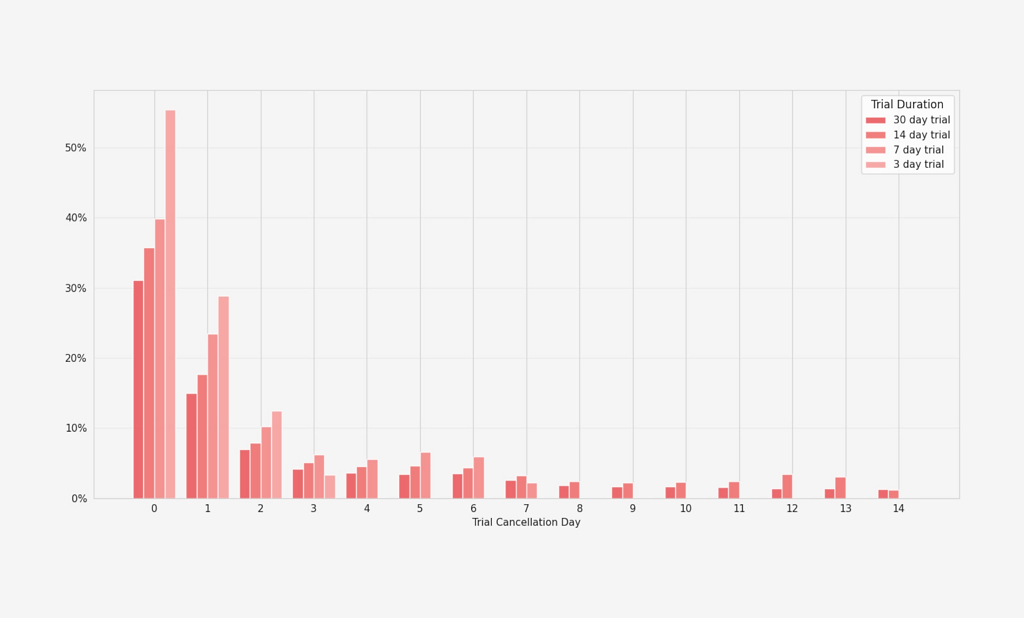
Which means what you show someone immediately after they pay matters a lot. The moment they become a paying customer? Hit them with a strong post-purchase screen that reinforces the decision they just made, reminds them why they signed up, and gets them moving toward the next value moment.
For short subscriptions, I usually recommend focusing this moment on action: what is the one small, simple thing they can do right now? The goal isn’t to explain every feature. It’s to get them moving toward the value they signed up for.
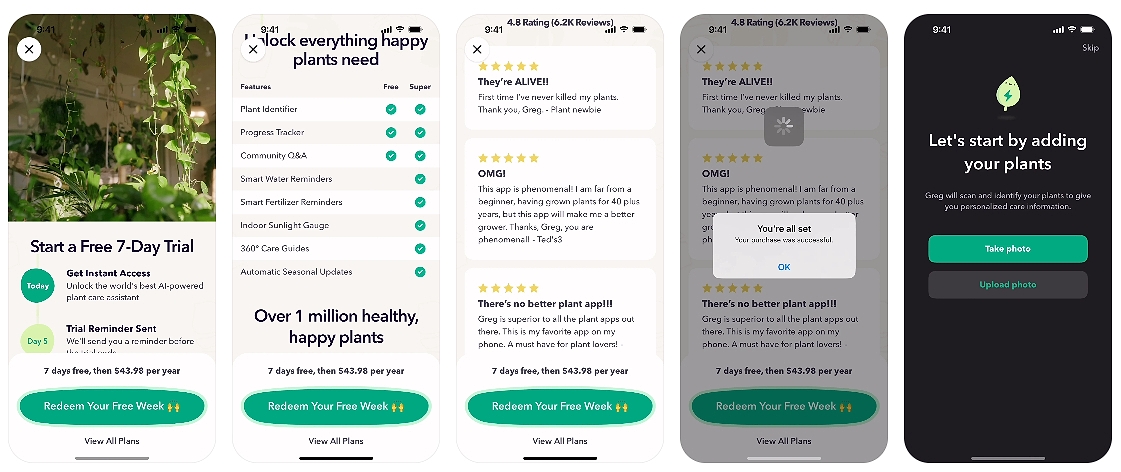
Greg, a plant care app, does this well by inviting the user to log their plants:
Day 1–3: deepen the value
From there, Days 1–3 are about deepening the value. The user should experience the app’s core action, see a result, and start building a reason to come back.
And because the window is so short, you can (and should) be more aggressive with communication than you would be for monthly or annual subscriptions.
Day 4–7: fast-track the habit
Now you're trying to fast-track a habit. The data is pretty clear that real habits take longer than 7 days to form. But that's okay. You don't need a fully-formed habit yet. You just need the first signs of one: a return visit and the core action repeated enough times for the user to feel the value.
If you aren't sure what level of usage is ‘enough’, reverse engineer it from the subscribers who stay. What do they do in their first week? As you identify the behaviors that matter, segment users based on those actions and analyze both the frequency of the behavior and the percentage of users who complete it: that's how you find the leading indicators of renewal.
Throughout all of this, notifications and emails are your friend. The window is short, so don't be afraid to communicate more frequently. Just skip the generic reminder-style notifications. "Don't forget today's session" is really just another way of saying, "Please use my app." Make your messages value-oriented instead:
- Celebrate what they've done
- Show what they could achieve next
- Introduce features that will help them get there
Timing matters just as much as the message itself.
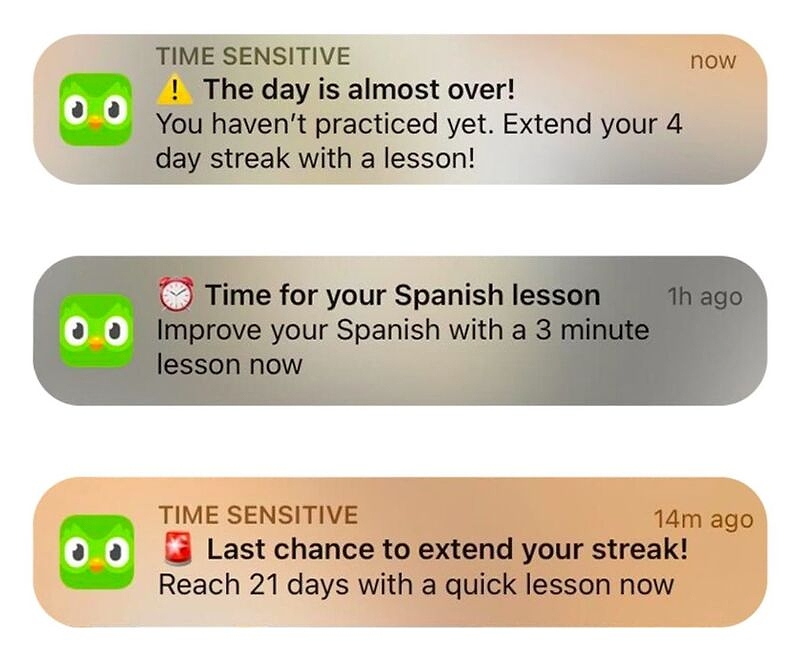
Duolingo tested sending re-engagement emails at different intervals and found that 23.5 hours after a user’s last lesson worked best: just before the same time the next day, when the habit would naturally repeat. And because Duolingo has streaks, they get to say, "Remember, you're on a 24-Day streak," instead of "Please come back."
For one client I worked with, we knew that completing a particular assessment (which includes human feedback — I know, revolutionary in this AI era) has a huge impact on both renewals and long-term retention. So our emails, push notifications, and even in-app messages all focus on getting new subscribers to complete that assessment as quickly as possible.
Once you know which behavior predicts retention, your job becomes much simpler: get more people to do that thing.
The monthly subscriber: 30 days to routine
The numbers are gentler for monthly subscribers, but you're still losing 39–58% at that first renewal.
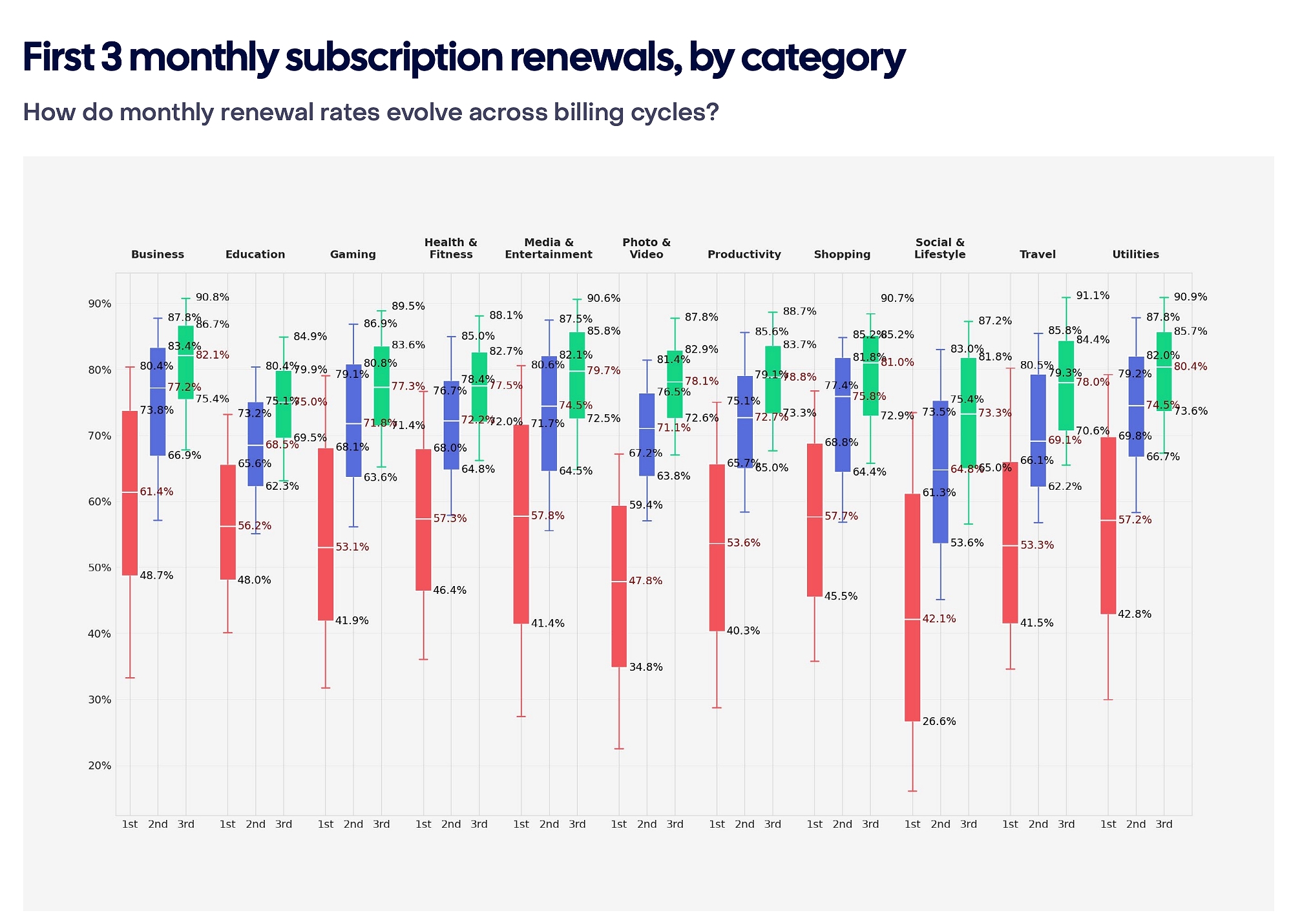
The good news is that you have longer than a week this time. You don't need to force-feed a habit in seven days. But 30 days go by faster than you think, which means each stage of the month needs a job. Week 1 is about activation. The following weeks are about building familiarity, reinforcing value, and creating reasons to come back.
Alice Muir shared on the Sub Club podcast that lifecycle messaging in this period has the highest ROI. So if you run monthly subscriptions, this is where you can focus your efforts: building out the communication and the relationship with the user.
Days 1–7: get them to a meaningful outcome
Not a completed tutorial, not onboarding finished, not even a streak starter. What you're looking for is a clear value moment. Someone probably won't feel fitter after a single workout or dramatically calmer after a single meditation session. But if they've achieved something, you've celebrated that progress with them, and it felt easy enough to do again? That's the beginning of a habit.
Days 8–21: habit reinforcement
This is where most apps go silent. I use the phrase ‘love bombing’ far too often in my work with subscription apps, but it fits. Most apps love bomb users for the first seven days and then completely forget about them. Take a look at your CRM flows. How often are you actually communicating with users in Weeks 2 and 3? The frequency can taper, but it shouldn't fall off a cliff.
At this stage, the goal is simple: figure out where the user is in their journey and help them take the next step.
Let's go back to the workout app example:
- The first flow gets them to Workout 1
- The next flow gets them to Workout 2
- After that, it's about building consistency
If someone hasn't opened the app in five days, that's a churn signal — so it’s time to follow up gently from different angles. They may not have found the right program, or there may be hesitations you can remove (equipment, time, or feedback they want to give).
A lot of this stage is about removing hesitations, concerns, and struggles.
Days 22–30: pre-renewal reinforcement
If they haven't canceled yet, this is when to reinforce the decision. Don't be the dark-UX company that hides the upcoming charge. Nothing churns someone harder than suddenly realizing they've been paying for something they forgot about. Your metrics might look better for a month, but in the long term, that's not growth.
Instead, think: positive reinforcement, progress reports, value summaries, and achievement highlights.
Loom does this well, showing how many meetings you've skipped and hours you've saved — things you could work out yourself, but probably never would.
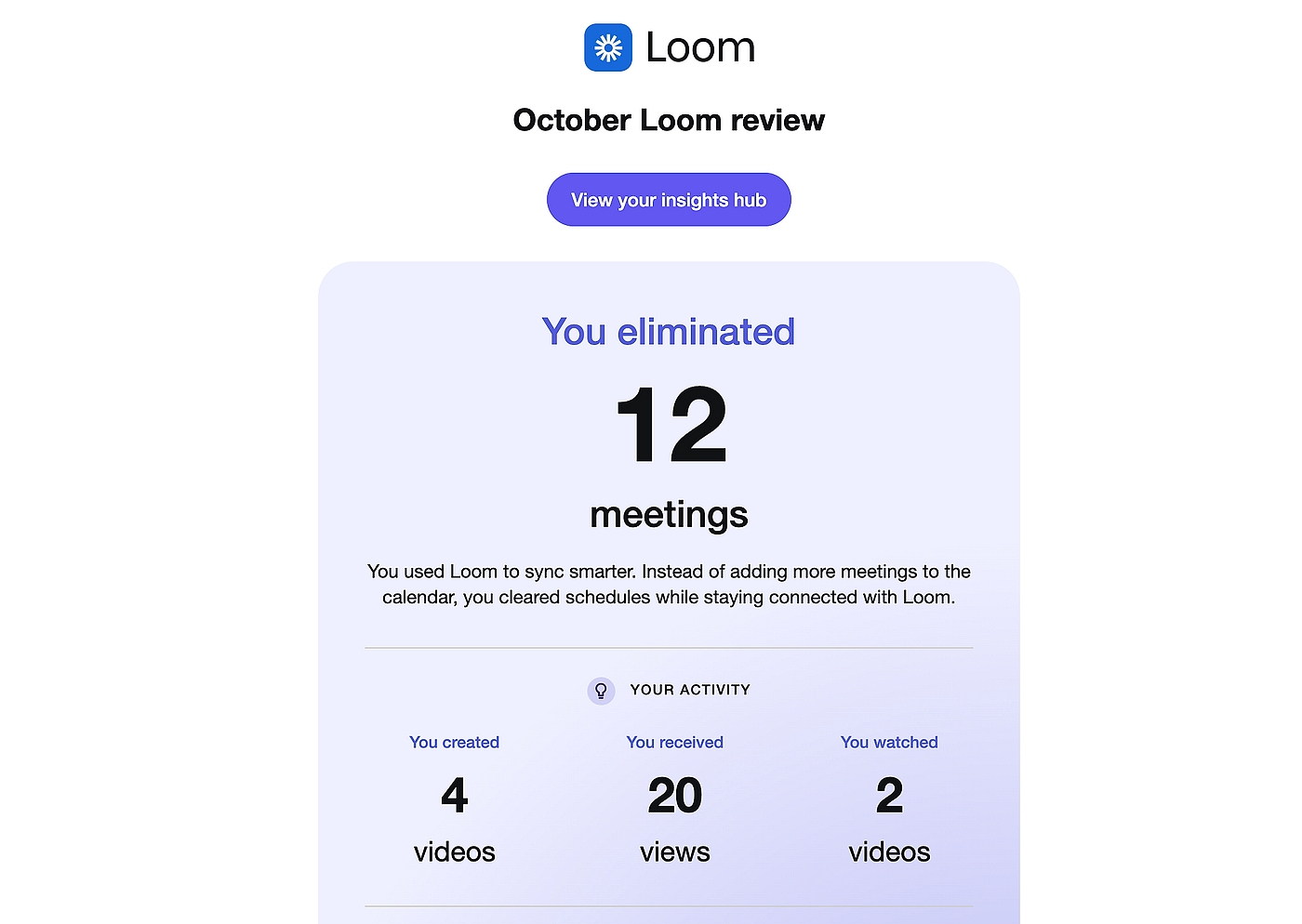
I love it when a workout app tells me how many minutes I've trained or that I'm in the top 10% this month. Arbitrary numbers? Completely, but they make me feel like I've dedicated myself to something.
This means when the "Should I renew?" thought arrives, there’s already a positive feeling attached to the decision. Even better: once they've cleared that first renewal, that's your opening to suggest a longer plan, so they don't have to face this decision every single month.
Overall, monthly subscriptions need more touchpoints than weekly subscriptions, weighted toward the start, dwindling over time, but never stopping completely. Adjust to the user: if they're highly active, acknowledge it rather than pushing them to do more. If they're not, help them take action and figure out what's holding them back.
The annual subscriber: 90 days to embed
A startup recently reached out to me: great product usage, but a far bigger drop at the annual renewal than they expected. It wasn't the first time I'd heard this, and it won't be the last.
Annual renewals are deceptive. Cancellations spike a little in Month 1, taper off, and you start thinking: "All is well with the world, they love us, they're staying". Then the first wave of renewals arrives, and it's a nasty shock.
Here's the thing: starting to prevent that churn at Month 11 is way too late. In my experience, most renewal decisions are made in the first 90 days, with data suggesting that around 30% of annual subscribers cancel in the first month.
Annual subscribers paid a large sum upfront. That makes them more motivated than weekly or monthly subscribers, which is great, but it also means they have more to lose. The gap between expectation and reality is much bigger if your product disappoints. I always say this to people who want to charge more: that's fine, but be conscious that expectations rise with the price. The data backs this up: low-priced annual plans see first renewal rates around 36%, while high-priced ones manage just 23%.
A disappointed $10 subscriber shrugs, cancels, and moves on. A disappointed annual subscriber feels burned: they request refunds, they leave negative reviews. The stakes feel much higher because they made a bigger commitment upfront.
So focus on the first 90 days. That's where the biggest drop-off happens; where your biggest opportunity is. If an annual subscriber is still active after around 90 days, the chance they renew is dramatically higher.
One thing to keep in mind: if an annual subscriber cancels, reactivation rates are extremely low, averaging around 5%.
Month 1: activation is key
This looks similar to what we covered in the monthly renewal section:
- First value
- Core value
- Reinforce value
Months 2–3: keep showing up
This is where apps ghost their customers. They have flows and fancy setups for the first seven days, maybe 30, then it’s radio silence.
Instead, keep integrating into the user's life until using your app feels so natural they can’t imagine being without it: a workflow, a daily habit, a routine. Embedding is the goal. Airship found that apps sending relevant pushes in the first 90 days see retention around 3x higher than apps sending none.
Months 3–12: don't let it go stale
The first 90 days matter most, but there’s a later risk: the product starts feeling same-y. Maybe they've achieved their main job-to-be-done and want to be challenged differently.
I had this with Peloton: loved it for the first few months, and if you'd looked at my first 90 days, you'd have bet on me retaining it. But after a while, it felt like they weren't hearing me anymore, and I stopped making progress.
So keep check-ins going throughout the year: lower frequency, higher quality. Annual subscribers chose commitment; you don't need to convince them as heavily as monthly users. But you do need to show that the product is improving and its use case is still supported.
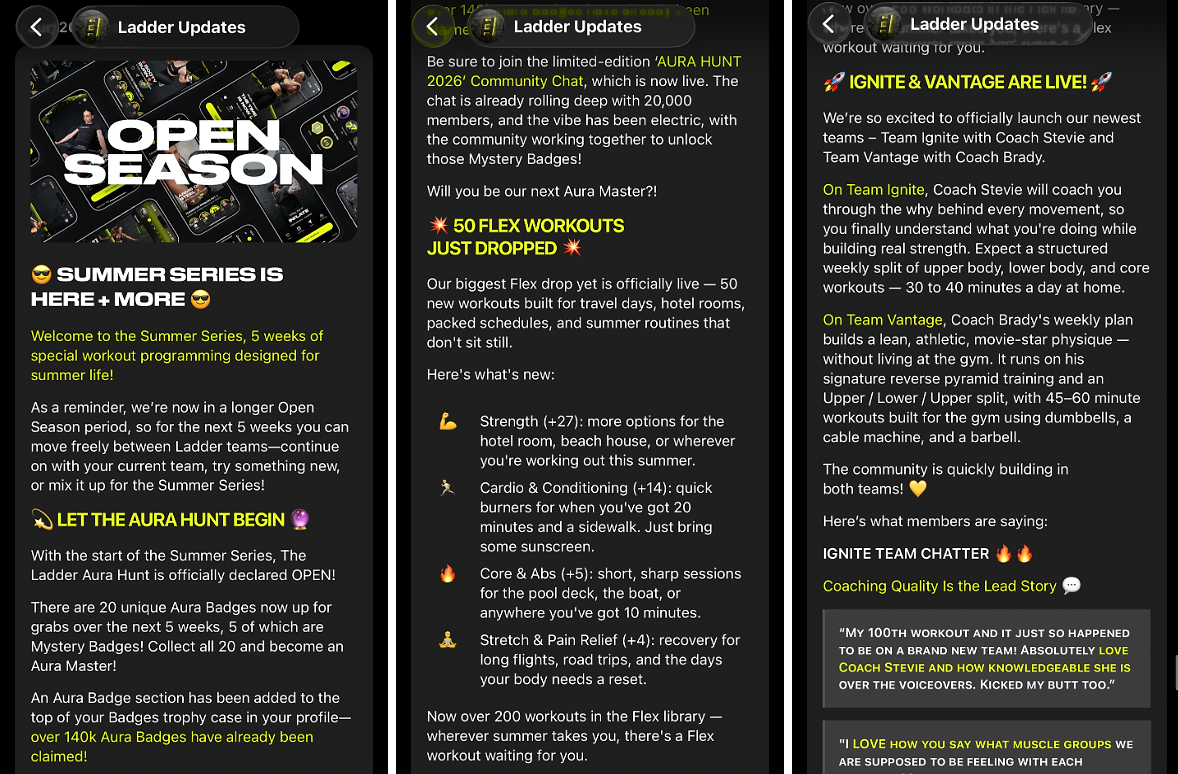
Personalized milestones are powerful here. I loved Ladder's recent summer update: extra flex workouts for while you're traveling, plus new programs I could switch to if I got bored with mine. It made me feel like they understood where I was as a customer and what I needed.
How to find your first renewal predictor
There is often a single early behavior (or a small set of behaviors), measurable in the first billing cycle, that predicts whether a subscriber makes it to renewal. This is your First Renewal Predictor (FRP).
Here's how to find it:
- Map your renewal curve and find where it stabilizes: where does churn drop off dramatically? For most apps, that's around Renewal 2/3, which is what the benchmarks show across subscription types.
- Compare early behaviors of survivors vs. churners: depending on plan type, look at Day 7, 14, or 30 behavior for subscribers who reached that stability point versus those who didn't.
- Identify the actions that most differentiate them: that's your FRP.
For Duolingo, the 7-Day streak is a predictor: one week of consistent engagement means the chance of long-term retention jumps. A streak doesn't just mean 20 minutes a day for seven days, it means they engaged in some meaningful way each day.
What first renewal predictors are not
What FRPs are typically not: session counts, onboarding completion, and trial starts. Those are volume signals, and volume doesn't prove usefulness. I've had days when I opened and closed a recipe app five times just trying to figure out what to cook this week, without selecting a recipe in the end. One open with a recipe chosen would be a far better signal of success than five opens with no action
FRPs are quality signals:
- A specific core action completed X times (sometimes within a date range)
- Engagement with a feature that only high-LTV users touch
- A returning pattern (back on Day 3 and Day 7, not just a single visit)
When analyzing this I also look at the cohort size. It's great if someone meditates 20 times in Week 1, but if only a tiny percentage of users do that, it's not a realistic target. Depending on the engagement level overall, I look for what the top 10% are doing. Then break the core action down by frequency to find the level that balances predictive power with a cohort big enough to matter.
Finally, it’s worth noting your FRP may vary per subscription duration, and can be very similar (or the same) as your activation metric.
If you get activation right, the first renewal takes care of itself.
If first renewal predictors sound suspiciously like activation signals, you're not wrong. Most FRPs are activation metrics, measured from a different angle. With a weekly or monthly plan, you don't have time to build a full habit and relationship before the first renewal. The real work is activating the user and helping them experience the product's value. (Annual — and maybe quarterly — plans are the exception: there you have to go beyond activation and focus on embedding.)
So if you have a first renewal problem, don't go shopping for a retention solution. Review your activation window and fix the product experience within the first seven, 30, or 90 days, depending on your plan type. The renewal will follow.
This is also why win-back campaigns aimed at re-engaging first-renewal churned users convert so badly: those users never activated, so there's nothing to win them back to.
I really like how Alice Muir explains it in the State of Subscription Apps Report 2026:
"In a market where year-one retention is declining across all durations, the winning strategy is not gating harder or charging differently. It’s accelerating time-to-value before the first renewal decision."
Remember Greg, the plant care app? Their monthly retention sits at 21% after 12 months, well above the median. But the more interesting part is what happens next: churn nearly stops. They lose just 3% more subscribers over the following nine months. Survive the early renewals, and your subscribers don't just stay. They settle in.
The first renewal isn't actually where you win or lose, it's where you find out whether you already lost.
How to find your first renewal rate in RevenueCat
Get started reducing churn by checking your first renewal rate by plan type in your RevenueCat charts: if it's below your category's median, the gap is almost certainly in your activation window, not your paywall, pricing, or marketing.
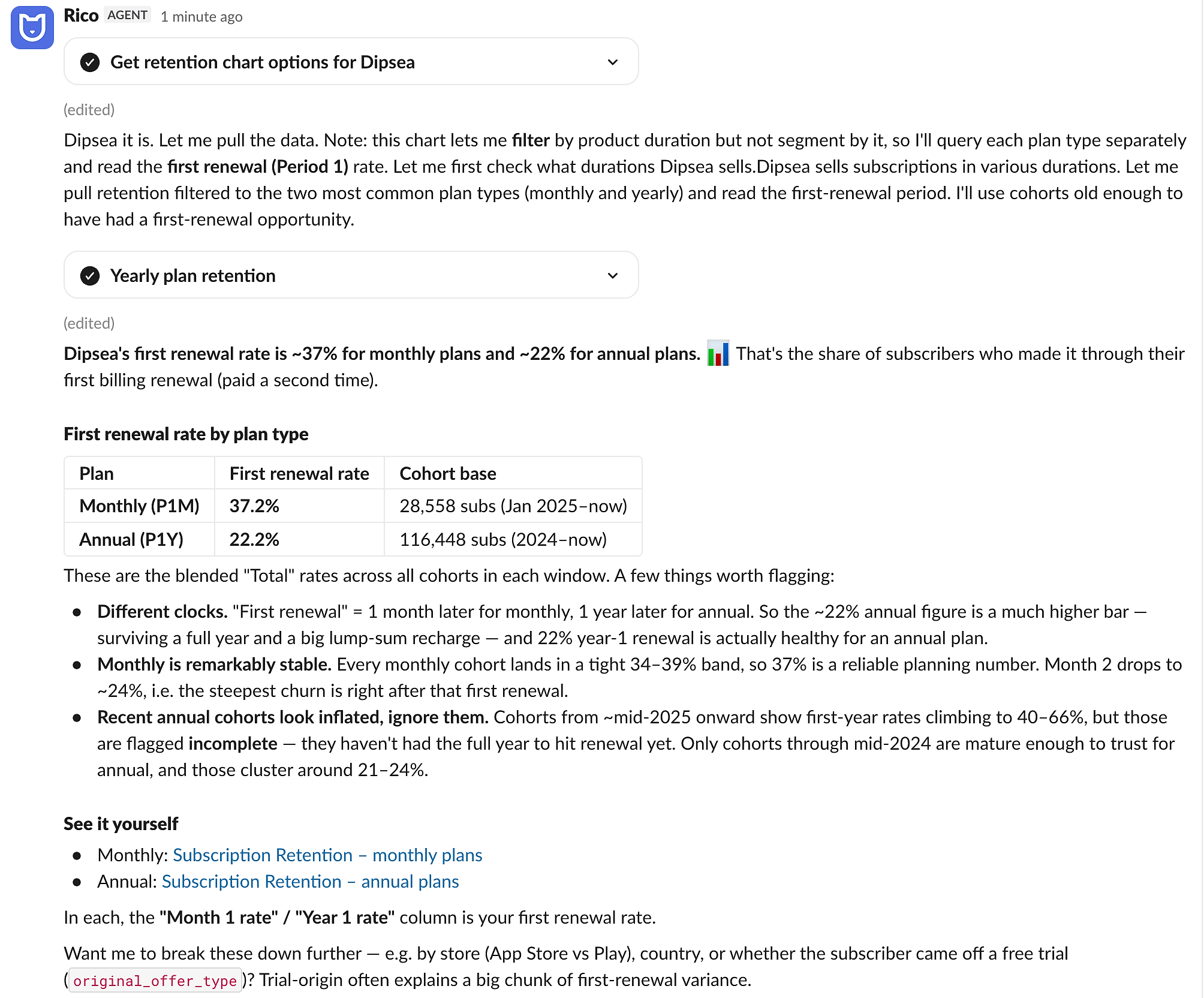
Here’s a quick step-by-step to check your first renewal rate in RevenueCat. You can also ask Rico to pull the numbers directly for you.
- Open Charts in the RevenueCat dashboard (left nav) and select the Subscription Retention chart
- Set your date range with the range selector: this chart cohorts subscribers by their first purchase date, so pick a window old enough that the cohorts have had a chance to hit their first renewal (e.g. for monthly plans, cohorts at least ~1 month old; for annual, at least ~1 year old)
- Segment by plan type: use the segment/breakdown control and choose Product (or Product duration) so each plan gets its own retention line
- Read the Period 1 column/point: that's the share of each cohort that made their first renewal (aka, paid a second time). Period 2, 3, 4 etc. show subsequent renewals
Two things to watch:
- When you segment by a dimension other than the subscription start cohort, subscribers in a segment can have different start dates — and therefore different renewal opportunities. The chart only measures the portion of the cohort that has actually had the chance to renew in that period, so don't compare a period's rate against the full cohort size.
- Duration = period length: Period 1 means one billing cycle later (one month for monthly plans, one year for annual plans etc.). That's why segmenting by plan type is the right move — it keeps the comparison apples-to-apples.