

With the holidays around the corner, we all get the itch to plan seasonal offers and big discounts.
It’s hard not to when it feels like every competitor is doing the same.
For subscription apps, there’s more to consider than sales. Discount an annual plan, and you’re accepting less revenue for a year. Offer a cheaper first month, and some subscribers may leave when the price goes up.
Does that mean holiday offers are too risky? Not necessarily. But they do require planning.
We analyzed nearly 5,000 apps worldwide during the 2025–26 holiday season to help you decide when to run a promotion and how to assess its results.
The research compares changes in new paying customers around Black Friday, Christmas, and New Year for apps with and without detected promotions. It also looks at what those buyers spent over six months, their renewals and refunds, and how apps presented their holiday offers.
Summary
- Apps with detected Black Friday promotions get more new paying customers and higher six-month revenue than in their September 15–October 12 baseline. Revenue per customer is lower, but the median app makes up for it with a larger customer base.
- Existing free users play a substantial role in Black Friday growth. Among apps with detected promotions, users who installed the app more than three months before their first payment account for about half the average increase in new paying customers.
- Christmas-only promotions show no clear acquisition advantage. Apps with offers detected only at Christmas perform similarly to apps without detected offers.
- New Year and January lead the holiday season for new paying customers, particularly in Health & Fitness and Gaming. Apps with detected New Year promotions get 14% more new paying customers per day than in September–October, while those without detected promotions get 4% fewer.
- Holiday paywalls put savings and urgency front and center. Discount claims, crossed-out prices, and limited-time messaging are common, and more paywalls show a single plan.
Holiday acquisition is lower overall, but apps with offers tend to perform better
Over the holidays, most app categories get fewer new paying customers than in their September 15–October 12 baseline. Even New Year and January, the strongest stretch of the season, come in slightly below it for the median app (3% fewer new paying customers per day).
Part of that dip comes from the baseline itself. Mid-September to mid-October is a strong stretch for new paying customers, so even ordinary weeks right after it are about 6% below. The 2024–25 season shows the same pattern.
Ad costs may also play a part. One analysis of large US Meta ad accounts found that CPMs for apps and services rose sharply around Black Friday, peaked in mid-December, and dropped below October levels in January. Higher ad prices can make new users more expensive to acquire in the run-up to Christmas.
Around New Year, new paying customers briefly rise above the September–October baseline. The peak doesn’t last, so the full period still comes out below it.
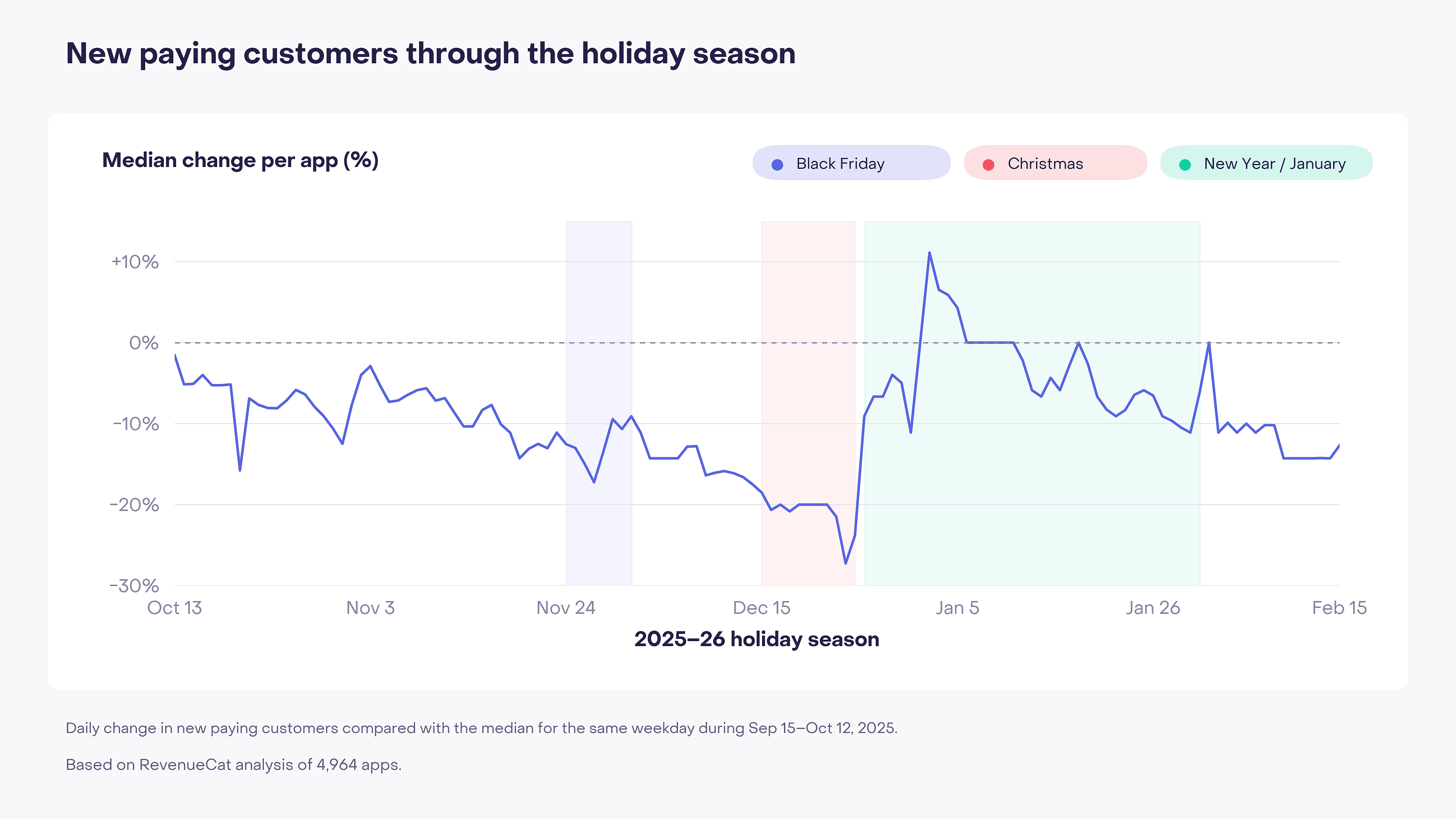
The two exceptions are Health & Fitness and Gaming, which stay above baseline across New Year and January (11% and 10% more new paying customers per day).
That’s likely when demand peaks for both: New Year resolutions for fitness apps, and new devices and time off for games.
But overall, the typical app gets fewer new paying customers per day than during that earlier period.

However, if we look at apps with detected promotions (421 at Black Friday, 208 at Christmas, and 236 at New Year), the picture changes.
During Black Friday and New Year, apps with detected promotions tend to perform better.
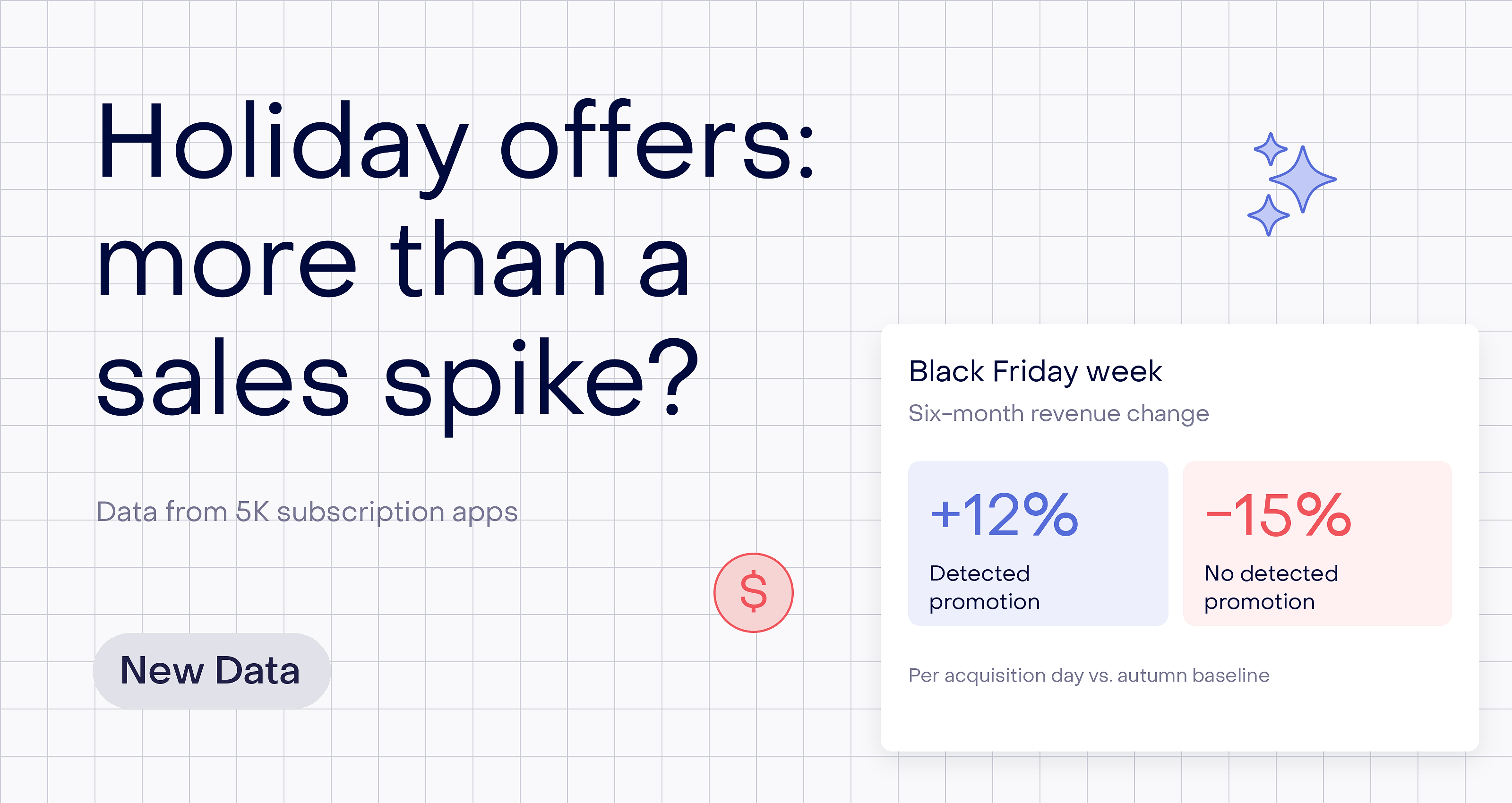
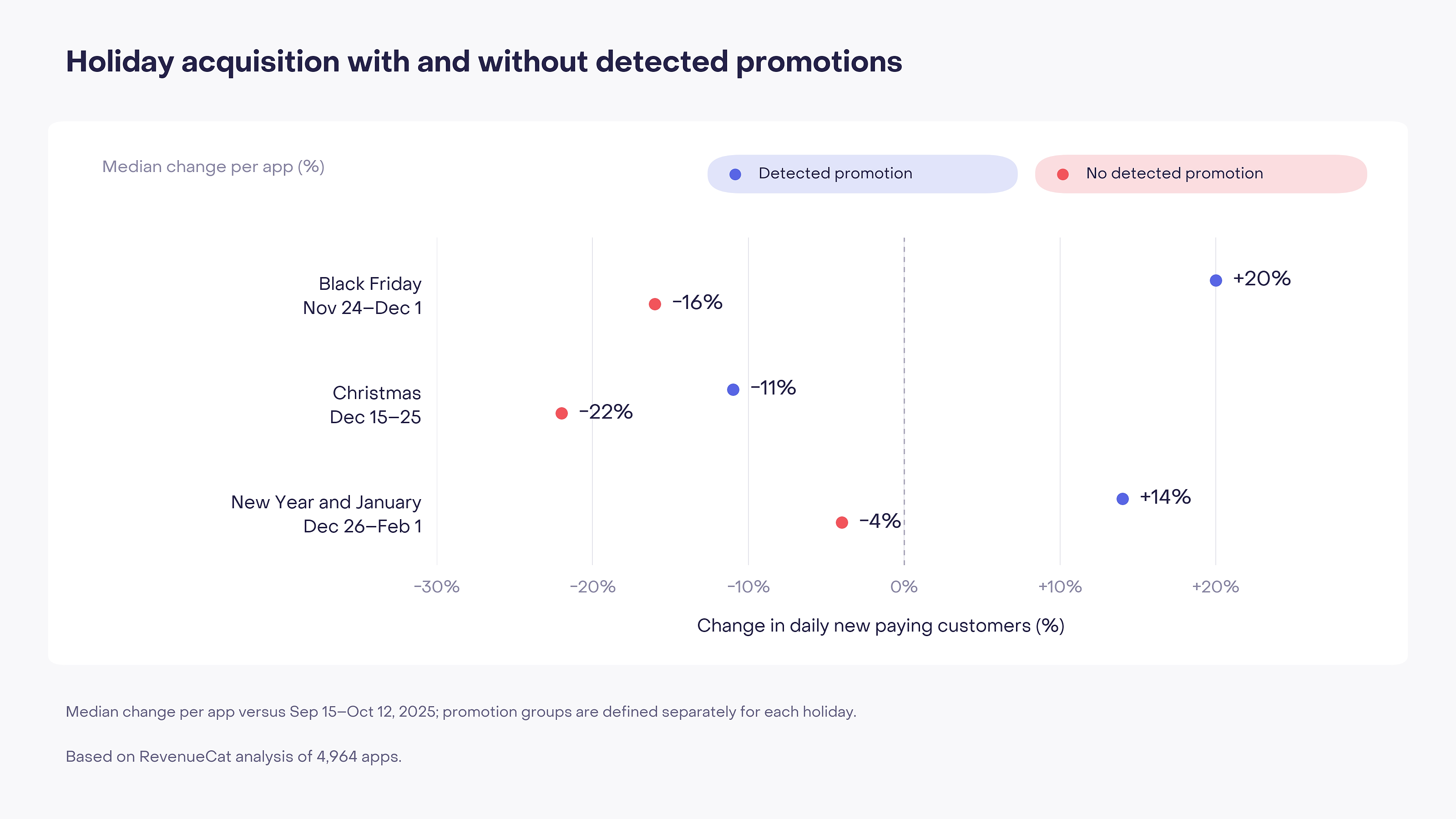
Black Friday shows the widest gap. During Black Friday week (November 24–December 1), the median app with a detected promotion gets 20% more new paying customers per day than in its baseline, while the median app without one gets 16% fewer. New Year and January follow the same pattern on a smaller scale: 14% more versus 4% fewer.
That said, Christmas shows a smaller gap.
Apps with detected Christmas promotions get 11% fewer new paying customers, while those without get 22% fewer. Most of that difference comes from apps that were also running promotions during Black Friday. Apps with promotions detected only at Christmas show no clear advantage.
We compare apps where we detect a promotion with those where we don’t. Most signals come from purchases, so offers with few or no sales can go undetected. Apps flagged only by holiday wording on their paywall, the one signal that doesn’t need sales, were 2% below baseline duringBlack Friday. Apps that run promotions may also spend more on ads. The results describe these two groups, rather than predict how much a discount would increase your sales.
More Black Friday buyers make up for lower revenue per buyer
Among apps with detected promotions, the increase in new paying customers during Black Friday and Cyber Monday appears large enough to make up for lower revenue per buyer over six months.
During November 24–December 1, 2025, these apps get 20% more new paying customers per day than in September–October.
Most of the extra customers are acquired in the five days from Thanksgiving to Cyber Monday. New paying customers peak on Black Friday (November 28) at 49% above baseline and stay at least 25% above it through Cyber Monday (December 1).

Each Black Friday buyer is worth a little less, but the extra buyers make up for it. Over the next six months, the median app earns 8% less revenue per buyer.
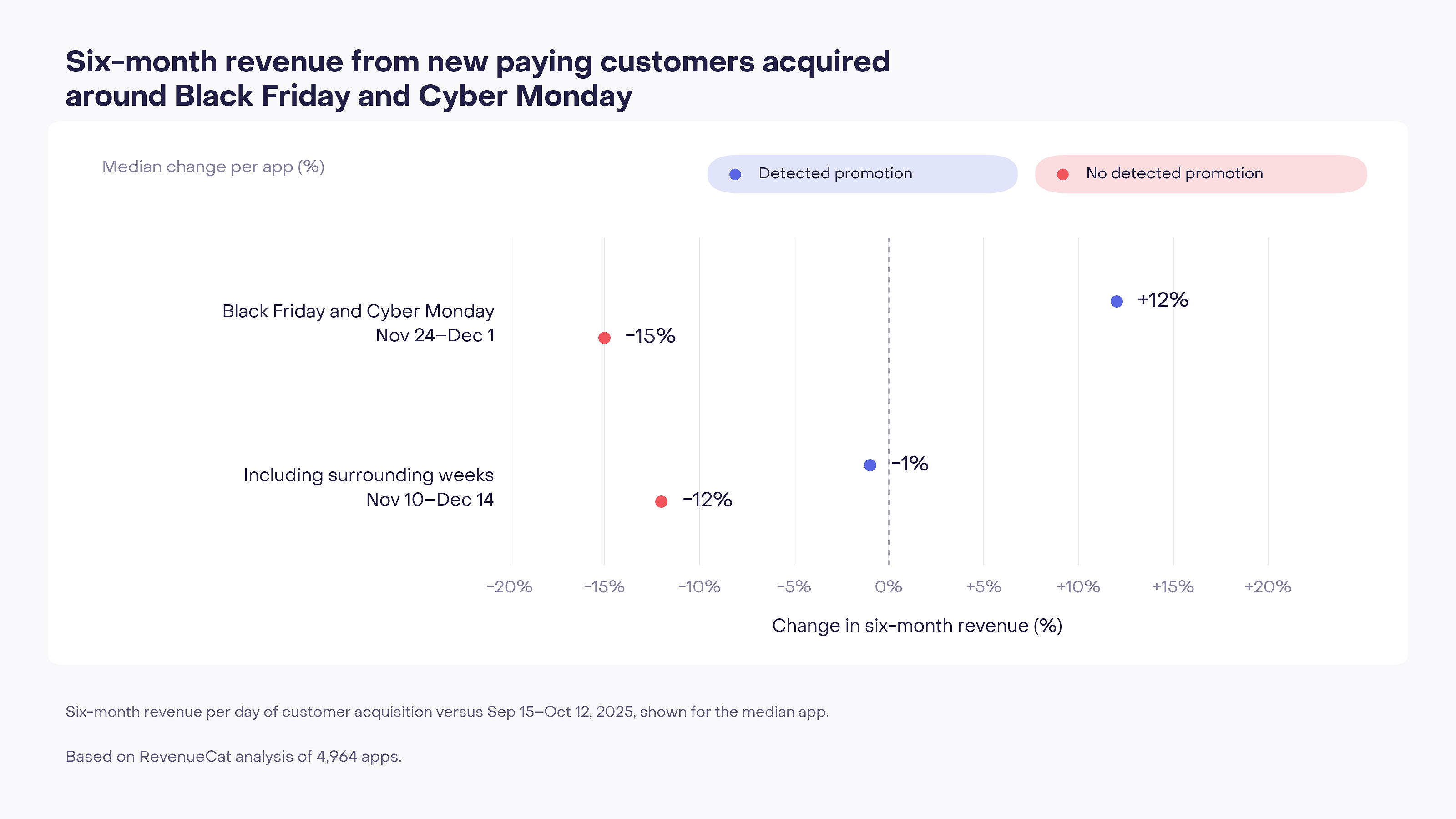
For the median app, buyers acquired on an average sale day generate 12% more revenue over six months than buyers acquired on an average baseline day. Overall, 60% of apps come out ahead.
That gain is limited to the sale week. Once the quieter weeks around it are included (November 10–December 14), the median app with a detected promotion is 1% below its baseline, versus 12% below for apps without one.
About half of Black Friday growth comes from existing free users
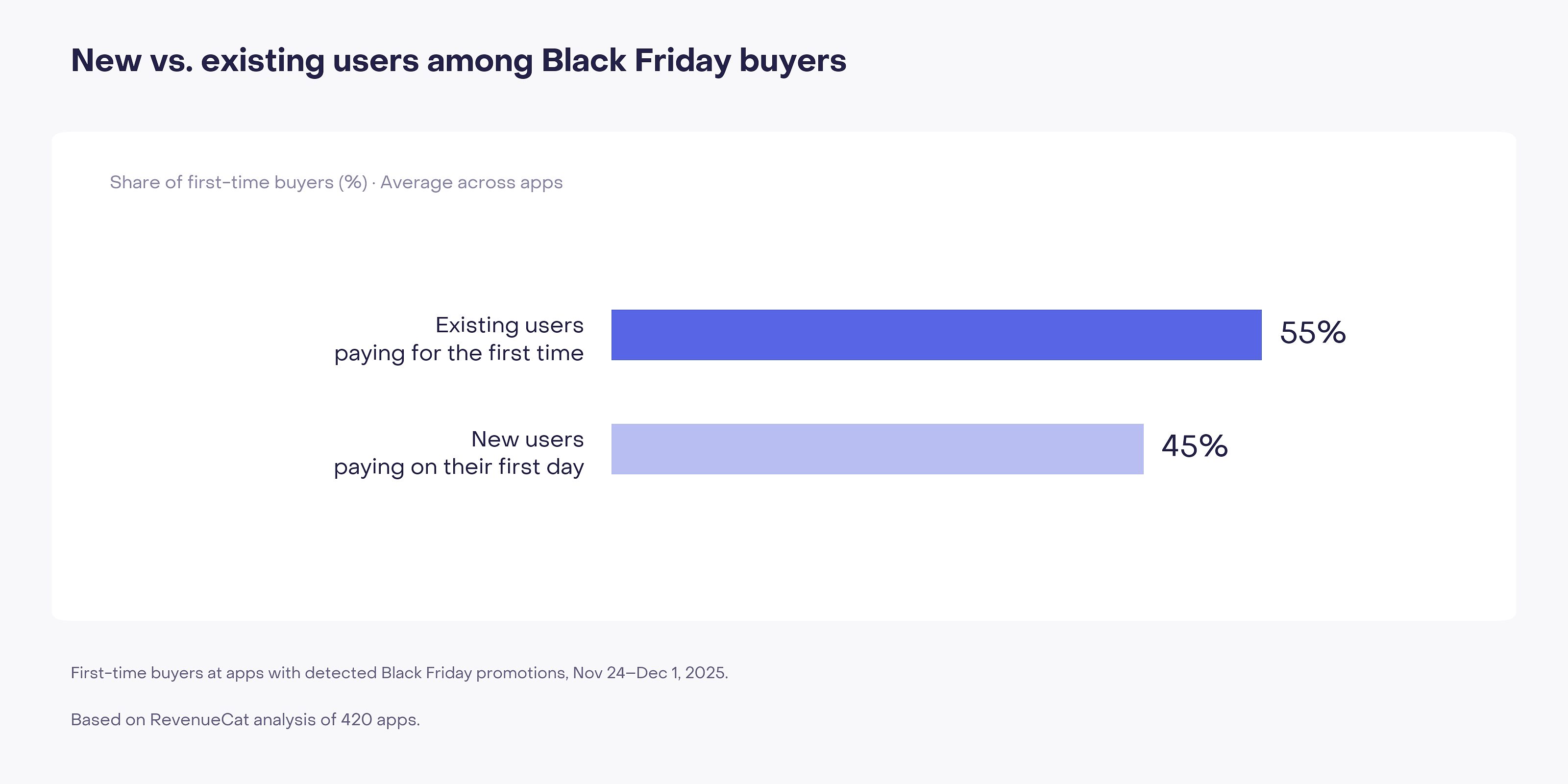
For apps with detected promotions, about half of the Black Friday increase came from people who’d had the app for over three months.
Black Friday buyers also look different from usual. During Black Friday week, 55% of these apps’ new paying customers had installed the app at least a day before paying, up from 45% in September–October.
So if you’re planning a Black Friday offer, don’t focus only on new installs. Some of the opportunity may already be in your free user base.
Black Friday offers also reach current and lapsed subscribers. In 9% of apps with detected promotions, these subscribers redeem at least three times as many offers per day as in September–October.
Annual plans account for nearly half of new paying customers
More Black Friday buyers start on an annual plan.
For apps with detected promotions, 49% of new paying customers bought an annual plan during Black Friday and Cyber Monday, up from 41% in September–October, mostly at the expense of monthly plans.

So far, Black Friday buyers on weekly and monthly plans renew about as often as usual. Weekly renewal rates change by less than one percentage point, while monthly second renewals are two percentage points lower.
Annual plan buyers look stable too, at least early on. Fewer of them request a refund within 30 days (2.7%, down from 4%), and auto-renew cancellations in the first 30 days don’t increase. Whether they renew is still an open question: their first renewal falls outside our six-month follow-up.
Utilities and Health & Fitness show the largest acquisition gains
The Black Friday gap varies widely by category. Among apps with detected promotions, Utilities and Health & Fitness get 46% and 37% more new paying customers per day than in their baseline, while Education and Social & Lifestyle stay roughly level.
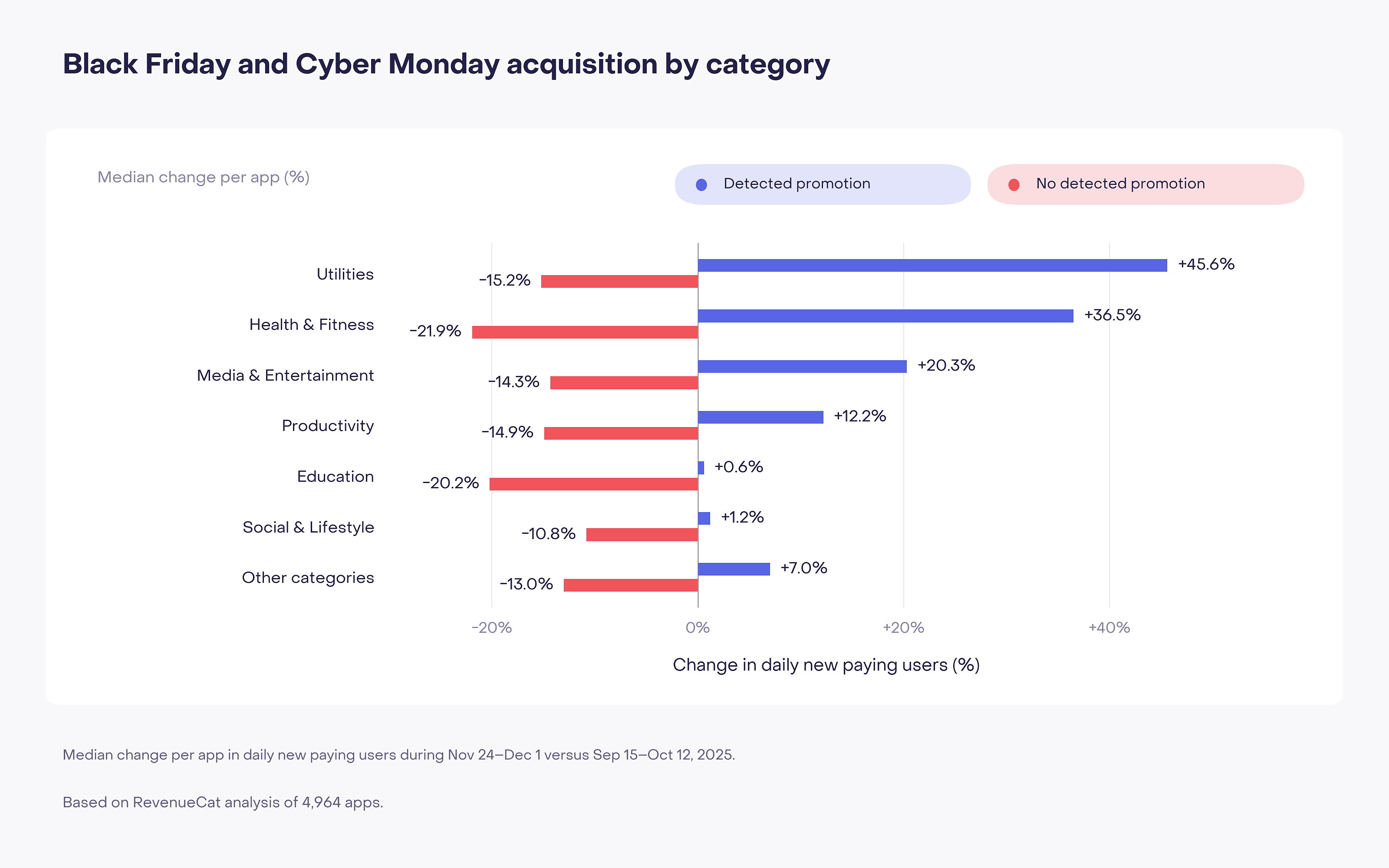
Apps without detected promotions are below baseline in every category group. If you’re setting a campaign target, your category’s results may be a better benchmark than the overall 20% increase.
Black Friday discounts extend beyond introductory offers
Apps offer introductory deals, reduce prices on existing subscriptions, or add cheaper subscription options.
Among the apps with detected Black Friday promotions, we spotted:
- Offers for first-time subscribers. In 45% of apps, purchases using first-time subscriber offers increased, mainly through introductory deals such as a discounted first month. Both new users and existing free users can redeem them.
- Lower prices on existing products. 16% of apps sold an existing product at a lower price. About half of these may be regular price changes, not holiday promotions.
- New, cheaper subscription options. 16% of apps introduced a temporary subscription priced below their usual one.
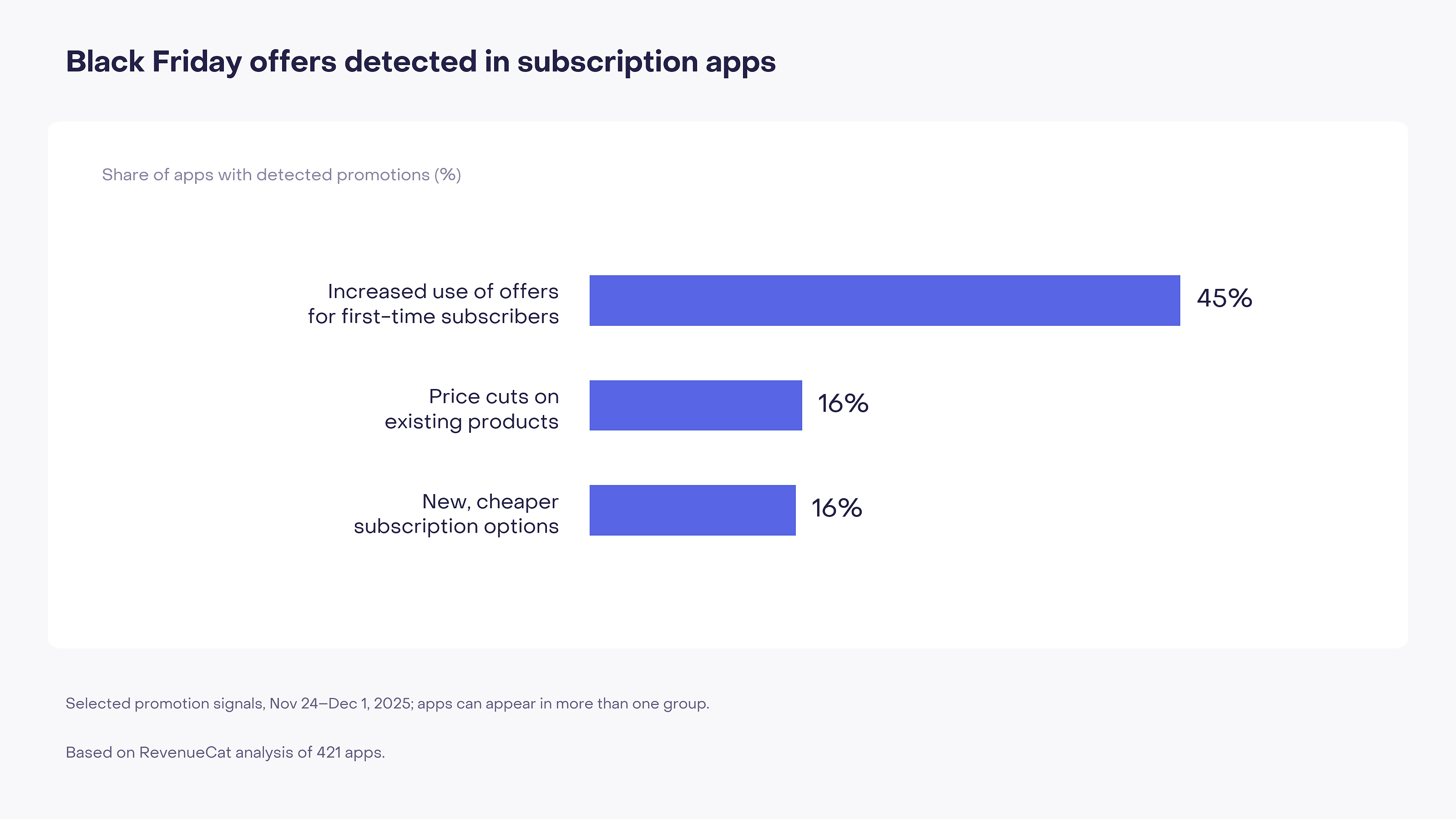
Apps can use more than one type of offer, and some promotions were detected through other signals, such as sale-named products, so these shares don’t add up to 100%.
Christmas offers don’t show the same promise as Black Friday
The Christmas results give us less reason to expect an increase in new paying customers.
During December 15–25, apps with offers detected only at Christmas get 24% fewer new paying customers per day than in their baseline, almost the same drop as apps without detected offers (22%).
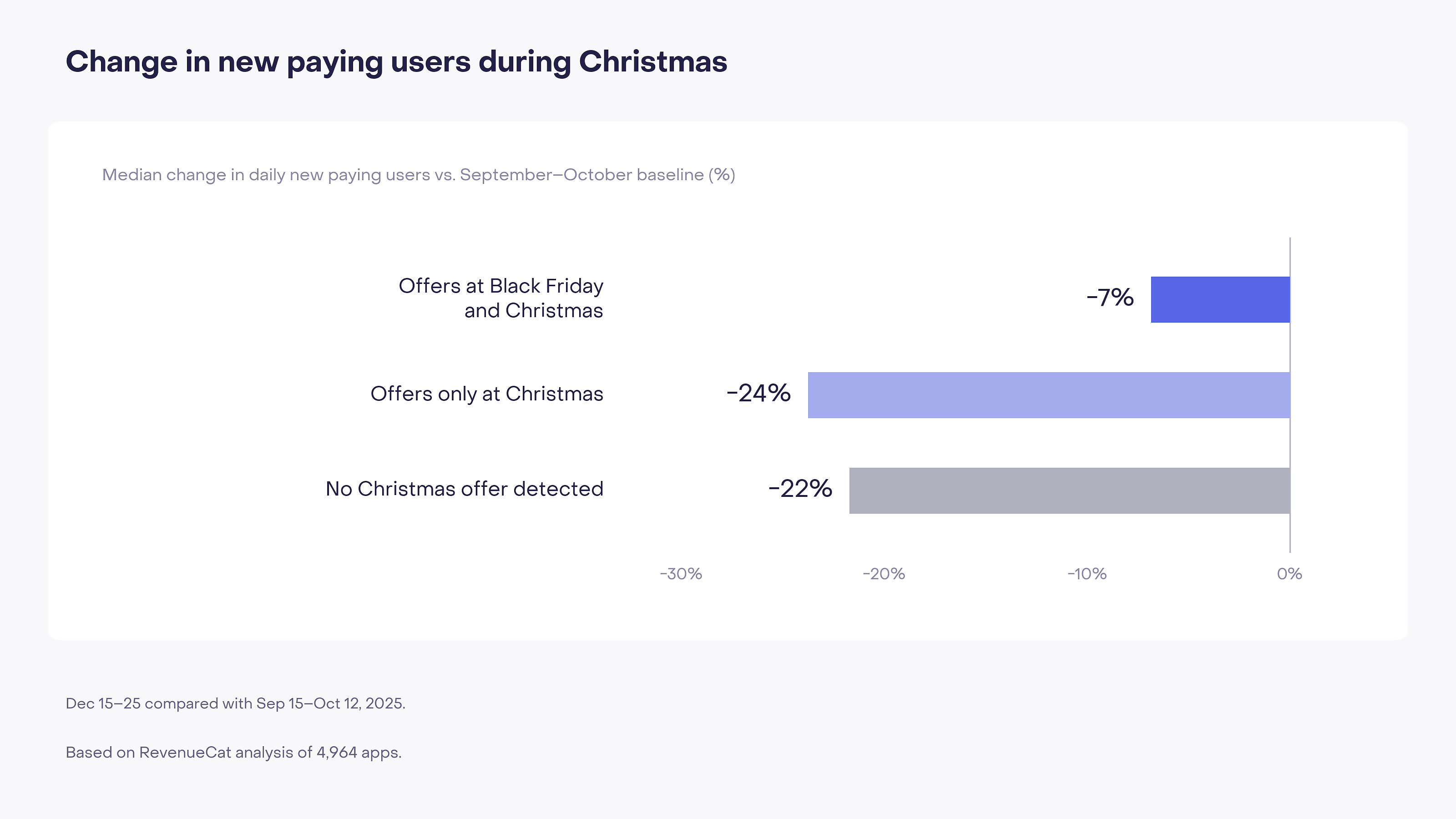
The stronger result comes from apps with promotions during both Black Friday and Christmas, which are down just 7%. But those apps were already 24% above baseline during Black Friday week, so their smaller decline doesn’t show that a Christmas discount has a notable impact.
Apps with New Year offers see more new paying customers into January
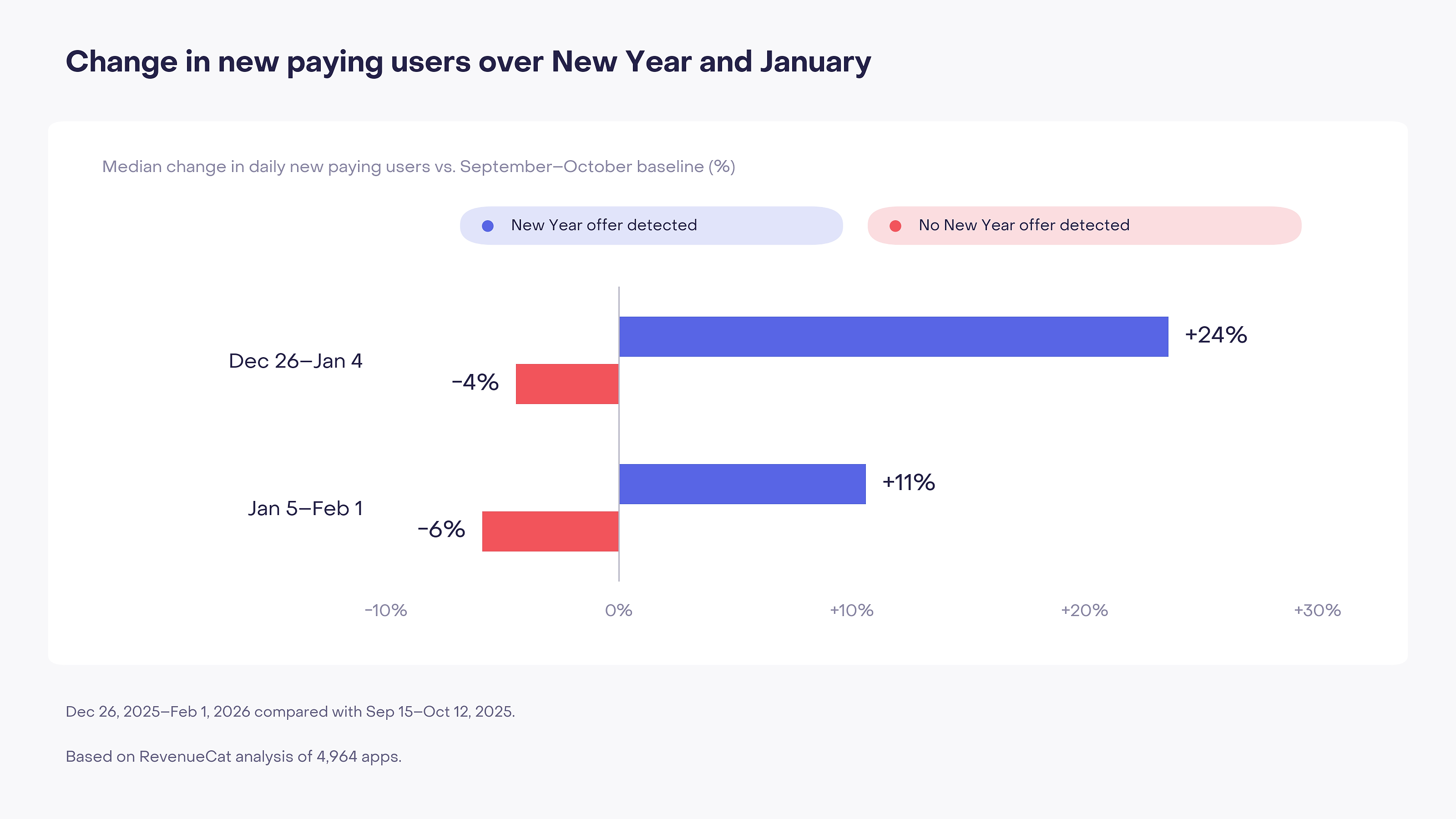
January is when apps with detected promotions pull ahead again. Over December 26–February 1, they get 14% more new paying customers per day than in their baseline, while apps without detected offers get 4% fewer.
January buyers also generate 10% more revenue per customer over six months than Black Friday buyers, with little difference in early renewal rates. That comparison is within apps with detected Black Friday promotions, so it doesn’t tell us whether New Year offers improve revenue. In apps without detected Black Friday promotions, January and Black Friday buyers are worth about the same (+2%).
The acquisition increase is strongest around New Year and smaller later in January:
- December 26–January 4: 24% more new paying customers per day for apps with detected offers, versus 4% fewer for those without
- January 5–February 1: 11% more, versus 6% fewer
The New Year lift is strongest in Health & Fitness, which goes from 28% below baseline at Christmas to 11% above over New Year and January. Gaming is also 10% above baseline over the same period.
These category figures cover apps with and without promotions, so they show where acquisition is stronger across the season (not where discounts work best).
How subscription apps present their holiday offers
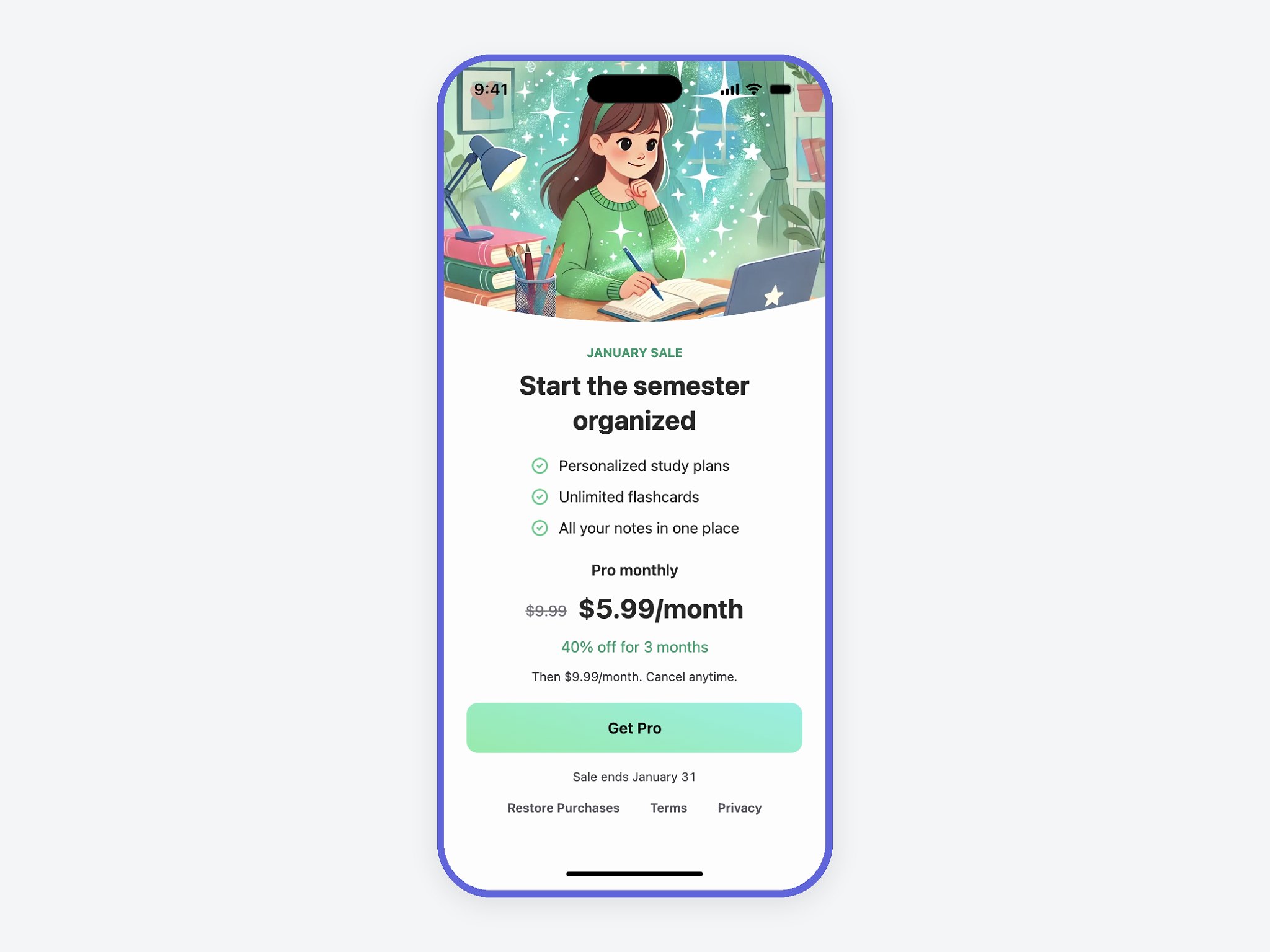
Holiday paywalls differ most from ordinary ones in how they present the deal. Percentage discounts, crossed-out prices, and urgency appear far more often on holiday paywalls. Free trials remain common, and lifetime options and single-plan layouts appear more often.
The percentage off is the most common holiday addition. It appears on 61% of Black Friday paywalls and 54% of New Year paywalls, compared with 8% outside the holidays. Crossed-out prices and urgency wording jump too, from under 5% of ordinary paywalls to roughly a third or more of holiday ones.
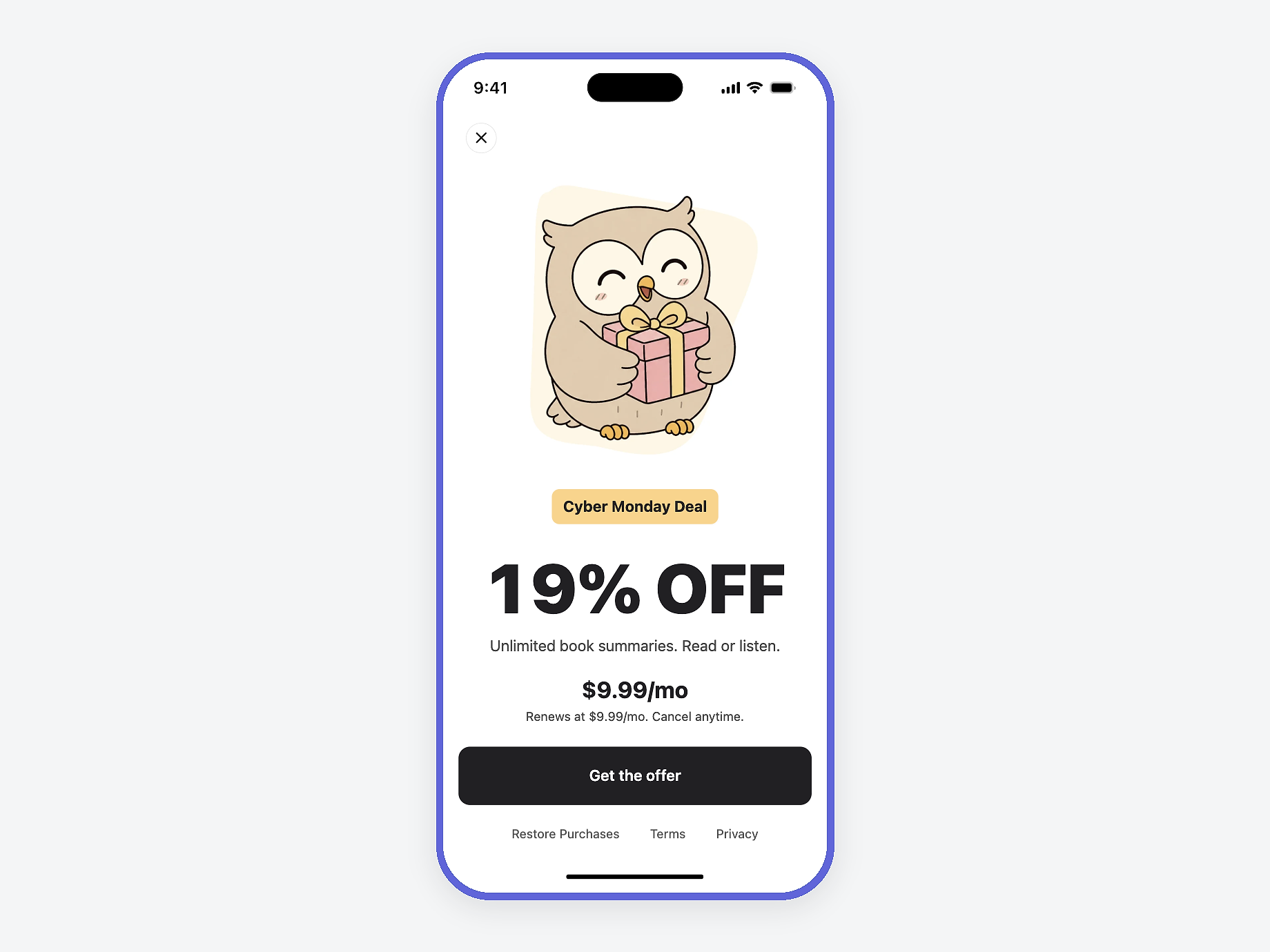
During Black Friday week, nearly three in four paywalls showing a percentage discount offered 50% off or more.
Our acquisition findings also suggest what to test in your paywall message. Existing free users account for a substantial part of the Black Friday increase. To target these users, test a paywall built around the paid features missing from their current experience, with the discount attached to that upgrade.
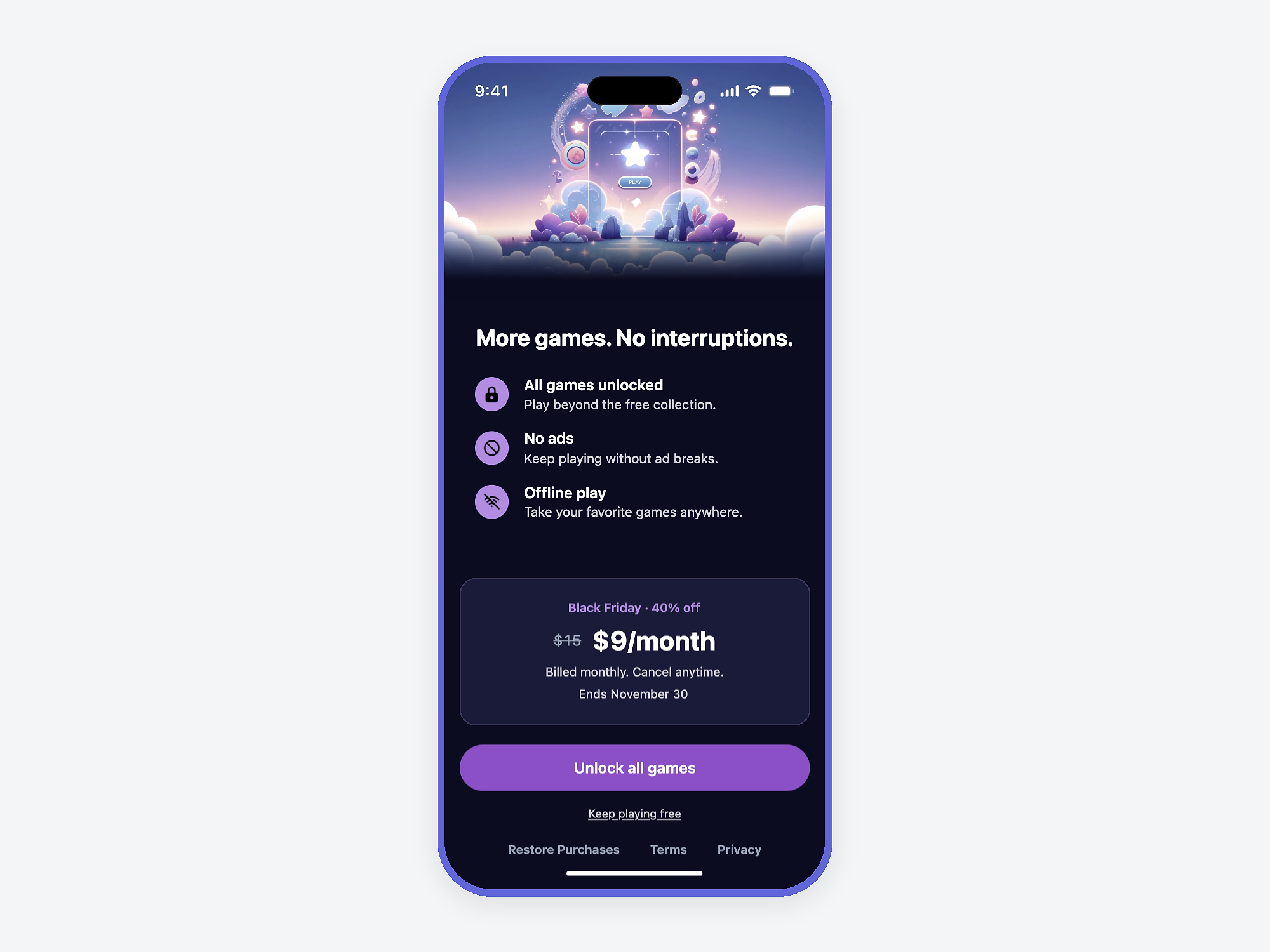
Lifetime access shows up about twice as often as usual: on 35–38% of Black Friday and New Year paywalls, versus 17% outside the holidays. The buyer gets lasting access at a sale price, while the app collects revenue upfront instead of relying on future renewals.
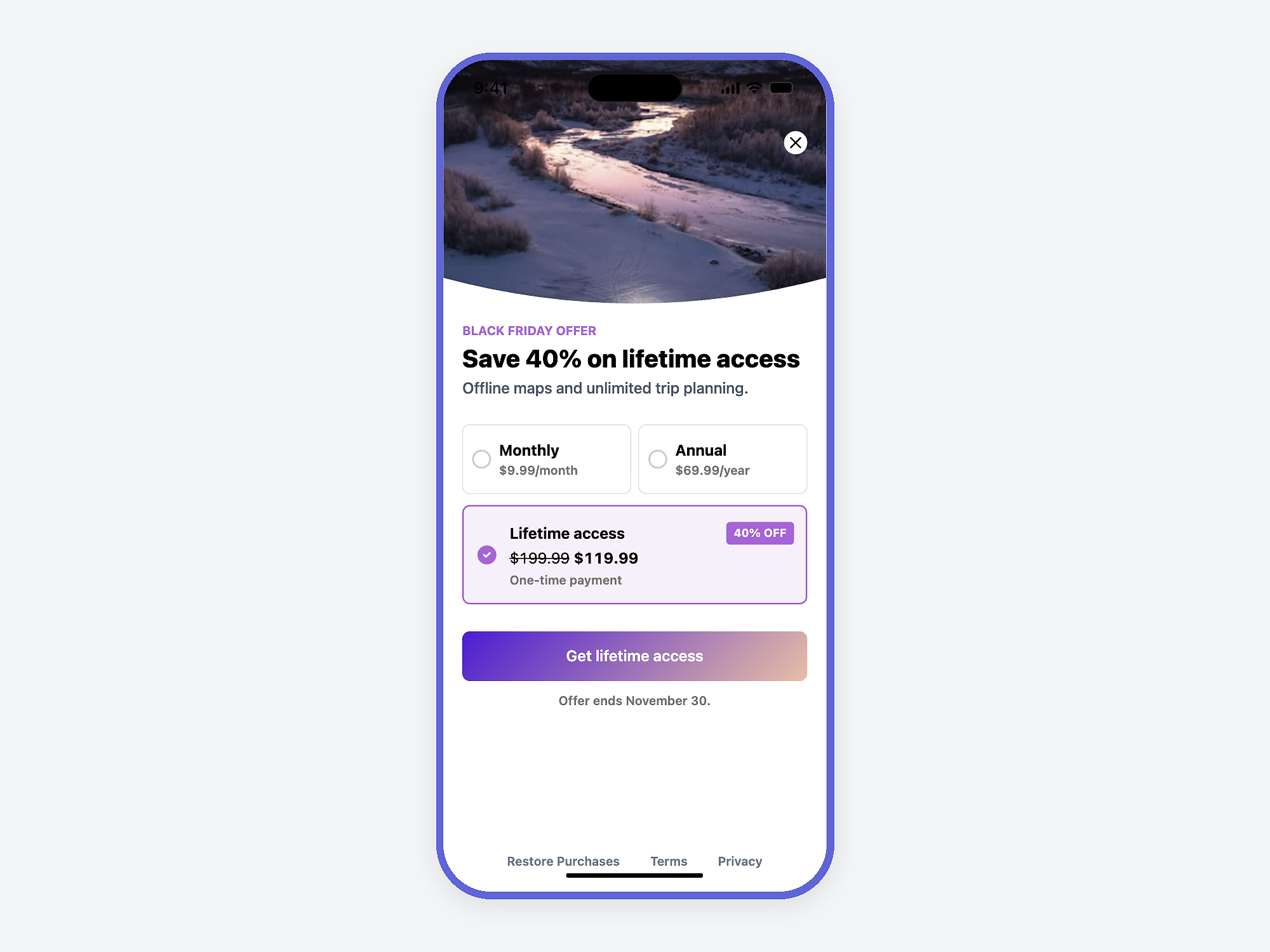
Finally, more holiday paywalls show a single plan (30–36%, versus 20% of ordinary paywalls). A single-plan offer screen removes the need to compare subscription lengths and may help focus the sale.
What to test in your next holiday campaign
Our data gives subscription apps a good reason to experiment with holiday offers. But there’s no universal playbook. Start with how users in your category behave, then adjust your approach for each holiday.
Gaming apps, for example, tend to do well around Christmas and New Year, when people get new devices and have time off. Fitness apps, on the other hand, pick up in January, once New Year resolutions start.
It’s also worth looking beyond net new users. During Black Friday week, about half of the increase in new paying customers came from users who installed the app more than three months earlier.
Converting existing free users, winning back past subscribers, and upselling current ones can all add revenue during this period.
Beyond timing and audience, a few parts of the offer are worth testing:
- Discount size: Most holiday paywalls that state a percentage go to 50% or more. A deep cut grabs attention, but it isn’t always needed. In January, for example, when more people buy even without an offer, a smaller discount might do the job.
- Urgency: About a third of Black Friday paywalls use limited-time wording, and one in five adds a countdown. Too much pressure can feel pushy, so test different nudges for each segment, such as showing long-time free users the premium features they keep running into.
- Lifetime access vs. subscriptions: A one-time plan appeals to people tired of subscriptions and brings in revenue upfront. Those buyers never renew, though, so price it with your annual subscribers in mind.
- Plan setup: Test featuring a lifetime option, focusing on a single offer, labeling one plan as the best value, or discounting a different plan length
- Price display: Holiday paywalls show crossed-out prices more often than ordinary ones, and many break down the price by week or month. Christmas paywalls also lean on gift wording and holiday emoji, so test which presentation fits your offer.
Put these ideas to the test
Build your holiday offer in RevenueCat Paywalls with AI or a template, show it to specific audiences with Targeting, and use Experiments to see which version brings in more subscribers and revenue.
How we collected the data
We analyzed 4,964 apps worldwide during the 2025–26 holiday season, comparing each app’s daily average of new paying customers with its own September 15–October 12, 2025 baseline. Apps needed at least 30 new paying customers a week in the baseline, and iOS and Android versions count as separate apps. A new paying customer is someone paying for an app for the first time, whether they installed it recently or had been using it for free.
- Holiday windows cover November 24–December 1 for Black Friday and Cyber Monday, December 15–25 for Christmas, and December 26–February 1 for New Year and January
- Promotion detection looks for increases in offer redemptions by new or existing subscribers, sale-named products or Offerings, lower prices on existing products, new cheaper subscription products, and holiday wording on RevenueCat Paywalls. Each signal must stand out compared with both the baseline and March 2026. Signals can overlap.
- Revenue and retention follow buyers for 180 days. Revenue is net of refunds and before store commission; cohort comparisons account for acquisition-window length. Annual renewals fall outside this follow-up.
- Paywall analysis covers RevenueCat Paywalls with holiday wording shown at least 100 times: 176 at Black Friday, 69 at Christmas, and 104 at New Year, one per app project. We compare these with 5,193 non-holiday paywalls shown October 13–November 9.
Results generally describe the median app; the install-timing split uses an average. Most promotion signals depend on purchases, so unsuccessful offers may go undetected.
The comparisons show associations, not direct proof that promotions cause growth or that particular paywall designs convert better.