
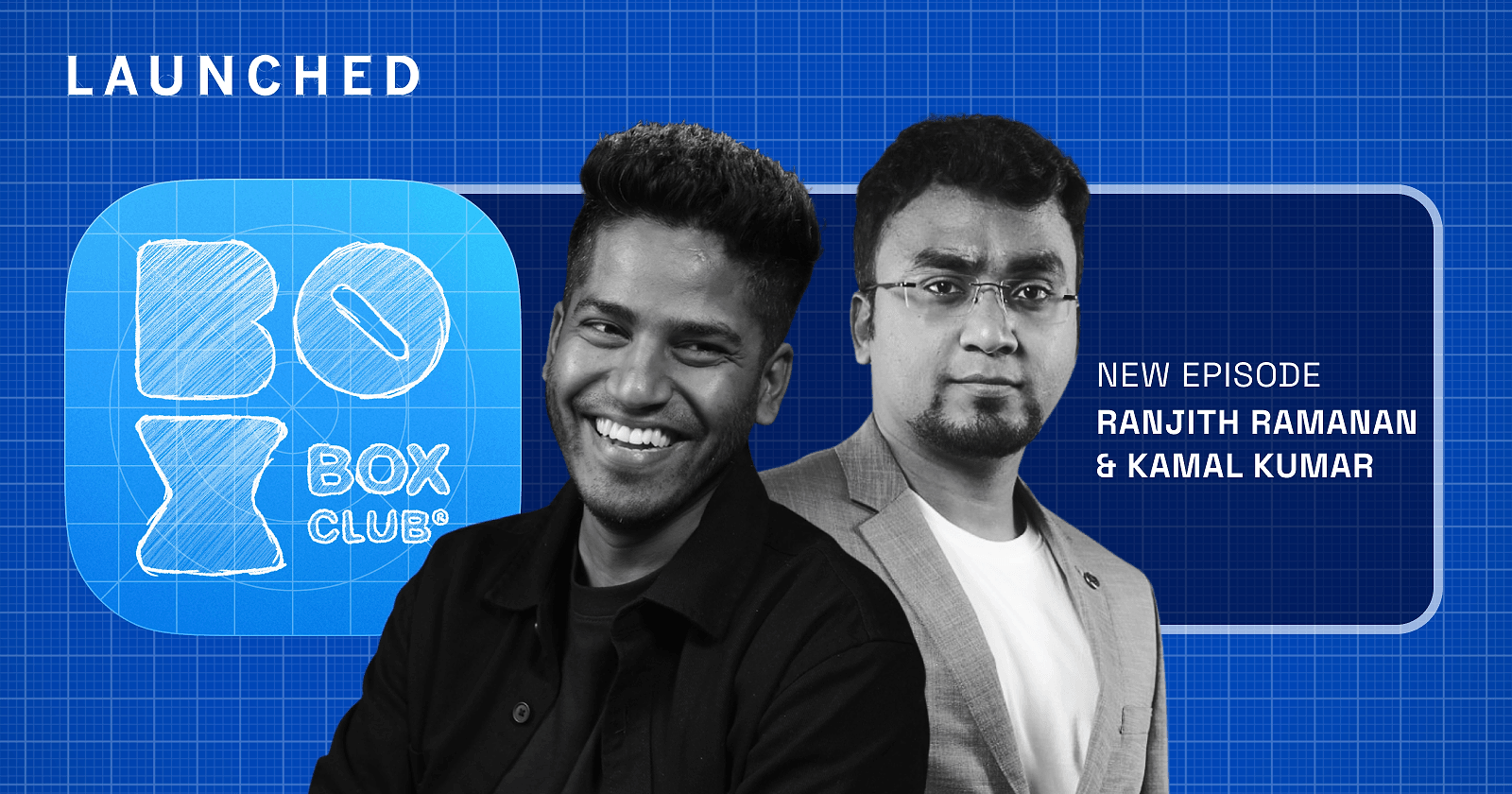
Box Box is the F1 widget app that Charles Leclerc has been spotted using and that the Mercedes, Haas, Aston Martin, and Alpine teams have all pointed their fans at. It was built by two strangers from Bangalore who met over a tweet, shipped it free in a month, and didn't quit their jobs until a Formula 2 driver asked to join the company. On this episode of Launched, Charlie Chapman talks to designer Ranjith Ramanan and engineer Kamal Kumar about how a side project for a sport they loved ended up with its logo on a race car.
Formula One noticed Box Box, and sent lawyers
Kamal is clear that there is no formal relationship with Formula One yet. The first interaction came from the other direction. "I think the first interaction that we had from Formula One was a legal notice that they sent us," he says. The app was listed as "box, box, club, F1 widgets," as Kamal says it, and F1 is a trademark. It also used the sport's official font, and photos of drivers and cars.
They read the rules, renamed the app, rewrote the App Store subtitle and description, dropped the font, and replaced the driver photos with their own 2D and 3D representations made with outside artists. None of which dented the mood. "We were quite happy about it, that it was not a huge deal," Kamal says. "We knew that, okay, formula one is actually noticing us." Ranjith puts it more bluntly: "Even if it was getting the legal notice. We were happy that they are using the product."
The relationship that did come was with Formula 2. Juan Manuel Correa, a former F2 driver, messaged Kamal on LinkedIn to ask what they were building. The founders had already turned down investors who talked only about money; after two or three calls they decided Juan shared the vision, and he joined the registered company's board as a strategic partner and brand ambassador rather than an investor. At the Abu Dhabi race he showed them his helmet, covered in Box Box logos, and the logo was on his car too. Charlie asks whether they paid for the sponsorship. They did not. "You imagine your logo on the products," Kamal says, "but then again, we saw it on a formula two car."
A Mexican fan's TikTok and a Mercedes tweet did the marketing
Neither founder had a marketing background, and their first guess about the market was India. Then the download spikes showed up in Brazil and the US. Kamal: "We were wondering, you know, why is this happening? How could this happen?" The answer was a fan in Mexico who posted the app on TikTok, a platform the founders couldn't even open from India. The video went to a million views and the downloads followed it across Mexico, Brazil, and the US. The first week brought close to 5,000.
The bigger wave came with iOS 16. Box Box already had home-screen widgets, so when Apple added lock-screen widgets the team converted its concepts and was live on day one. A share-your-lock-screen trend started the same week, and the Mercedes F1 account joined it, asking fans to post lock screens with Mercedes wallpapers. The screenshots carried Box Box's widget with no name on it. "The other Mercedes fans, they were like intrigued, like, what is this?" Kamal says, and the fans who knew answered them. "I think in that one week after the tweet, we had like 250,000 downloads." Haas and Aston Martin followed on TikTok, and the second viral moment arrived when a user spotted the lock-screen widget on Charles Leclerc's phone in one of his own vlogs.
Charlie's read on the TikTok moment is the lesson for anyone building something visual: luck was involved, but the app had to look good enough to catch an eye in a video before any of the rest could happen. Ranjith has a name for that. He designs for the first-open "wow" and for what he calls the multiplayer effect, where "you see the app and you become the UGC" and show it to the next person.
Users asked for a way to pay, so Ranjith designed things worth paying for
The first version had no paywall at all, on purpose. The founders added a WhatsApp support line, bought a SIM card for it, and answered every message, expecting feature requests. What they got was different. "The users were like, you guys are doing such a good job, I would like to pay you," Kamal says. "And you're like slightly taken aback." Charlie's response: it's always a good sign when your users are asking to give you money.
Charging came with a rule. So much had been given away that the founders refused to take any of it back from the community that had supported them, which meant the paid tier had to be built from new things: widget themes, an Apple Watch app, complications. The first goal was small, earning back the $100 developer account fee. The subscription was yearly and timed to the racing season, so a fan pays for a season and decides again the next year.
They priced it, as Kamal remembers it, at $5.99 a year, and users told them it was too little. "You are doing so much, but then you are asking so little," he recalls them saying. "Why don't you add like a place in your app where I can give you more money?" The answer was tiers through RevenueCat, including a higher-priced option, with lower-tier subscribers still receiving some of the new features. The end-of-season survey that settled the pricing drew around 5,000 to 6,000 responses, which Ranjith admits he pads with eight or nine questions when he only wants two or three answers.
Ranjith hides new designs from Kamal, because Kamal builds them overnight
The two met because Ranjith, a designer who doesn't code, posted an F1 widget concept on Twitter after every developer he knew turned him down. Kamal replied: "bro, I'm interested." They had, it turned out, been sharing a wallpaper album with a mutual friend for a year without ever speaking. Ranjith's due diligence was Instagram, where he found a photo of an F1 car tattoo and decided, in his words, "he is the person."
They built the first version in about a month, working, as Ranjith puts it, like Batman: after his US work calls ended at 10 p.m., messages from 11 until 3 or 4 in the morning. The working relationship has one quirk. Kamal is so keen on the sport that if Ranjith shows him a half-finished concept, there's a build in his inbox the next morning. "So I need always to hide from him any new future," Ranjith says. "I'll hide him. And until I finally myself. Oh, this is fine to show him. Then I'll put it there."
Charlie's takeaway is one he gives often on the show: a designer-and-engineer pair forces the design to happen before the code, and the engineering problem of making a beautiful design work is more fun than designing around what's easy to build. Kamal agrees from the other side. The healthcare and fintech apps he'd built before were, in his word, boring; Ranjith's designs were what kept him up at night.
There's more in the episode: the Apple developer centre email that looked so much like spam that Ranjith half expected a kidnapping when he drove there, the day both founders quit their jobs, the end-of-season beta trick that gives fans a cliffhanger, and why the team's second app, Go Club, is blue.
Guest links
- Ranjith Ramanan on LinkedIn
- Kamal Kumar on LinkedIn
- Learn more about Box Box Club
- Learn more about GO Club
- Learn more about Arkade Club