
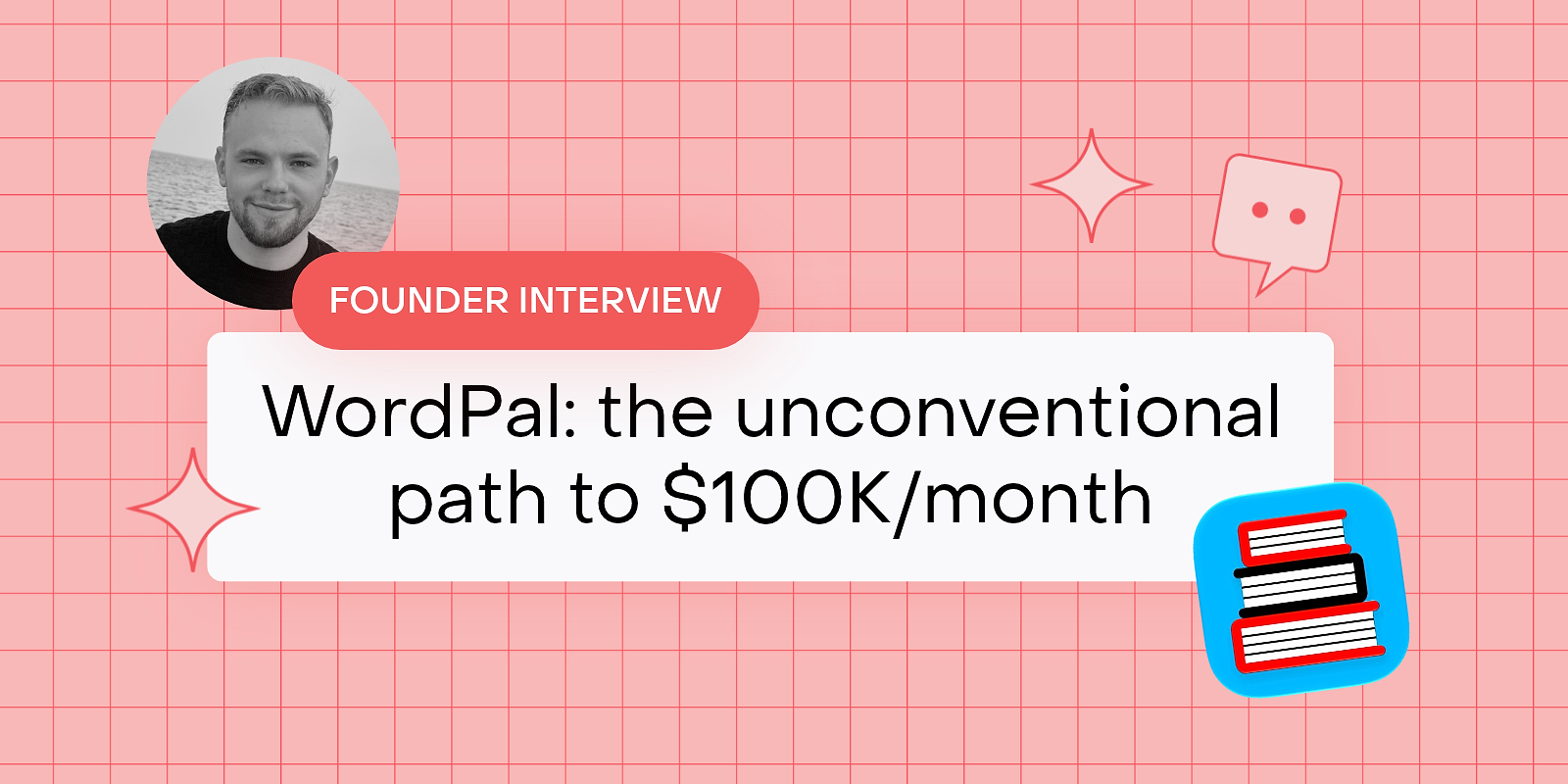
Most teenagers spend their summers gaming. Owen shipped two apps.
By 15, Owen Farmer, Founder of Dynamic Apps, had not only built two apps but shipped both: SpeakTimer, a timer app that uses voice reminders to help with effective time management, and WordPal, an app designed to help native English speakers improve their vocabulary and learn new words.
This was all by 2019. I was already a few years into the industry, and Owen hadn’t even finished school.
It’s an incredible story of someone who is now just 22, yet has nearly nine years of industry experience — and took some unconventional routes along the way.
Having spoken to Owen multiple times at different events, I was intrigued by this young founder who’d already had such an impressive growth journey. So I sat down with Owen to learn more.
At first, it felt like he was downplaying himself, comparing his journey to founders of much bigger apps (an actual humble brag). I tried to remind him that so few apps even reach this stage. Fewer than 5% of apps ever reach the $10k/month mark within their first two years. So to do all of that with no prior experience, straight out of high school, is pretty impressive.
While it’s not the classic growth story, I think it’s one worth listening to. We often talk about best practices, what to do and what not to do. But as Julie Hansen of Babbel said at App Growth Annual 2026, sometimes, the unconventional route is the right one. And who knows? It might inspire you to take a different path on your own growth journey.
Unconventional move #1: He built two apps at once
This is honestly the last thing I’d ever recommend to a client. I’m always telling people to do less and focus their efforts.
When I asked Owen why he chose to launch two apps, and about that initial product-market fit, he laughed. He didn’t even know what product-market fit was at the time. Fair point.
“I’d be lying if I said there was a huge strategic decision behind it.”
The reality was that he had two ideas, and he enjoyed building. He built the first one, SpeakTimer, which delivers customized voice reminders set to your timers. Then after seeing how hard it was to learn all the vocabulary needed for the 11+ entrance exams (a standardized exam for 10- to 11-year-olds to get into a grammar or private school in the UK), he decided to build WordPal as well.
After launching both, he quickly saw that his first app, SpeakTimer, was getting only a few downloads a day. WordPal, by comparison, instantly outperformed it.
It wasn’t strategic, but it taught him a lot. He built SpeakTimer in the hope that people would come. It solves a problem people might not even know they have, which can make marketing trickier. With WordPal, he was launching into a market with existing search demand, so he focused on App Store optimization (ASO) from day one.
“There’s the whole ‘build it and they will come’ fallacy every founder goes through. I learned that with SpeakTimer… [With WordPal], I didn’t have to generate demand from scratch. I could capture existing intent.”
Ironically enough, while we all talk about the importance of focus, he’s kept SpeakTimer alive despite its initially slow revenue. And it’s proved useful over the years, giving him a safe space where he could trial the switch to subscriptions before rolling it out on WordPal.
“It was a big change, so I did it to my SpeakTimer app first… that was kind of like a little trial run.”
He sees it as a testing ground rather than a distraction. And while the focus advice still holds — Owen says himself that he can’t give both apps equal attention, and he doesn’t actively work much on SpeakTimer — he’s learned a lot from actually running two.
Unconventional move #2: He didn't monetize for years (and then did it ‘wrong’)
In those initial years, WordPal was completely free. There were no ads, no in-app purchases, and his running costs were minimal: £80 a year for an Apple Developer Program membership and a bit of software.
A lot of parents invest in their kids’ sports clubs. But Owen’s parents invested in making sure he could run his app.
“When I started, I wasn’t even trying to make money. I was just doing it for fun.”
Normally, I advise people to monetize early, because free and paid users behave very differently. But Owen didn’t need the revenue. He had virtually no costs. Instead, he needed signal and reviews, so he stuck with a free app. That helped him build up its reviews and, as a result, his main growth channel: ASO.
“I was reluctant to put ads in for a while because I wanted to build up good reviews.”
Being bootstrapped and running WordPal alongside school, leaving WordPal free made sense. Even though he didn’t know what product-market fit was at the time, Owen was unintentionally focusing on PMF by ensuring his app did a good job of meeting the market’s needs — which he could track through reviews.
Once he was 17, Owen decided to try monetizing WordPal. Again, nothing fancy: £2.99, later £4.99, as a one-time lifetime purchase. No onboarding, no paywall on open. After someone had been using the app for a while, the paywall would appear, and roughly 1,000 people upgraded.
He deliberately avoided subscriptions because he was still in school and didn’t want the maintenance obligations that came with them.
It was only once he left school that he switched to subscriptions, charging around $30 a year. By the time he made that change in late 2022, he’d spent years optimizing the product and experience, helping him grow to $30,000–$40,000 a year, almost entirely through organic growth.
“I was obviously way underutilizing monetization by having a £2.99 or £4.99 one-time fee.”
I asked how he dealt with existing one-time purchases, expecting it to have been a headache. Many apps going from OTP to subscription push existing users to upgrade, but Owen explained he simply grandfathered existing users in. And very generously: they kept everything they’d already paid for, plus got a heavily discounted subscription rate. And there was no obligation to switch.
As a result, nobody complained, but many upgraded. It’s a powerful example of how you can make a major monetization or price change without burning trust. It is possible, guys!
“I kept them grandfathered on that plan because that’s the fair thing to do.”
Unconventional move #3: He skipped university
Owen was a star student. Literally: he got four A*s at A-level and was set to apply to Oxbridge (that’s Oxford and Cambridge for those of you across the pond). Put simply, Owen is extremely smart. But despite what some of his teachers advised, he chose the app business, and decided to work on WordPal full-time instead.
I was curious what his parents thought of all of this, having experienced plenty of parental pressure to go to university myself. I loved hearing that his parents posed university as an option, rather than a must.
His parents have also been part of WordPal every step of the way. In the beginning, that was helping with the early app content, design, and testing. Later, the accounting and the data side of things. But more than the practicalities: Owen calls them the biggest support of the whole journey, and it clearly shows.
Owen’s thought process at this point was fair enough: if I can make this much while building two apps part-time alongside school, earning a few thousand a year as a 17-year-old, what could it become if I focused on it fully?
The teachers who knew him backed him. It also allowed Owen to learn through real-life scenarios, applying it straight away, rather than the classic school approach of revising for the future. You can spend forever studying, but so much of that formal theory can turn out to be wrong — or simply relevant to a different stage of growth.
“There's so much advice about apps, and a lot of it can be right — but for different stages. VC-backed is different to bootstrapped, and [getting to] the first million is different than [getting from] one to 10 million.”
In my eyes, Owen didn’t really skip university. If the goal of higher education is to expose you to new ways of thinking, expand your knowledge, and gather new skills, then I’d say Owen enrolled in the University of Apps. Today, nearly half his life has been spent building them.
Unconventional move #4: He did everything himself (including the stuff ‘you need an expert for’)
Whenever you start exploring a paid channel like Meta ads, the advice is usually to bring in an expert. There’s so much to it, with endless nuances to learn.
As you might have guessed by now: Owen never did this.
Whatever he touched — ASO, then Apple Search Ads, and eventually Meta — he always learned to do it himself first.
His initial growth came organically, but at a certain point, that wasn’t enough. So he started building on it with Apple Search Ads, which became a real growth lever for him at the time.
It was hyper-relevant to his audience, given there weren’t many direct competitors in the space. It also allowed him to outbid Grammarly-sized companies by playing on efficiency: his keywords were more relevant, which gave him a better return and fueled his initial paid growth.
When Owen started, he knew nothing about Apple Search Ads. So he built his own structure for learning a new channel: create a personal handbook, work through guides, YouTube videos and podcasts, then turn that theory into practice before too long.
Not learn-forever, but also not winging it.
“I like to make an initial handbook for myself by listening to loads of resources… then as I start, I can refine my own knowledge based on what I see.”
At that early stage, having an ads agency simply didn’t make sense for a bootstrapped company.
“If you're paying an agency, your ROAS has automatically gone down.”
For example, in the beginning, even $5,000 a month in ad spend can be a lot for a startup. Add a $3,000 a month agency fee on top, and your acquisition costs have just jumped from $5,000 to $8,000, meaning the agency needs to perform around 60% better than you would alone just to break even on their fee. Compare that to a later-stage company spending $50,000 a month on ads with a $10,000 a month agency: there the agency only needs to perform around 20% better to be worth it.
There’s a deeper reason for doing it yourself first, too — one I’ve heard from other founders who have taken a similar approach. You learn what to look for when you eventually do hire. You understand the bottlenecks, what good looks like, and what does and doesn’t work.
Owen had even heard the same advice from agencies themselves:
“I've literally had agencies tell me this, they said do it yourself to start off with. Otherwise how are you going to know who's a good agency? How are you going to know what to look for if you don't have a clue how it works?”
Apple Search Ads did more for him than just bring in installs, though. The extra volume meant he could test paywalls and onboarding much faster, with bigger sample sizes, and get his unit economics correct before he ever touched colder traffic.
That’s also why the move to Meta eventually made sense.
ASA stops scaling once you’re forced into broader, lower-intent keywords, where you’re suddenly competing with the Grammarlys of this world. And CRO can only take you so far. Once the LTV was strong enough, Meta, with its much higher ceiling, became the logical next step.
The results speak for themselves. Meta helped him reach $25,000–$30,000 a month within months, and his first $100,000+ month came in January 2026.
Rather than being anti-help, Owen sees this as hiring with purpose. He knows that, at some point, he’ll need to bring other people on board. He already has help, including Louie, an old school friend who became his editor, a creative strategist, and occasionally some lexicographers.
“I hire when there's a problem… a lot of companies hire proactively and then end up sacking a lot. Hire with a purpose.”
Doing it yourself does have a shelf life, though. At a certain point, it starts to hurt you.
Yes, as a founder, you’re the person who cares the most. Yes, you know the business better than anyone. But you can’t become an expert in every area, and eventually, being spread too thin means that your knowledge doesn’t outweigh the results you could get from someone who specializes in it.
For the early phase Owen was in — running a business focused on sustainable growth rather than speed — this approach made a lot of sense. He admits that, in hindsight, he wishes he’d started Meta sooner. But the years he spent working on the product and figuring out the numbers through Apple Search Ads meant that when he did start testing Meta, he already had strong LTV to work with.
Unconventional move #5: Big swings over textbook testing
One of Owen’s biggest regrets wasn’t a channel, wasted spend or a bad hire. It was the time he wasted on too many nitty-gritty optimization tests.
He’s never really had a win from small changes, and he learned first-hand that small uplifts need far more data to prove themselves. You can end up waiting weeks or months, only to learn nothing.
“If there's one mistake I could go back and fix, it was changing little things. I don't think I've ever had a win from changing little things, and I wasted all that time.”
He knows that everyone recommends testing one thing at a time and waiting until you hit 95% significance. But rather than following that textbook approach, he focused on big swings.
Bundling small changes into meaningful experiments — for example, a completely new paywall — meant that even if four out of five changes were good, he could still see an overall uplift.
Setting success metrics, Owen settled for 90% significance, accepting a higher risk of calling a false winner. But if most of his calls are right, the wins compound.
“Sometimes you've got to just go on what's happening — vibes, as crazy as it might sound. And this is someone who was very maths-y at school.”
Now, he did admit that this isn’t the ‘variant A had 100 visitors and 20 converted, variant B had 30 convert — we have a 50% winner!’ school of testing. No, you need more data than that, and you also can’t claim a 50% uplift from numbers like those.
Owen de-risks his swings first, or tests on SpeakTimer. That way, if it tanks, the loss isn’t as big.
“I do a pre-run on maybe 10 or 20% of traffic, so if it dropped conversion in half, I only lose 5% overall.”
I asked him about learnings. Specifically, could you really be sure why something did or didn’t work if you tested so many things at once?
He said that while learnings are valuable, revenue matters more. He can’t always say with confidence exactly what worked and what didn’t, but he can see whether an experiment made a meaningfully positive or negative difference. He also tries to bundle changes with the same underlying motive, so there’s still something to learn from the result.
He found that these big tests taught him far more than following conventional wisdom and hoping it would work. A lot of the advice out there, like people needing to try the product before seeing the paywall, simply didn’t make a difference for him.
“The performance just wasn't what I expected. It was actually worse.”
The same went for tweaking copy… I know, ironic for a word app.
“I’ve seen a text-heavy onboarding screen where the average time spent was about one second. People spend less time reading these screens than developers might expect.”
Instead, focusing on the visual aspects and really improving the structure had a far bigger impact.
So how does he decide what’s worth a swing?
Benchmarks, mostly — taken with a grain of salt. If a particular paywall style is working well across the industry and yours looks nothing like it, that might be a sign that other apps have discovered something. That’s worth a proper swing rather than another round of tiny tweaks.
That’s exactly how he ended up moving to a multi-stage paywall, splitting the trial, reminder, and pricing across separate screens so people only have to process one thing at a time.
Unconventional move #6: He didn't let AI become the strategy
AI has made ‘creating more’ far too easy. More features, more ads, more content… in less time than ever before. Owen has seen too many apps jumping on the AI bandwagon, building 10 features with AI in three months and creating future busywork for themselves in the process.
"AI has actually propagated the busy fool problem. So many people flex on LinkedIn about all these AI things they've built and I'm like — where's the revenue?”
Building the right things, the things you have actual evidence your users want, based on insights and data, is far more powerful.
Owen’s not anti-AI by any means. He uses it to support the coding and creative process.
“I think about what I would do from a business strategy point, and then if AI can speed it up, I'll use AI.”
The same thinking shows in his content. When Owen started out, WordPal had just 100 words. Over the years, he carefully built it up with the support of expert lexicographers. For something as human as language, that care and precision are what people pay for.
It’s a pretty good summary of Owen’s approach throughout his journey: use the tool to accelerate the strategy, rather than letting the tool become the strategy.
Unconventional move #7: Not growing at all costs
You might be wondering at this point why I’m highlighting an app that has taken eight years to get close to $1 million a year, which is where Owen is now.
Because I agree with something Owen believes, that’s at odds with so much of growth culture. (Yes, this is me, a growth advisor, saying that growth isn’t the only goal.)
There are other ways to grow. There are other ways to be successful than trying to scale as fast as possible.
I’ve worked with bootstrapped companies before, run by a few founders who are building a business that supports them as individuals, rather than building something that leaves them working all day and miserable in the process.
It’s the same for Owen. He’s in a niche market, and he’s happy about it, because his goal isn’t a huge team or a big office. It’s a profitable business that funds his life and allows him to do the things he loves.
“Why do I need to get a $10 million investment for a vocabulary app?”
I met Owen because he goes to so many conferences to invest in himself — to learn, to grow, to have those conversations. But he’s chosen to take things slower and build a sustainable business, versus chasing hyper-growth. He’s never sought outside financing, beyond getting a bit of help covering short-term revenue gaps while waiting for Apple payouts so he could keep scaling his ad spend. Yet throughout it all, he’s still remained focused on profitability.
“I want a balanced life… I'm not going to let work sacrifice my health and relationships and family. That's not a trade I'm willing to make.”
He recently increased his prices and focused on driving annual subscriptions, accepting a dip in retention because it allowed him to remain confidently profitable.
I get that.
I’ve had the same experience with my consultancy business. I could work more hours and earn more money, but I value being able to go for a bike ride on a Friday morning or take my dog for a long walk in the forest.
Maybe that doesn’t look like growth to everyone.
But it’s growth on his terms.
Curtis Herbert made a similar case on the Sub Club podcast, explaining how he grew Slopes to $1M in ARR over nine years without outside funding.
What's next: crossing the million on his own terms
So what does the future look like if growing at all costs isn’t Owen’s goal?
He’s approaching a tricky milestone: the $1 million mark in annual proceeds, where Apple’s commission increases from 15% to 30% because he no longer falls under the App Store Small Business Program threshold.
This isn’t about trying to avoid Apple’s fees or deliberately staying small to dodge them. It’s about knowing that, once he crosses that threshold, the maths needs to work.
He’s already running those calculations and focusing on improving the funnel so he can continue scaling past that point.
“There's no point doing more work to make less profit.”
He does hope to grow beyond that, but not for the sake of growth alone. Only if it makes sense.
Maybe one day he’ll work on a different app. Maybe he’ll stop working on WordPal altogether. But for now, he’s growing it slowly and steadily, in a way that works for him.
He’s not even actively pursuing Android growth for WordPal, because he knows it’s a bigger job that would require more staff. He’s happy having a profitable business where he’s learning, growing, and making an impact.
He knows there’s still plenty of room to improve: pricing, paywalls, onboarding, retention. That’s where his attention is going. And I think that’s the real lesson from Owen’s unconventional route.
The worst thing you could do is read this story and think, “Oh, I have to do this too because I want to be unconventional.” Instead, see it as proof that the standard playbook encodes someone else’s context — their funding, team, pressure, stage, even their life goals. It isn’t the only way to build a business.
Owen’s edge isn’t about being controversial for the sake of it. It’s about knowing his own context and being willing to question the playbook against it.
In some ways, I think Owen misses being that 15-year-old who built an app for fun and fell in love with coding, developing, and creating. He says it himself:
“When I first started, I didn't care about the revenue at all. I just loved making the product… I miss that feeling.”
That’s a feeling he wants to get back to, and I think he will: he’s deliberately built time into his business to keep improving the product, even when those improvements are harder to measure. He’s still focused on making WordPal a genuinely good product and experience, rather than growing at all costs.
I’ve told him that if anyone tells him he needs to follow a more ‘conventional’ route, he should remember that there’s already plenty of evidence that his own route works for him.
I can’t wait to see where his journey goes next. And I don’t know about you, but I’m highly impressed by what a 22-year-old has already achieved.