

Apple's Retention Messaging lets apps show a message or offer when subscribers go to cancel through App Store settings. Apps can use it to offer a discount, suggest a different plan, or remind subscribers what their subscription includes.
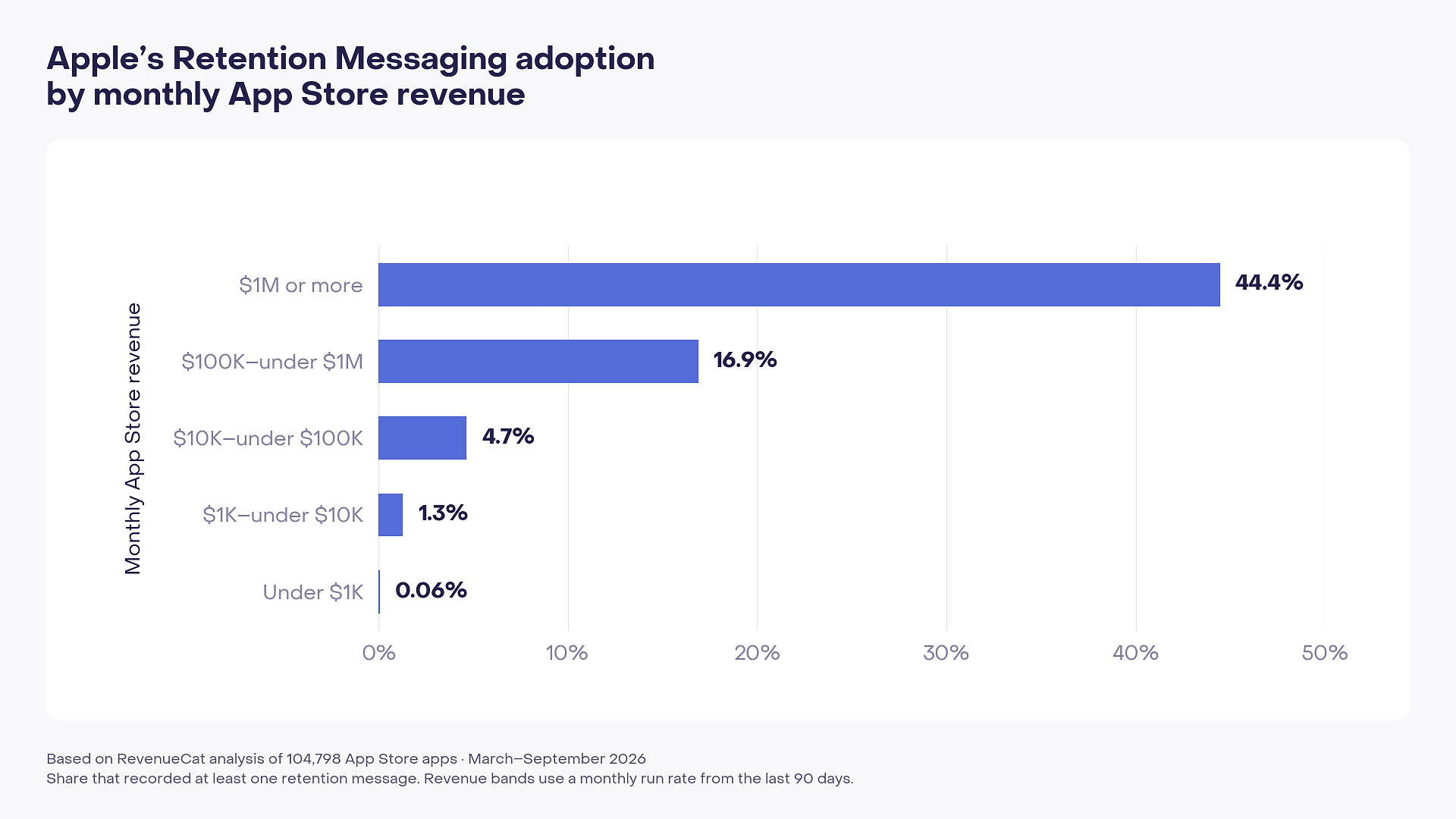
The biggest apps are moving first. Nearly half of apps tracking $1 million or more in monthly App Store revenue through RevenueCat have tried it, even ahead of the wider rollout.
We analyzed 22 million recorded messages across 309 apps to see how they set up their messages, how often subscribers leave without canceling, and how much those results vary.
Tip
The apps in our study have early access to the real-time Retention Messaging API and use it through RevenueCat. Developers can currently request access from Apple, with a simpler App Store Connect version coming this fall.
Larger apps are getting an early start with Retention Messaging
Among App Store apps using RevenueCat, 44% of those making $1 million or more a month have tried Retention Messaging through RevenueCat. That falls to 17% for apps making $100,000–$1 million a month, and below 5% for smaller apps.
For a large subscription business, even a small improvement at cancellation could affect thousands of subscribers. But these figures also reflect an early rollout: apps currently need Apple's approval to use the real-time Retention Messaging API.
Smaller apps can request access, too. Once Apple approves the request, RevenueCat handles the server side. You'll still need to pass Apple's performance test and get each message approved before it goes live, so build that into your timeline.
What a typical save rate looks like
The save rate shows how many subscribers who see the retention message don’t cancel within 24 hours, or take the offer instead. If you use RevenueCat, this is the same metric as the App Store Save Rate in Charts.
At the median app in our analysis, it was 17%, or 17 in 100 subscribers. That's based on 309 apps that showed at least 100 messages between March and September 2026.
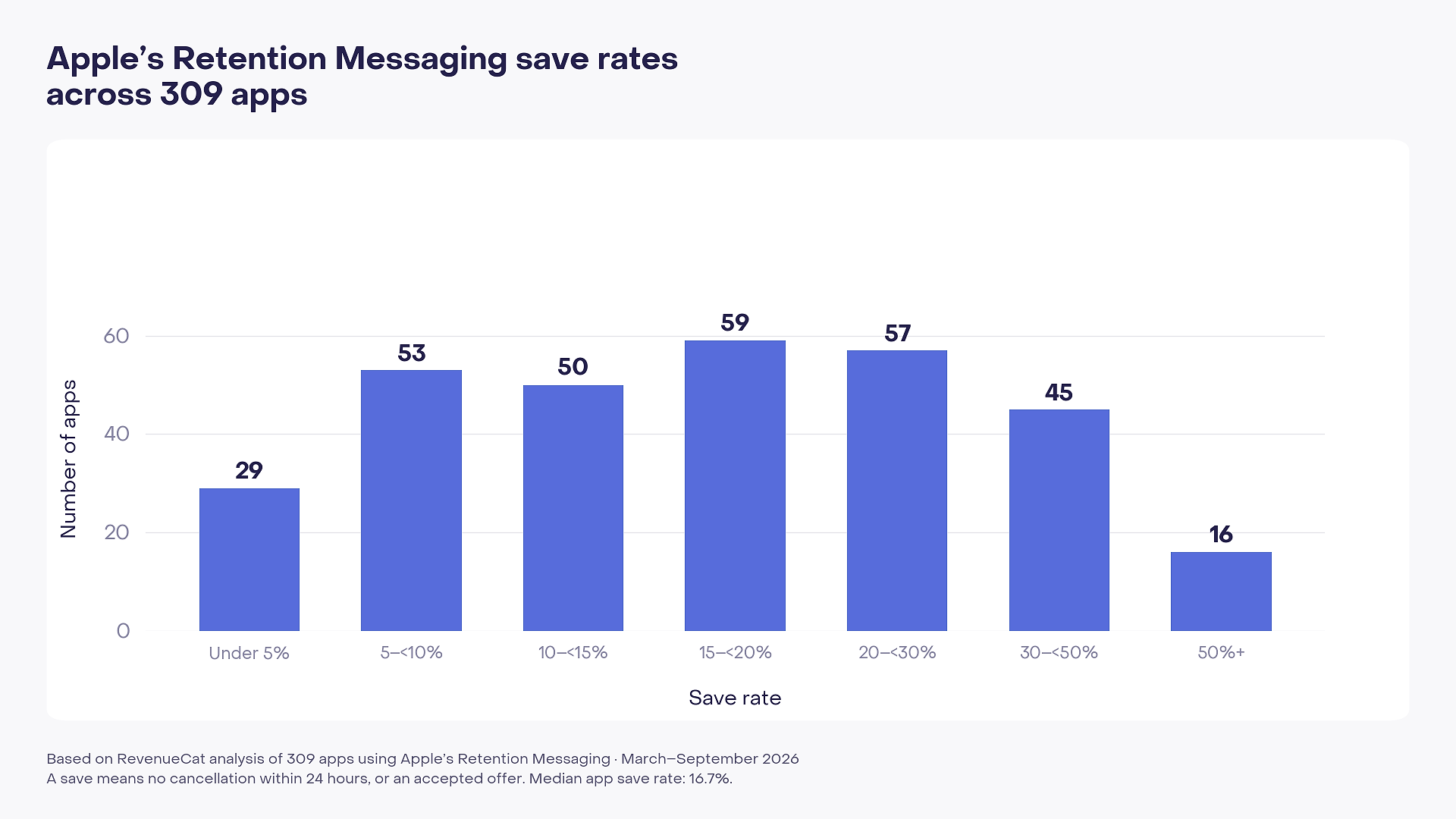
The range between apps is wide. At a quarter of apps, fewer than 10 in 100 subscribers didn't cancel. At another quarter, more than 27 in 100 didn't. And at the top 10% of apps, it was 42 or more.
The save rate is a useful benchmark, but a limited one. It doesn’t show how many subscribers stayed because of the message, since some would have stayed anyway. Someone who cancels a few days later still counts as saved, and the metric doesn’t track whether they renew. (The cancellation data below points the same way.)
Most apps offer a discount or plan switch, but few subscribers accept
Almost nine in 10 apps (87%) in our analysis regularly show subscribers a discount or plan-switch offer when they try to cancel. Yet subscribers accept fewer than one in 100 of those offers.
Apps combine offers with text messages in several ways. The most common setup pairs text messages with promotional offers (27% of all 309 apps), followed by primarily promotional offers (22%). Another 38% use setups that include plan switches.
Together, these groups account for 87% of apps; the remaining 13% primarily use text.
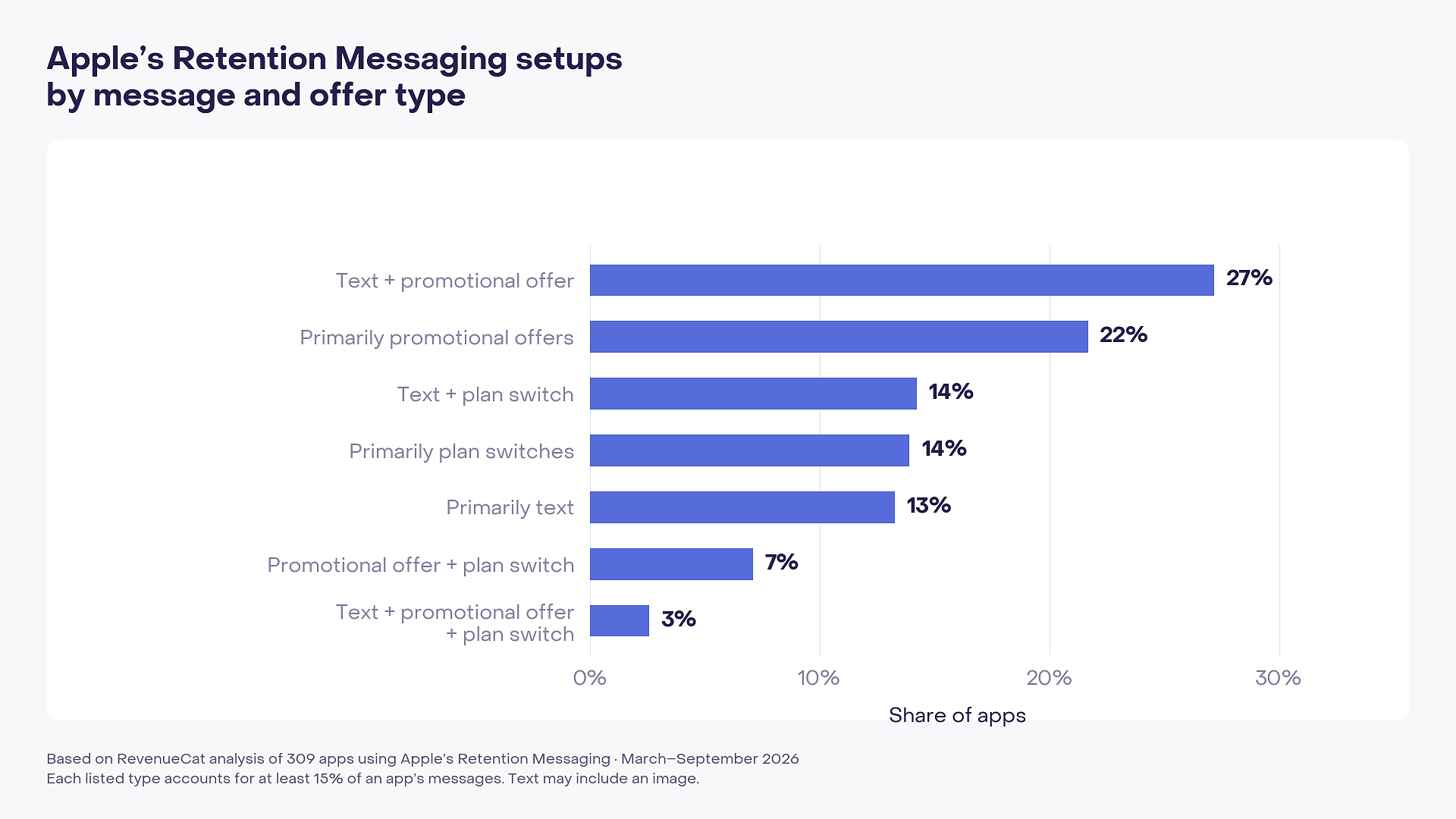
We count a message type for an app only if it makes up at least 15% of the messages the app sends. So an app labeled 'promotional offer only' may still send a few other types. Text messages may include images. Percentages are rounded.
Across these apps, subscribers saw about 4.3 million promotional offers and 1.3 million plan-switch offers. They redeemed roughly 29,000 discounts and accepted about 7,000 plan switches: acceptance rates of just 0.68% and 0.52%, respectively.
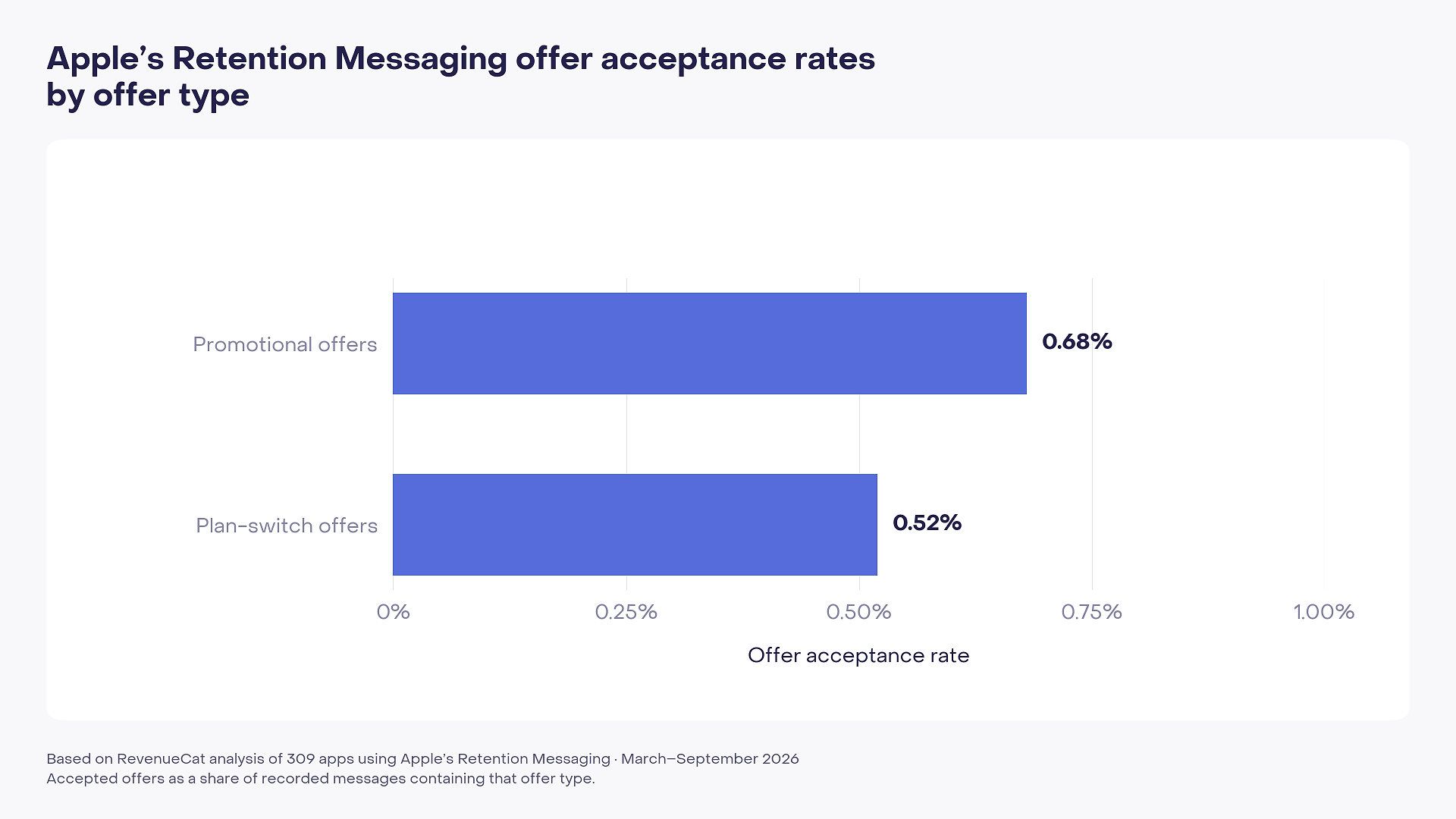
In other words, subscribers rarely take the discount or switch plans, even though most apps offer those options. Most recorded saves happen without either: the subscriber doesn’t accept an offer, but also doesn’t cancel within the next 24 hours.
One possible explanation is that subscribers are still deciding when they reach this screen. Some may reconsider or postpone canceling without taking an offer. For developers, it’s also worth testing messages that explain which features or benefits subscribers will lose if they cancel, alongside messages offering a discount.
Early data shows no clear effect on cancellation rates
In our analysis, cancellation rates fell at many apps after they introduced Retention Messaging. But comparable apps not using the feature saw even larger declines.
We looked at 64 apps with at least 500 paying customers and compared paid cancellations (excluding trials) in the three months before launch with the launch month and the two months after.
Of these apps, 34% saw their cancellation rate fall by at least 10%, compared with 46% of comparable apps without Retention Messaging.
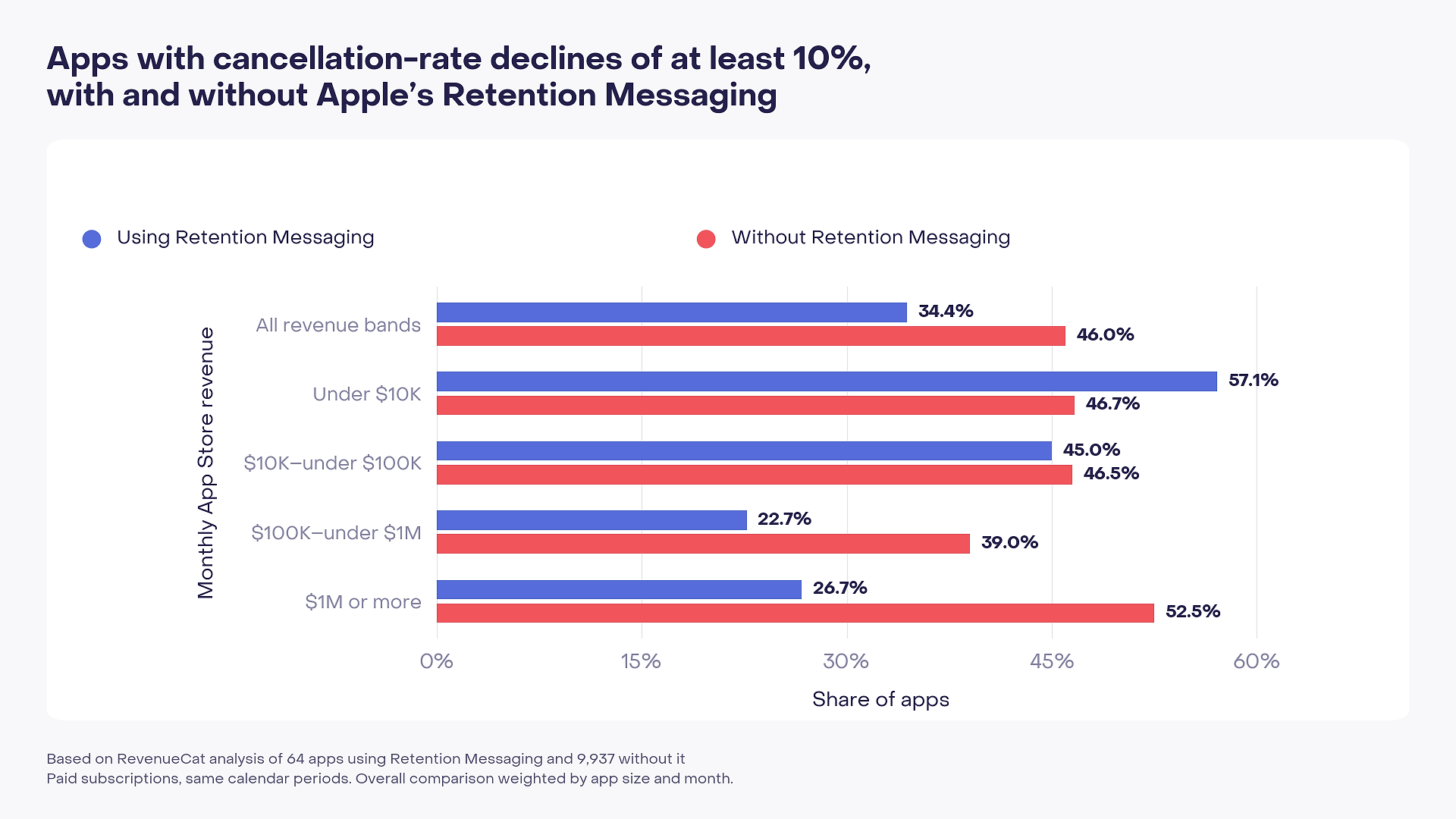
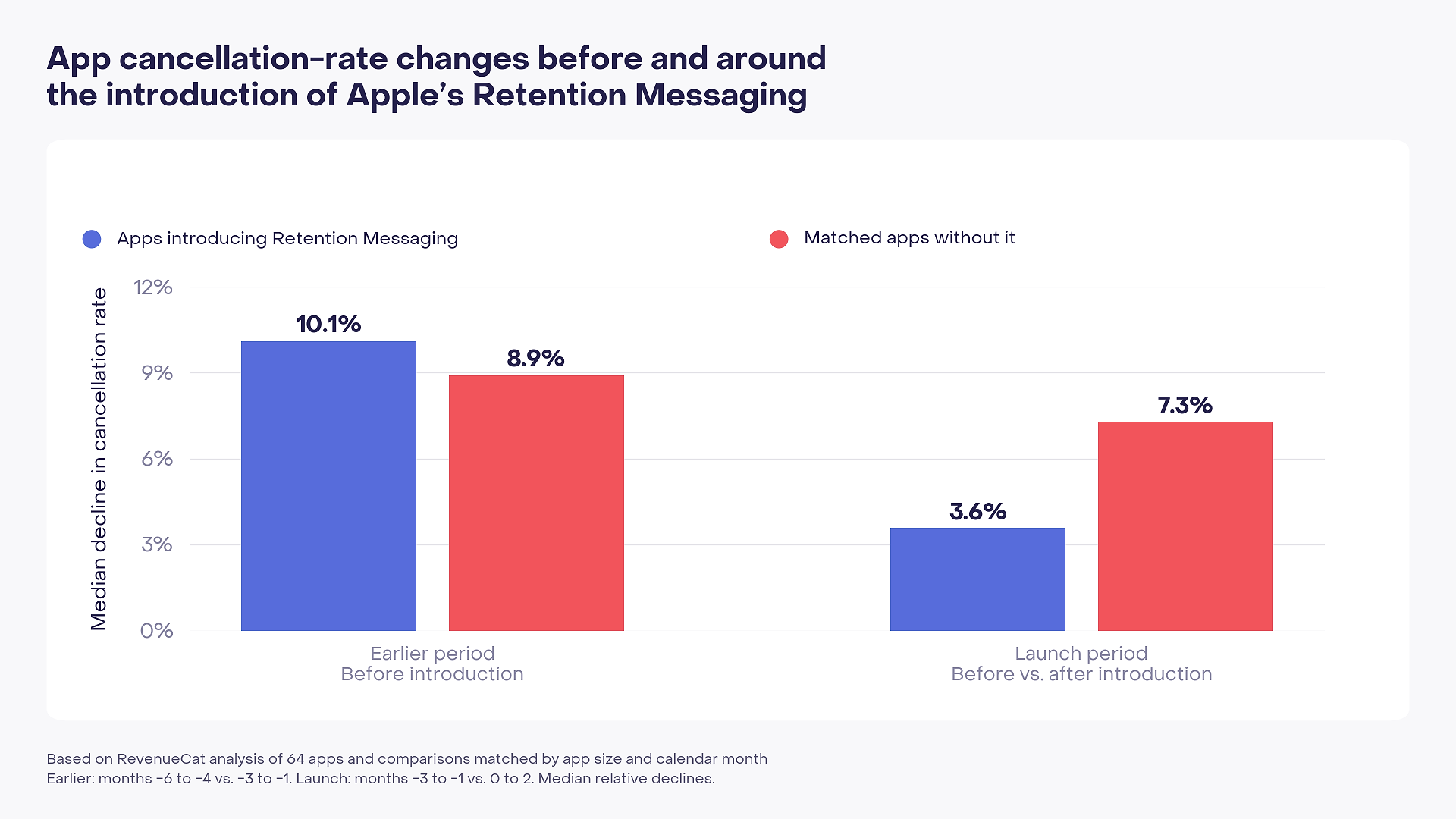
Besides, both groups were already on a similar downward trend before launch.
Afterward, cancellation rates at apps using the feature fell less than at comparable apps without it: 3.6% versus 7.3%. With 64 apps, a gap this size could easily be chance, so the data doesn’t show a measurable effect either way.
The next step is testing Apple Retention Messaging in practice
Our early data doesn't show a clear, immediate reduction in cancellations from Retention Messaging. We're already working on experiments to understand its impact more directly, and we'll share those findings as they come in.
For developers preparing to try it, the best strategy is to compare different approaches before making discounts the default. Low offer acceptance doesn't necessarily mean the discount needs to be bigger. Price may not even be the issue.
Start with what you know about why subscribers cancel, drawing on cancellation surveys, support conversations, and product usage. Then test messages that address those reasons: a discount for affordability concerns, a different plan for subscribers whose needs have changed, or a reminder of useful features they may have overlooked.
If you do offer discounts, be selective about who sees them. When every subscriber who opens the cancel screen gets one, some may learn that starting to cancel is an easy way to get a lower price. With RevenueCat, you can control who sees an offer, for example by excluding subscribers still in a free trial or those who've already redeemed an offer. Setting up Retention Messaging directly in App Store Connect doesn't offer this kind of targeting.
RevenueCat’s Retention Messaging Experiments, now available in the RevenueCat dashboard, lets you test up to four messages against each other to see which works best for your app.
Track renewals and revenue alongside the save rate to see which message keeps subscribers through their next payment. If you're still waiting on Apple's approval, you can prepare your messages in the sandbox environment. Learn more here.
About the data
This analysis covers Apple Retention Messaging activity recorded through RevenueCat from March 22 to September 20, 2026, with data compiled on September 24.
We identified 406 apps with at least one message. Save-rate and message-setup analyses include the 309 apps with at least 100 messages, totaling 21,960,020 recorded messages. Messages are counted once per subscription per day, so the total does not represent unique subscribers.
The median and percentile benchmarks give each app equal weight. Message-type setup groups use a 15% threshold. Adoption shares compare apps that tried the feature with App Store apps tracking revenue through RevenueCat in the last 90 days.
These are early participants in Apple’s access program, not a representative sample of all subscription apps. The analysis describes recorded outcomes; it does not establish that messages caused subscribers to stay or renew.