
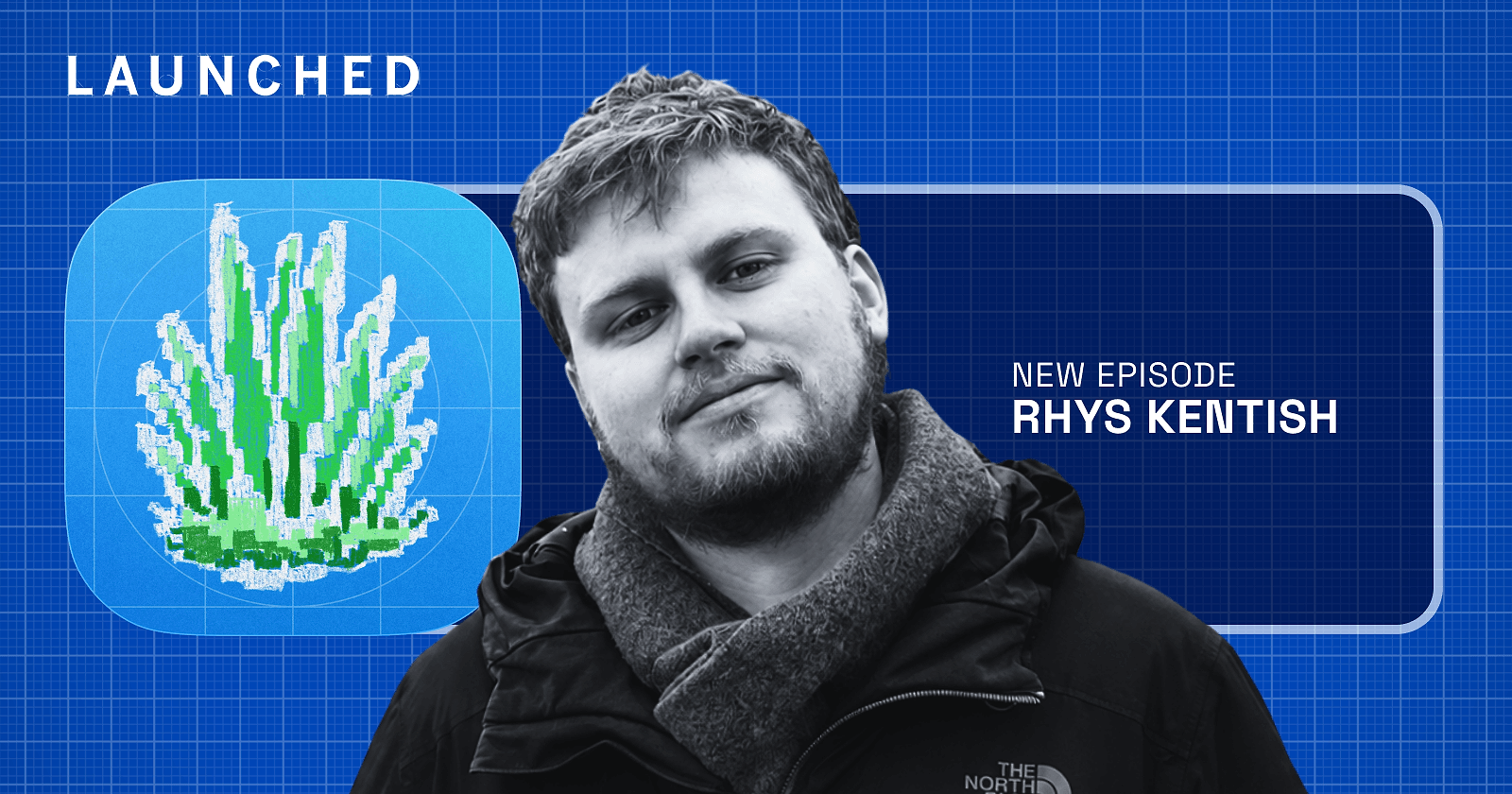
Touch Grass is a screen time app with one rule: your distracting apps stay locked until you go outside and take a photo of real grass. Rhys Kentish, a Welsh mobile engineer in London with ten years of app work behind him, built it as a side project to fix his own winter scrolling habit, posted a rough prototype to Reddit, and watched it go viral before it existed. On this episode of Launched, Charlie Chapman talks to Rhys about the launch that nearly bankrupted him, the parody app that drew a cease-and-desist, and the retention problem a viral spike leaves behind.
40,000 preorders, and a Google Vision bill of $20,000 a week
The first version of Touch Grass checked your photo with Google's cloud vision API, because the plan was modest. "I was expecting maybe, you know, a couple hundred people to download it in the first couple of weeks," Rhys says. He posted the polished version to Hacker News and Reddit one morning, went for lunch, and came back convinced his analytics were broken: "I was just like, what, 6000 people are on this stupid website that I built."
He put the app up for preorder the same day, and he thinks that's a big part of why it kept spreading. People could press a button without hitting a price, "because as soon as you kind of hit a paywall, no one will ever want to share it again." Around 40,000 of them ended up with the App Store notification that the app was live.
Then he did the arithmetic on Google Vision at that scale. "It would have cost something like $20,000 a week to run on the Google Vision API. And I was just like, oh my days." The fix was the kind you can only do once: "I did not sleep for three days while I rewrote the entire, like, vision detection thing to native on device." It shipped before launch, just about, as Charlie says. Launch day itself was a party with family and friends and, in Rhys's words, "something stupid, like 50,000 unique active people on the app."
The lesson is the one every viral-app founder learns in the wrong order: a per-call cloud API is a fine prototype decision and a dangerous launch decision, because the bill scales with the hook.
The website is one screen recording, and the tweet got 1.5 million impressions
The marketing for Touch Grass was unusually small. The website hasn't changed since launch day: "It's just a screen recording and then some text saying like reduce your screen time something, download Touch Grass and that's all the website is." The first post was "a very, very, very early prototype of the sort of mechanism no like UI polish or anything," which hit the top of r/SideProject in November; Rhys spent two or three months polishing it and posted again.
He has one timing tip for European developers: post in the morning. If it does well in Europe, it's the first thing the US East Coast sees when it wakes up, and then the West Coast after that. Charlie admits to setting 3 a.m. alarms for the same reason back when Product Hunt ran on a daily cycle.
Then a friend told him to tweet it. The tweet was a single sentence, "I built an app to stop me doing scrolling by touching grass. That's it.", over a screen recording, and it ended up with around 1.5 million impressions, reporters in the replies, and interview requests from TechCrunch and Fast Company. All of this while the app was still in preorder.
Charlie's observation is what makes the story useful rather than just lucky. Most viral stories hinge on one famous account picking something up. This one "landed and performed excellent on multiple separate platforms at the same time," which points at the hook rather than the channel. Rhys agrees, and says it's deliberate: "The way I start marketing is I will distill the app into one sentence," which he then says to people in real life and watches their faces before he builds. For Touch Grass, they chuckled.
Tinder's lawyers objected to one word in Tender's App Store listing
Rhys's next app after Touch Grass was Tender, a Tinder parody in which every profile is his wife and you can only swipe right. She loved it. Tinder didn't. "They sent me a scary letter saying cease and desist. But it wasn't for the name. It wasn't for the gesture. It was for the word swipe in the App Store listing." Tinder, it turns out, has trademarked "swipe." Rhys's reaction: "okay, this is scary." The listing was changed and the app is still in the store.
The twist is what happened next. TikTok didn't care much about the app, but "TikTok actually resonated with the story of Tinder sending me a cease and desist," and the legal letter became the marketing moment. Rhys shrugs at this as the natural order of things: "I do everything with the story in mind sort of thing." Charlie's version is the old line about never wasting a crisis, with a sensible caveat about being careful where lawyers are involved.
Touch Grass was the easiest app in the world to delete
The 50,000-user launch hid a flaw that took Rhys a while to see. "It is an app that is so easy to uninstall. Like if you want to get on Instagram, the first thing you're going to do is uninstall touch grass like if it's raining outside or something like that." You couldn't just switch it off, "which might have been a product oversight by me at the time." Charlie names it for him: a churn problem. He adds a detail that makes it worse. iOS now asks, at the moment you delete an app, whether you'd like to cancel the subscription too, and almost everyone says yes.
So the rebuild is about staying rather than spiking. Rhys is gamifying the whole thing, with eight-bit UI, rewards for hours spent off your phone, and critters that visit a meadow, plus "guides" modeled on the dogs he and his wife dog-sit, with a paid feature planned where your own pet becomes your guide. He's candid about the shape of the growth chart: "Touch grass graph is like this mega mega viral spike and then a very, very long tail." He's never run a paid ad for it, and he's not trying to recreate the spike. "I'm just trying to rebuild slowly and not necessarily chase the viral moment again and just work on the retention side of things."
Charlie's advice on copycats: assume nobody is copying you
Rhys isn't sure he'd post an unpolished prototype today, because people can copy you faster now. Charlie pushes back, hard. Even if a thousand clones appeared the day after a viral post, the preorder page meant the traffic had somewhere to land; without it, "there would have been 30 apps called Touch Grass" and the clones would have collected the downloads. Copying, he says, "is a tale as old as the App Store," and the fear of it mostly stops people from marketing at all. His base case: "I think it's good to have your base assumption be that nobody cares about you, and nobody's like sitting there copying you. And if people are copying you, that's a signal that you've you've gotten traction."
Rhys's answer is that character is the moat, and so is the person. "I think the idea has to have character and those apps or ideas or websites or games or whatever, they're the hardest to copy." He has clones every day now, and people on Reddit and Twitter point at them and say he did it first, because they follow him, not just the app. "Like your app is not necessarily the brand like you are your brand."
There's more in the episode: the Canadians who demanded touch snow mode (it now has touch sand and touch anything modes too), the unreleased app that charged Rhys real money every time he opened TikTok, the cinema he rented to premiere his first app's YouTube vlog, and the half-finished bird-song app that's Strava for wood pigeons.