

I’m not going to tell you that AI is not coming for you. I know founders wake up at 2am thinking: “Why would anyone pay for my app when AI does it for free?”
But I also don’t believe apps will disappear altogether. Ethan Garr, a growth advisor, shared on a Sub Club Live about building with AI that a friend had said apps would be gone within six months. Not what you want to hear when you work in the app space. Yet here we are more than six months later: apps are still around, and more are being launched than ever before (7x more since 2022, to be specific). So I don’t believe they’ll disappear. Yes, LLM chats are replacing certain apps. Yes, the space is changing faster than ever. But the data suggests there is still hope, and I’m willing to cling to that data.
Especially as I’ve found you can win the game if you focus on the areas where an LLM chat cannot beat your app.
"...since March we’ve seen a significant spike in student interest in ChatGPT. We now believe it’s having an impact on our new customer growth rate."
When CEO Dan Rosensweig of Chegg, a homework-help subscription service, said this during an earnings call in 2023, the impact hit hard:
- The company’s stock fell 50%
- By 2025, 45% of their workforce were made redundant
- By Q2 2026, the freefall continued and they attempted to pivot away from homework toward an employability platform
Every step of the way, the blame was the same: AI.
Now take Duolingo: ChatGPT, and most LLMs for that matter, can also tutor you, for free. Google has layered live translation into its products — only a few months ago, I did a full strategy session with a subscription app startup in Portuguese (even though I don’t speak a word of Portuguese). The experience was honestly mind-blowing. I’m curious what I’m like in Portuguese.
Yet Duolingo isn’t floundering:
- Q2 2026 revenue was up 18%
- DAU rose 23% to 58.7 million
- Paid subscribers increased 17% to 12.7 million
By contrast, Duolingo’s CEO Luis von Ahn seems largely unimpressed by AI competitors:
“Just having conversations in French on something like ChatGPT gets pretty boring after a while. It doesn’t keep you there. We keep you on task with all the gamification.”
So what explains the difference between the two? Why is one being, frankly, obliterated by AI, while the other’s owl is gleefully celebrating its success?
It’s about the app itself: while both companies create educational content, Chegg’s product is essentially a one-shot answer: a lookup experience without enough built around it in terms of data, habit, and workflow. Duolingo, meanwhile, has spent 14 years building gamification systems and habit-forming product design that are much harder to replicate.
People will pay for AI apps, they just won’t stay
One thing worth separating before we dive into the numbers is what we mean by an ‘AI app’, because we often talk about these all under AI:
- An LLM chat is ChatGPT, Claude, Gemini
- An AI app is a subscription app with AI as a central feature inside it, like Cal AI or Rosebud (and quite possibly yours)
The first is the free competitor keeping you up at night. The second might be your own app. The data below is about the second.
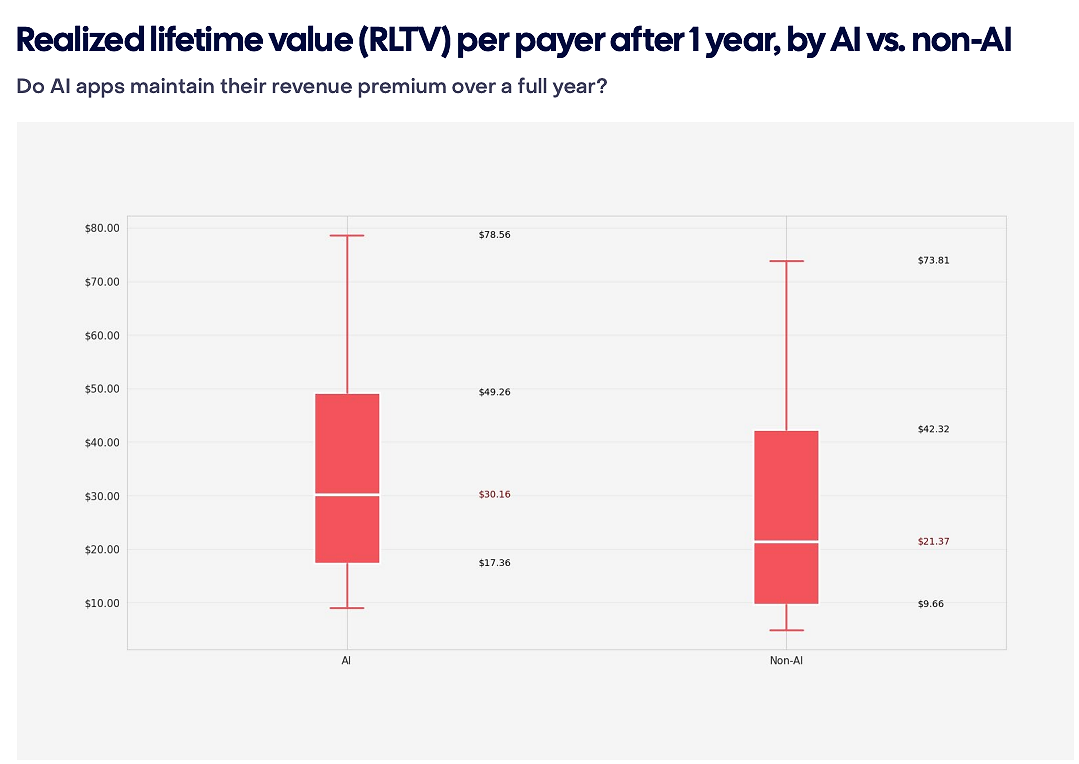
AI-powered apps are casually out-monetizing and outperforming non-AI apps, according to RevenueCat’s State of Subscription Apps 2026:
- 41% more revenue per payer
- 52% better trial conversion
But there is a flip side to this:
- 12 month retention of 21.1% vs. 30.7%
- Refunds are about 20% higher
So consumers are willing to pay for AI apps, but the harder challenge is getting them to keep paying. When OpenAI launched the AI video app Sora, it got more than 12 million downloads, but by Day 30 retention was a miserable 8% or so compared with the 30%+ industry standard. Since then they’ve sunsetted Sora, and I was met with this depressing screen:

So the question in this article’s title is secretly the wrong one: people will pay. They’re already paying more — and faster — for AI-powered apps than for almost anything else right now.
The real question is why will they still be paying in month six? That’s a product question, not a marketing one, and it’s the question the rest of this article sets out to answer. (It’s also a much nicer question to wake up to at 2 am.)
AI alone isn't enough to win customers permanently, and Sora proves it: when the company that builds the model can't keep people, the model was never what kept them. Which is also why I don't think the other AI apps or copycat AI apps in your category are your biggest competitors.
ChatGPT is the biggest ‘window’ ever built
A while ago, I was standing in the kitchen, checking several weather apps on my phone, trying to decide whether to walk the dog now. I turned around to find my father-in-law looking at me like I’d lost it: "Why are you doing that? Just look out the window."
Weather apps’ competitors aren’t other apps; they are looking out the window, asking around, or even just going to stand outside.
In the world of apps, your window is ChatGPT, Claude, or whatever other LLM chat of your choice. The free models, for now, can do a lot, and we see growing usage in categories of apps that support them, e.g, one in five US chatbot users ask for medical advice, and as many again about diet and fitness.
The second, more meta way it is your window competitor is the ability to help you and others build faster. App launches went from about 2,000 to 14,700+ per month in four years; the volume is huge.
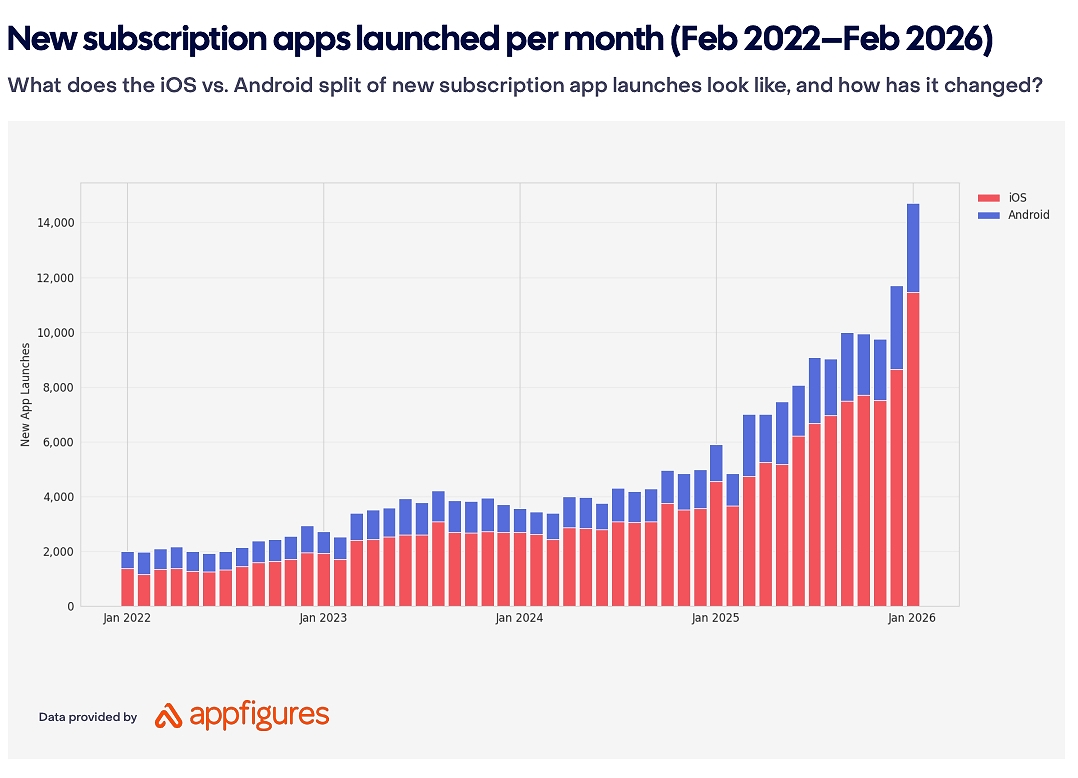
But in that, we still see 69% of subscription revenue going to pre-2020 apps, versus just 3% to apps launched in 2025 and 2026. Eric Seufert argues that while the cost of building is lower, the cost of distribution has increased because apps are all chasing the same attention. Rik Haandrikman echoes this: distribution is a moat.
Those who are holding on to that 69% know what a weather app can do that a window can’t, what their app can do that an LLM can’t. Those who can’t explain the differentiator of their app are the ones slowly dying under the weight of AI's growth.
Anatomy of the apps AI has actually killed
This is not a random murder spree; AI’s victims share something in common (I clearly need to stop reading Swedish noir novels). The apps replaced by LLM chats have one or more of these four things in common:
- No structure
- No memory
- No habit
- No precision advantage
Most apps being replaced are a single question or task and an answer. That was Chegg’s real problem: strip away the branding, and the product was a prompt with a subscription attached. Stack Overflow, a question-and-answer platform for developers, is on the same path, with traffic falling around 6% every month since early 2022. Why? An LLM gives you the same answer instantly, in a conversation, without posting a question and hoping a stranger replies.
Dan Layfield, Founder of Subscription Index, made a point on Sub Club that explains the pattern: your retention is dictated by how long the user has the problem you solve. Phone plans are retained for decades because the problem never goes away. An answer-lookup problem dies the second the answer arrives — and now the answer arrives in three seconds, for free. Chegg's real problem was never ChatGPT; it was that the problem they solved only lasted one homework question at a time.
The uncomfortable truth: if your app’s value fits in one prompt and one reply, you are in the blast radius.
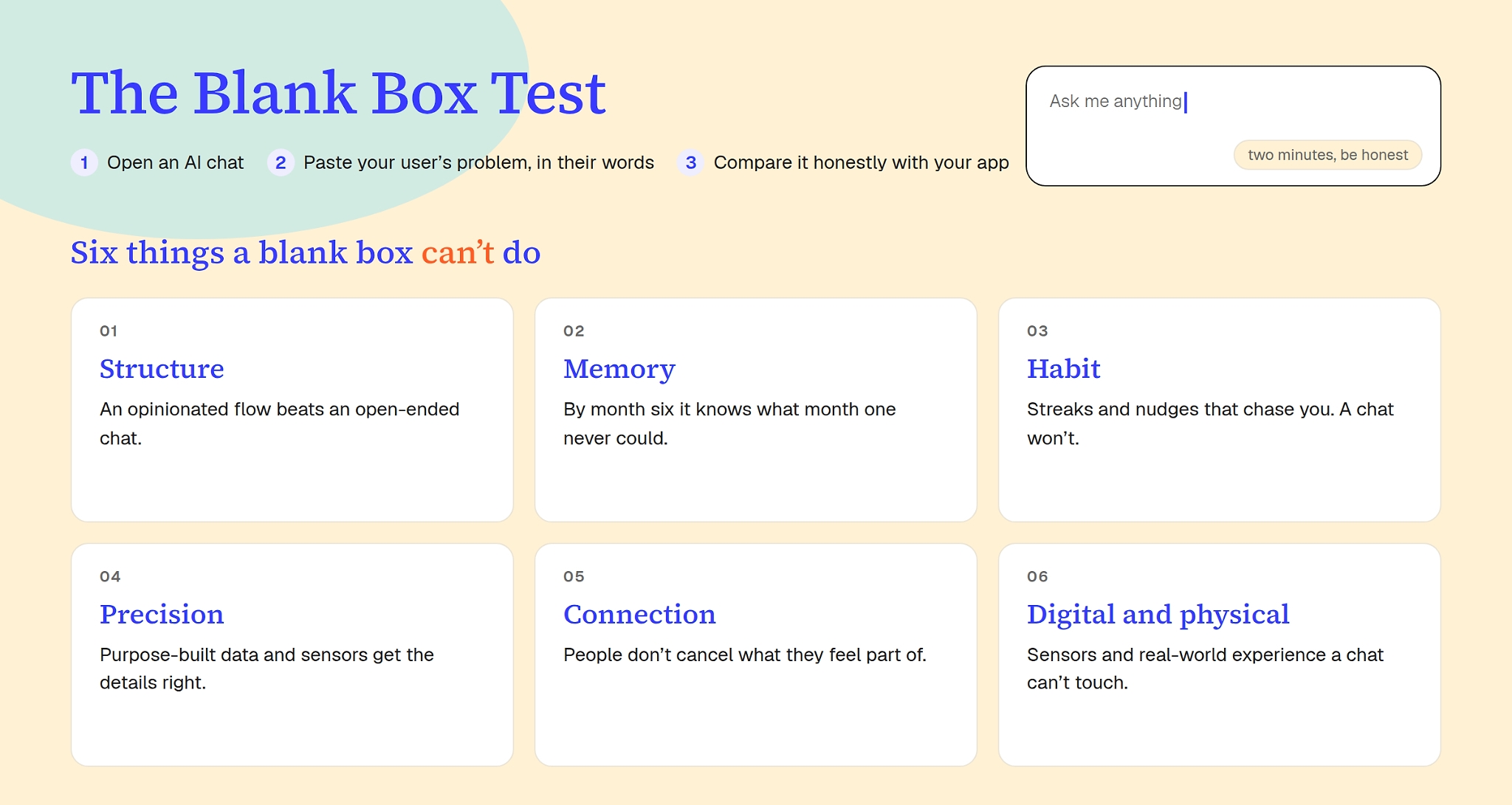
The Blank Box Test (and six things a blank box cannot do)
I have a challenge for you called the Blank Box Test. It’ll only take two minutes:
- Open your LLM chat of choice
- Write out your user’s problem in their words
- Analyze the results vs. what your app offers
Hopefully, you’ll see one of six advantages appear that you can lean into further. If not, your app is replaceable. So consider each of these six areas and see which could help you effectively beat an LLM. With all of these, yes, there are ways an LLM could do these things, but a general chat doing all six — or even one of them — to a very high level for everyone’s daily needs? Unlikely.
And to be clear, this isn't AI apps vs. non-AI apps. Cal AI, Rosebud, and Tolan are all examples I’ll mention that lean heavily on AI. The difference is that AI isn't what they're selling you — rather, it’s part of their infrastructure that helps them lean into one of the six differentiators against LLMs. That’s why I’ve also intentionally shared several non-AI examples.
1. Structure
I use Deliciously Ella and Mob Kitchen for recipe inspiration. Until I had what I thought was a genius idea: why not use Claude to build a weekly meal plan based on what I already have in the fridge, my dietary requirements, the foods I love, and the kinds of food that work well for me as someone with ADHD and an intense sweet tooth? A perfect, personalized plan.
So I did exactly that. I used it for a few weeks, but eventually went back to my usual apps because I missed the beautiful visuals of seeing what I was going to cook. I missed feeling inspired and getting excited about new recipes. The checklists and text in Claude just weren’t doing that.

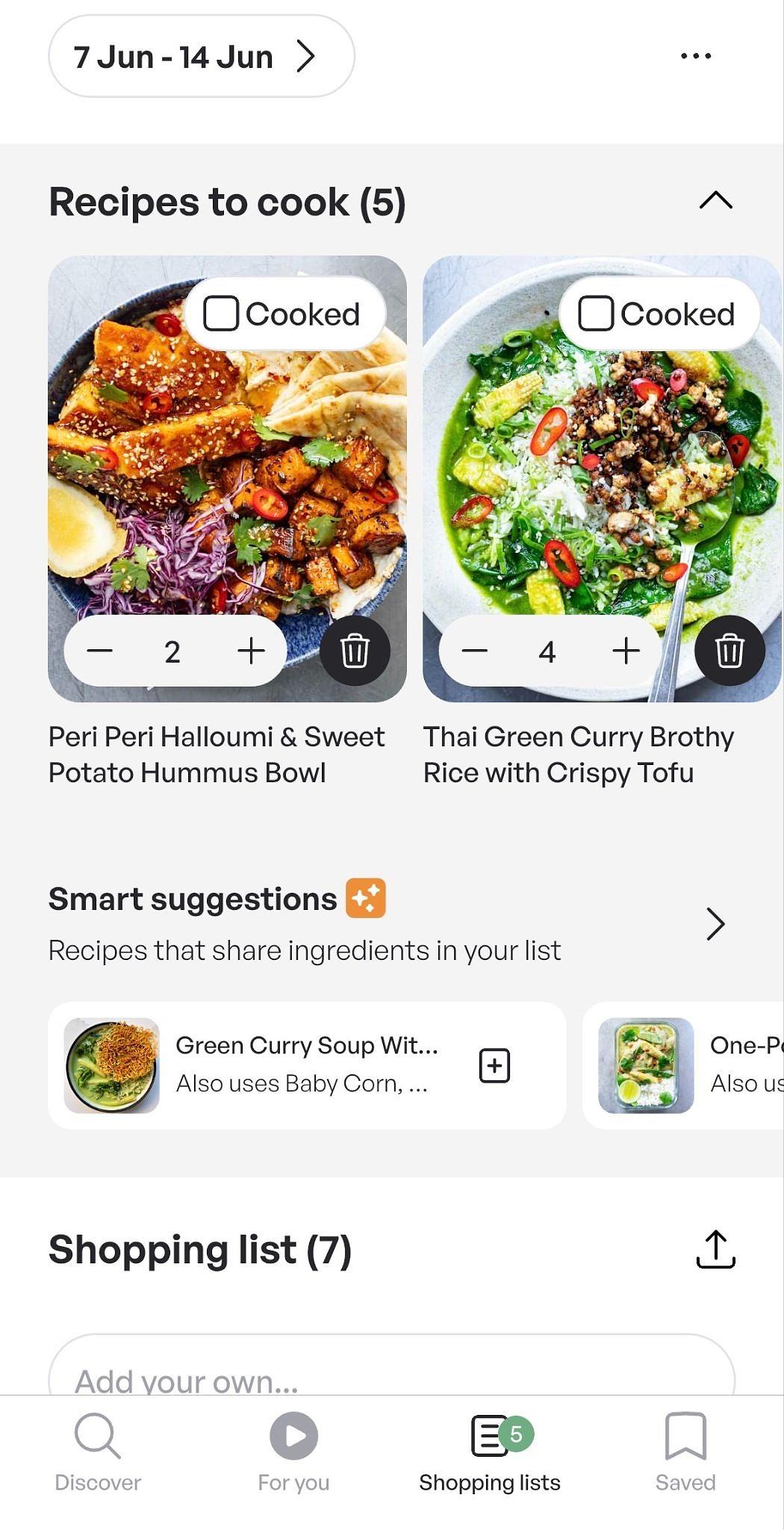
While I probably could have forced Claude to create images and build everything into a visual weekly dashboard, the structure of the apps is what gives them their value. I can browse them on the go, discover recipes as they catch my eye, and build my shopping list along the way. It’s not worth it to me to rebuild that, and I’d argue that for most average consumers it wouldn’t be.
I also think that’s why apps like Runna are still winning against LLMs. For some people, a quick plan generated by an LLM will be enough for their daily run. But Runna gives you the full calendar, guidance during your run, and the exact structure of every workout you can follow live. It turns a plan into an experience, and that’s where the added value lies.
2. Memory
Luckily, the days when our LLM chats acted like Dory from Finding Nemo are gone. Building structures like second brains (a persistent, semantically searchable digital knowledge with AI) can allow your LLM to have so much more memory than ever before. But you still have to get it to use that data in some cases to make your experience better, and not all data sources are easy for the average AI user to connect to an LLM.
Meanwhile, your app can use the accumulation of user data so that by month six it is so much better than it was in month one, in ways you may not have even thought of. Memory + judgment of the right prompts are powerful.
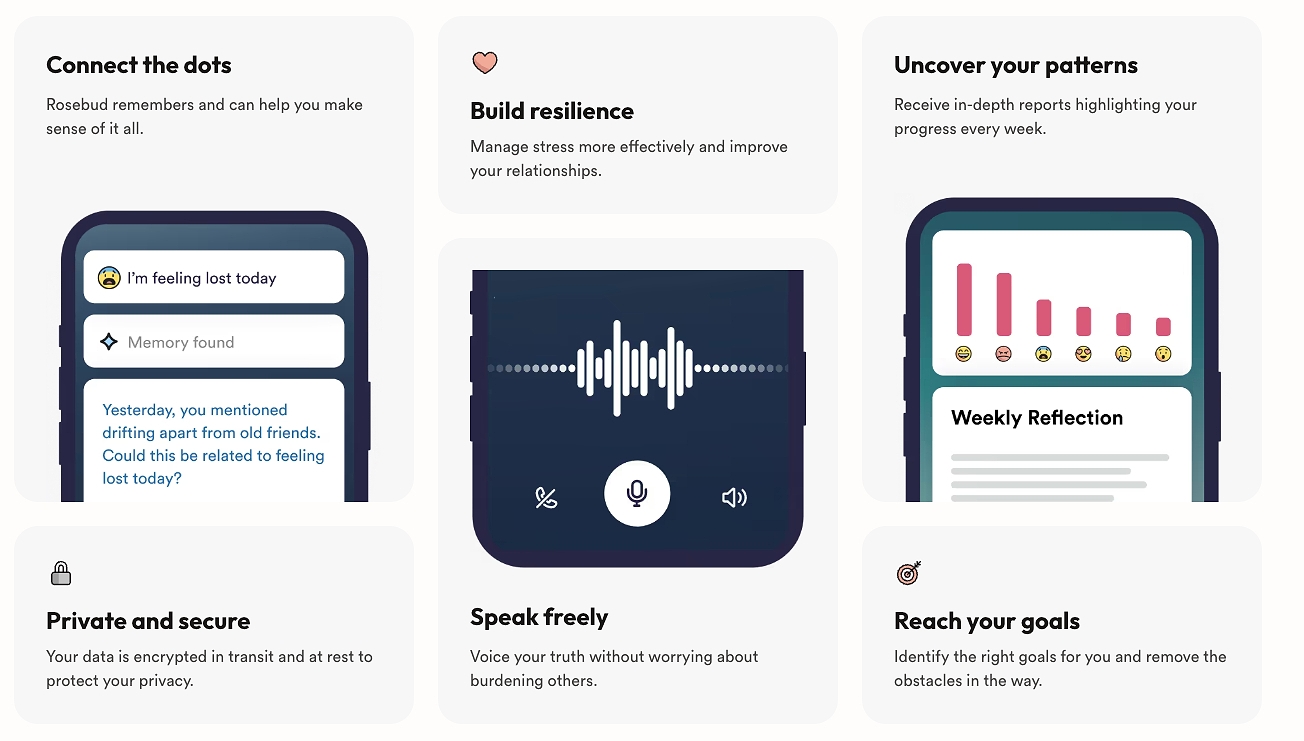
This is the investment part of the Nir Eyal Habit Loop: getting users to invest in your app. If you do so, ensure that the investment pays back, and you’ll be able to add value to their experience, like Rosebud, an AI journaling app that collects your data over time and uses it to better reflect and learn with you.
3. Habit
Habit comes down to accountability: being able to push someone to take action, whether that’s through streaks, reminders, or other forms of gamification.
Duolingo is a perfect example. You can ask an LLM to help you build a habit out of something, and it can tell you the theory behind habituation. Having it embedded in your app in a beautiful, intuitive way, with all those reminders and nudges already built out — it’s technically possible with AI, but not something the average user is willing to do themselves.
The numbers behind those nudges are not small either. When Duolingo introduced leaderboards, Jorge Mazal, their former CPO, shared that overall learning time went up 17% and the number of highly engaged learners tripled.
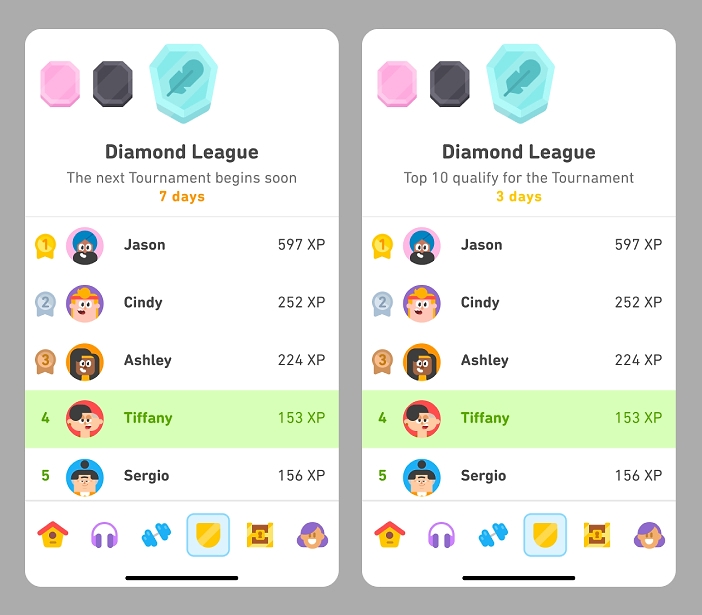
Once a streak passes 10 days, the odds of someone quitting drop sharply. An LLM can explain habit theory to you beautifully — but it won’t cause a terrifying owl to chase you at 9pm because your streak is about to die.
4. Precision
Cal AI launched in the middle of the rise of LLM chats in May 2024. Within a year, its teenage founders were claiming around $2 million in monthly revenue, and by the time MyFitnessPal acquired it, it had passed 15 million downloads. The acquisition also gave them MyFitnessPal's food database of 20 million foods and 68,500 brands, allowing them to redesign and improve the product.
You could argue that their product is just a simple question-and-answer tool, but the precision with which they can tell you what is in your food, thanks to all that data and insight, is much better than asking ChatGPT. Especially if you combine it with their structure for organizing and tracking your calories and intake. Gives us hope, right? If two teenagers can beat LLM chatbots, so can we.
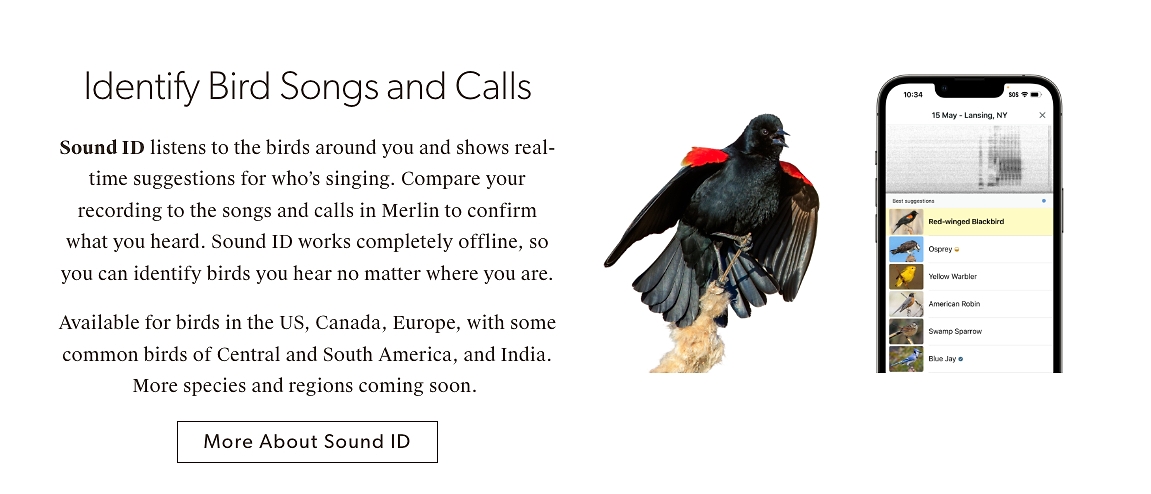
Merlin, a bird-sound app, is another great example of this. They have a curated acoustic library built from decades of eBird and Macaulay Library data and have 10 million active users. That dataset and the precision to recognize bird sounds effectively are their strengths.
5. Connection
Trust, tone, and brand feel go a long way in building a connection. Look at Tolan, the AI companion. It builds a personality that stands out and gives a feeling of connection. Its founder argues that doing this well, with voice, memory, and character, is exactly what LLM Chats are not set up to focus on.
But connection goes further than an app that knows you. It’s about belonging: Duolingo’s leagues, Strava’s clubs, the run crew that only exists because the app brought them together. People don’t cancel things that feel like a part of them. Emotional connection is a strong driver of retention. I also find it telling that AI companion apps are on track to pull in $120 million even though chatting with an AI is free: people pay for a relationship, not a reply.
In a world flooded with vibe-coded apps, those that take the time to build connection and an experience stand out.
6. Digital and physical
I also believe there’s room for another advantage in subscription apps that combine physical and digital to deliver value. I use a subscription app called Willow to better understand what my plants need and know when to water them, when to move them to a sunnier or less sunny spot, and more.
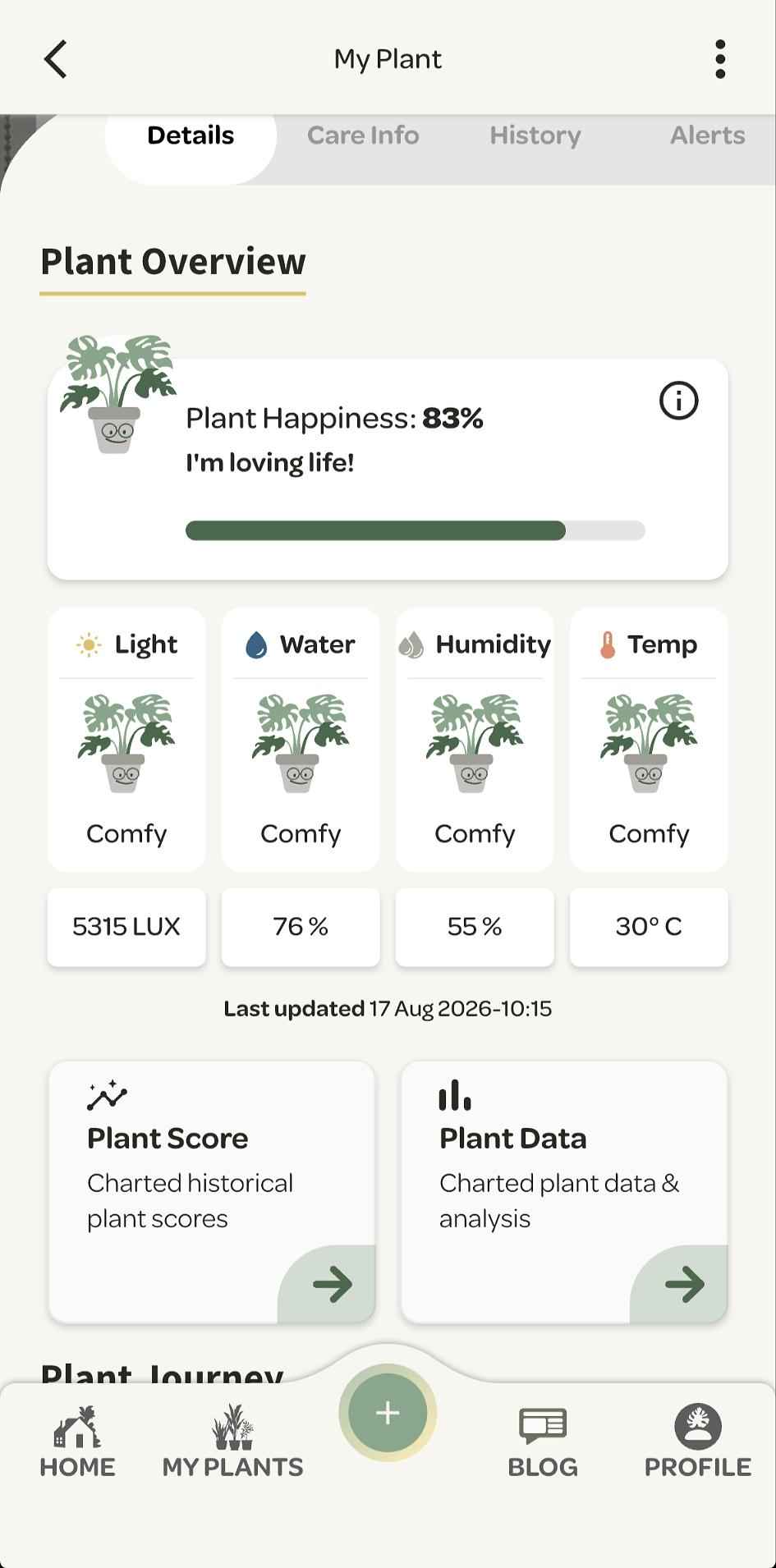

They can do this better than an LLM chat by itself because they have sensors to feel and gather this data. While we can connect LLMs to other data sources, I believe there’s room for the physical advantage of naturally creating combined experiences with reality to add extra value.
The power of multiple moats
The combination of a few of these has allowed even ‘wrapper’ apps to survive and thrive. Take Co-Star, an astrology app: readings are written by a mix of AI and human writers, and Midjourney thought its packaging and ritual were worth acquiring in 2026. Yet users pay anyway: for the packaging, the birth-chart personalization, and the daily push ritual. That is a combination of structure and habit helping them win.
What this means for what you build, say, and charge
Firstly, you need to understand which of these six differentiators are available to your category and deliberately invest in them, figuring out what can truly make you different from an LLM chat or a quickly-created AI competitor. It will help you speak to your most loyal users and understand: if they are using LLMs, why are they still choosing you? If 95% of your audience still sees that value and understands it, and it’s not just down to brand loyalty, that helps you work out which of these matters most.
With distribution being the challenge now, your existing audience is a moat in itself. Investing in retaining users through the initial experience and onboarding, by building in guidance and value, is going to help you win.
From there, communication comes down to marketing and sharing outcomes that a blank box can’t promise. You want to sell the job you helped them achieve, not the engine. I’m not the only one who cringes at the label ‘AI-powered’ — Irrational Labs conducted a study of 767 software users in which AI-powered features actually lowered the perceived value and did nothing to justify the higher price. AI is a tool, not an outcome.
Finally, don’t risk getting into a race to the bottom. Yes, competition is fierce, but competing against the $0 competitor won’t help you win. Price isn't a long-term differentiator, and we see that in the State of Subscription Apps report too: high-priced cohorts hold at 6x the LTV of lower-priced cohorts, and premium positioning signals the differential you’ve built. You just need to make sure you deliver that value for that price. Your free tier is competing with that blank box too, since it is the more limited experience, so make sure your free experience shows off the same advantages.
The irony of it all
We’ve talked about LLMs like ChatGPT as competitors. We talked about them helping your competitors build, but there’s an additional challenge; they are also your distribution channel. You can’t completely ignore them or move away from them. They need to know your app in order to suggest it to users. And they are undeniably useful — Brian Balfour recommends integrating them early in your app and if you can, letting their ecosystem help you win while you strategically differentiate.
Your users will continue to pay for you if your app knows them (memory), structures them (opinionated workflow), holds them to it (habit), gets the details right (precision), feels like somewhere they belong (connection), and helps them get more value out of the world around them (physical and digital). Run the two-minute Blank Box Test this week if you haven’t, and start building the things a blank box cannot do.