
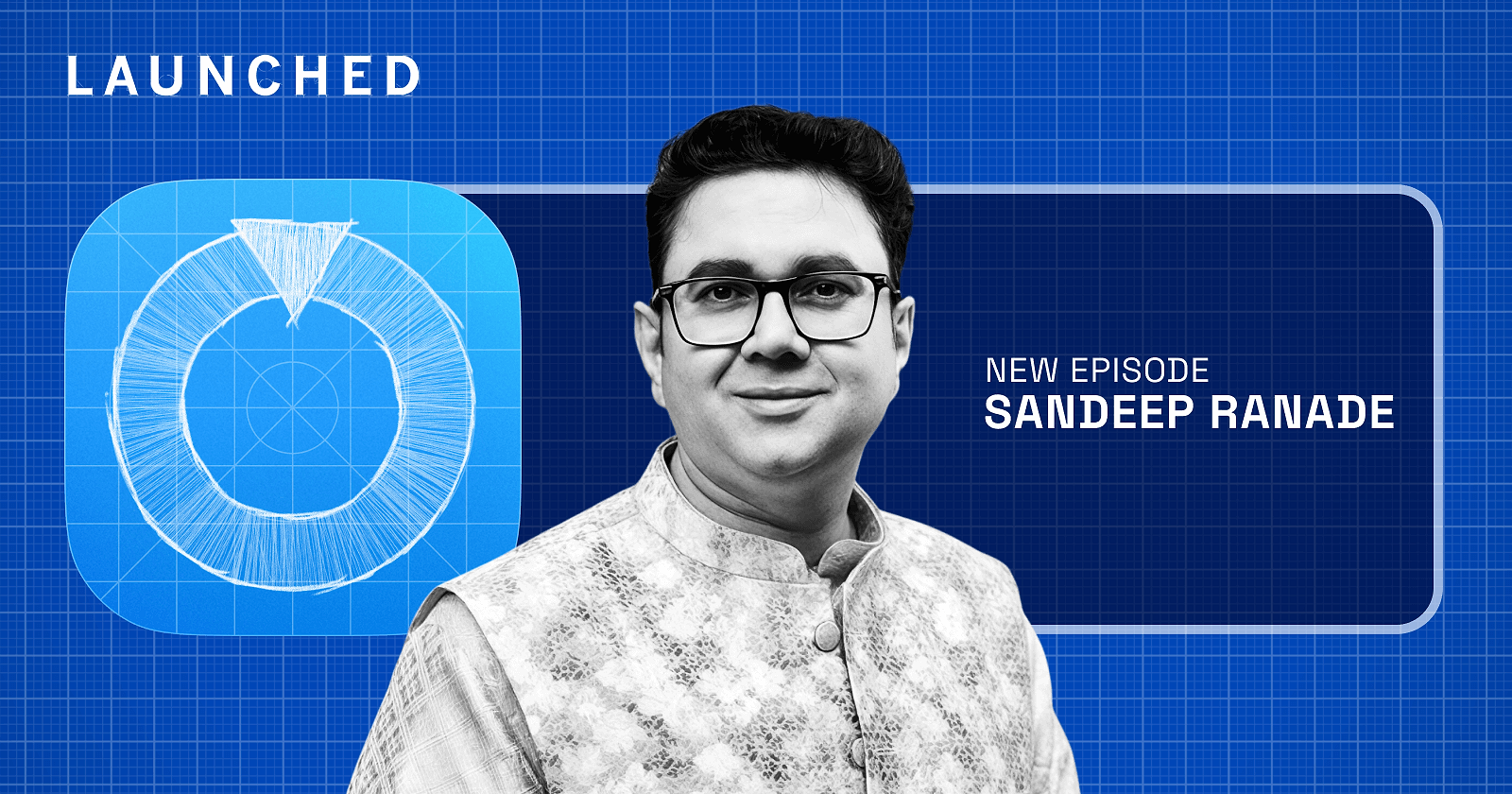
When a long-time student still couldn’t distinguish close intervals, Sandeep Ranade didn’t write another lesson plan — he wrote code. NaadSadhana blends Indian classical music with real-time, AI-assisted feedback so vocalists can train like professionals. This is how passion, patience, and purpose shaped the product.
From Microsoft to music mastery
“I’m from Pune… I did my master’s in computer science from Johns Hopkins University in America in Baltimore. I’ve worked at Microsoft… then at Google,” Sandeep says. After more than a decade in Silicon Valley, he and his wife — then at Apple — moved back to India “to do something that we were interested in, that we wanted to do.”
He had been teaching Hindustani classical music since 2005. “There was a student … she said, please help me. I’m frustrated with my journey. I’m not making any progress.” That single conversation revealed the problem that would define his next decade.
Solving a real problem, one note at a time
“In the first 10 minutes, it became painfully clear that she had major problems in note recognition itself,” Sandeep recalls. “She couldn’t recognize half of them. She would just know the big ones and then all the minor notes she would sort of miss out on.”
A doctor ruled out tone deafness, leaving Sandeep to diagnose the issue himself. “She had gotten into some bad habits … when she was learning and practicing, she didn’t get enough guidance to course-correct as she was making the mistakes. So those mistakes became the habit.”
He wanted a tool that could give her feedback whenever she practiced — something a human teacher couldn’t provide around the clock. “I thought, hey, it’s 2017. There must be an app that does this by now.” But, he found, “sadly, there was no single app that did this for human vocals. There were thousands of guitar tuners on the App Store, but not a single app that did human vocal tuning and guidance.”
To fix that, he dove deep into digital-signal processing and psychoacoustics. “It took my iPhone 7 Plus battery from about two days to 20 minutes. I could have probably made an omelet on my phone,” he laughs. After nine iterations, he finally had “an algorithm that was correct, accurate, fast, and battery efficient.”
When he tested it with his student, the results astonished him. “She was able to go from a score of 5 percent to 80 percent. It took her two weeks. I was not expecting this.”
Tech meets tradition
“There was an ancient system of learning in India called the guru-kul. Guru is the teacher, kul is the home. So the student would go live with the guru traditionally and learn the craft for years and would be instructed and guided for eight, ten hours a day or more.”
That continuity, he says, produced extraordinary precision. “Today, students are learning an hour a week, practicing by themselves many times a week without any guidance. And the danger is that if you practice something multiple times without knowing whether you have gotten it right or not, that is where things start to become kind of dangerous.”
NaadSadhana became a digital re-creation of that traditional mentorship — a tireless teacher able to correct singers in real time.
Building slowly, scaling sustainably
“I never realized that an app needs to be promoted and there’s marketing involved,” Sandeep says. “I just put it up on the App Store … I probably broke even on my developer fees.”
Early users spread the word organically. “Some people said to other people that, ‘Hey, I’ve been using this app, my notes are improving.’ I told it to a few people that I know and that was it.”
In 2021, that quiet persistence led to worldwide recognition. “I attended the Apple Design Award ceremony [as an audience member], looking at all of these beautifully designed apps … and in 2021 NaadSadhana won for innovation. I’m only the second Indian to ever win this award.”
Evolving the sound of the future
“I’ve had offers to buy out the app, and the only question I ask them every time is: What feature would you add next? … It now truly seems that I’m the only person who’s passionate enough to evolve this app in the way that I care about.”
For Sandeep, NaadSadhana is an artistic calling, not just a product. “There are things that people don’t know that I’ve done that will not matter to the vast majority of people, but it’ll matter to me. From a business point of view it’s not truly necessary, but from an artistic point of view it makes the world of a difference.”
What app builders can learn from NaadSadhana
“I typically tend to solve problems for me or people who are close to me,” he says. “Because I am the first customer of my solution … there are no compromises.”
That builder-first mindset shaped every decision. “It has to behave a certain way … nothing less than that will be acceptable.”
And rather than chase growth, he focused on depth. “I was focused more on the feature set and capability of the app … I thought that the more capable I make the app, the more attractive it’ll be to people … and that has been happening.”
Final takeaway
Sandeep calls NaadSadhana’s underlying technology “artistic intelligence.” “What my app is doing is enhancing humans. I’m giving them a flight simulator, not a self-driving car.”
That philosophy extends to accessibility. “Music without any barriers, without any boundaries,” he says. “Just because a person doesn’t have eyesight shouldn’t make it a barrier to be a musician or to create content.”
NaadSadhana shows how technology can deepen — not dilute — tradition. Design for mastery, not virality, and you’ll earn trust that lasts.