
Remember Quibi? It may be one of the most expensive examples of a company arriving just a little early
For those who weren’t online yet: in 2020, Quibi bet that people would watch premium stories made for their phones, delivered in episodes of ten minutes or less. It raised an eye-watering $1.75 billion and was shuttered less than a year after going live. And with that, short-form video for mobile died and was never seen or heard from again. Or did it?
Today’s short-drama apps were built for how people actually use phones: upright, in short bursts, and often one cliffhanger away from paying. They combine serialized stories, aggressive paid acquisition, and monetization that begins almost immediately. This time, the numbers look a little different
China got there first
Quibi approached mobile video from the top down. It brought Hollywood budgets, stars, production practices, and a conventional streaming subscription to a smaller screen. The episodes were shorter, but much of the machinery still came from television
Short drama as we see it in the app stores today developed in China. Its immediate roots lie in the serialized shorts that spread across platforms such as Douyin and Kuaishou in the late 2010s. Chinese regulators formally recognized micro-short drama as a distinct format in 2020, and the market accelerated during the pandemic. It originates in an ecosystem where vertical video, web fiction, mobile payments, performance marketing, and fast, inexpensive production were already the norm
The stories were built differently too. Chinese web fiction had spent years refining plots around base human desires and conflicts: romance, revenge, sudden wealth, family betrayal, hidden identities, and dramatic reversals. Short drama translated that rhythm into video. Every episode had a job: establish the stakes quickly, resolve just enough, and create the next reason to keep watching
The business model developed alongside the format. Viewers could sample a story for free, pay to unlock the next episodes, watch ads to earn access, or subscribe. Distribution often started with a dramatic clip on a social platform and ended inside a mini-program or dedicated app. The same story attracted the viewer, kept them watching, and eventually asked them to pay
By June 2024, China had 576 million micro-drama viewers (more than half of the country’s internet users!) according to the China Internet Network Information Center. China’s domestic micro-drama market reached roughly RMB 50 billion that year, overtaking the country’s cinema box office for the first time
This was already a mass-market business before most Western entertainment executives had heard of ReelShort or DramaBox. Omdia estimates that microdramas generated roughly $11 billion worldwide in 2025, with China accounting for about 83% of the total
What travelled overseas was more than the shows themselves. Apps such as ReelShort began producing local stories with English-speaking actors and familiar settings while keeping the rapid pacing, performance marketing, and payment mechanics that had already been tested in China
ReelShort founder Joey Jia told TIME that the company can take a story from idea to live in front of an audience in roughly three months, see exactly where viewers stop watching, and rebuild a failed concept with different characters. That feedback loop is hard to reproduce when a traditional production takes years and most of its budget is committed before the audience sees a frame
This is no longer contained to China
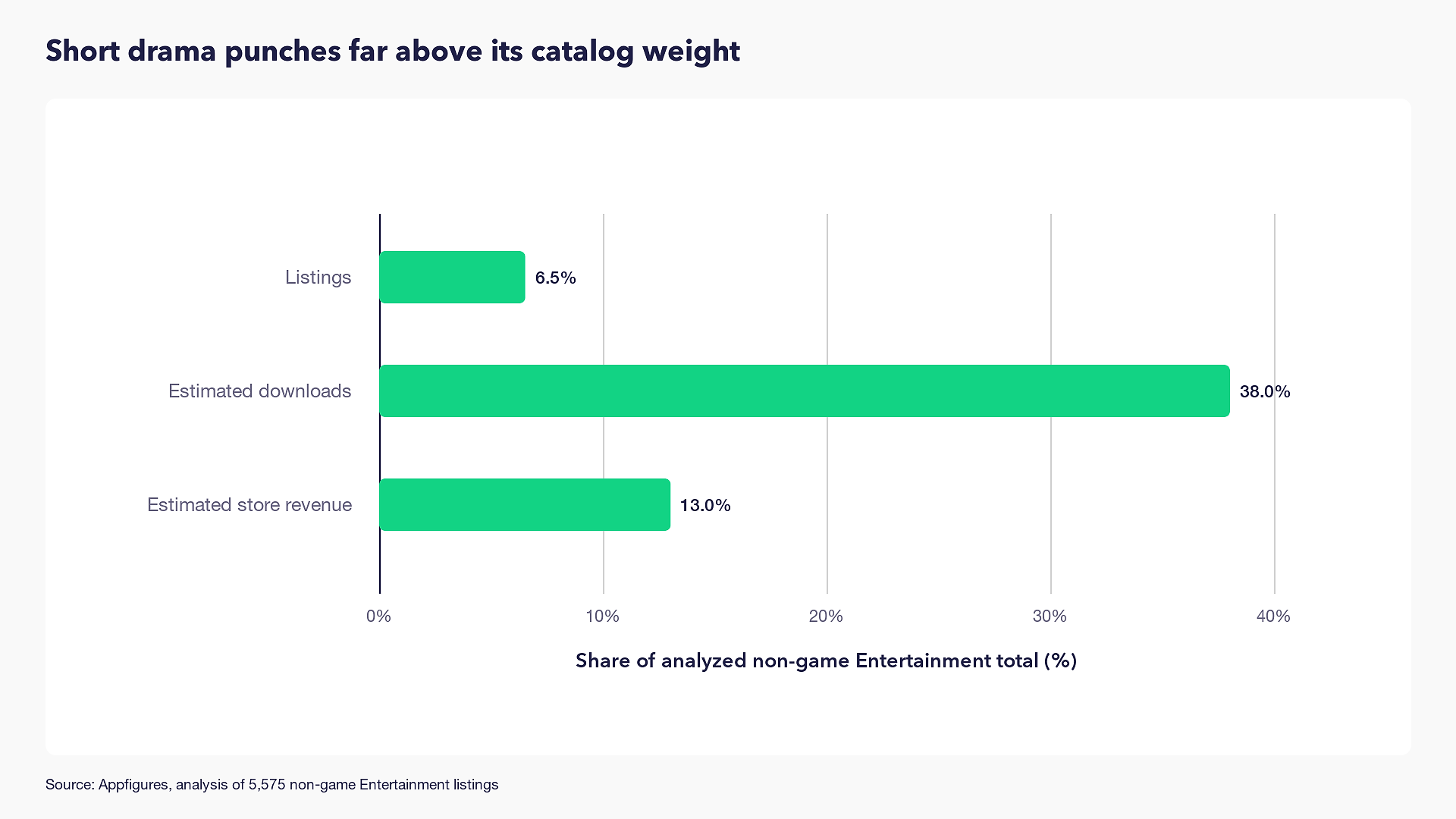
Based on Appfigures data, we analyzed over 5,000 of the highest grossing non-game Entertainment apps, and found roughly 360 short-drama apps in the listing (around 6.5% of all apps in the category). Together, they generated about 145 million estimated downloads and $230 million in estimated store revenue in the latest 30 days
When we look at download numbers, it becomes clear that something’s happening. At just 6.5% of the Entertainment listings, short-dramas generated 38% of downloads and 13% of store revenue. Its share of downloads was nearly six times larger than its share of apps
Like most categories, short-drama is top-heavy. The ten largest apps generated roughly 78% of the group’s estimated store revenue. At the other end, the long tail represented about 70% of apps, attracted 23% of downloads, but only 1.5% of revenue
Small apps can still attract installs. Turning those installs into substantial store revenue is much harder
The two app stores also play very different roles. Android produced 76% of estimated downloads, while iOS produced 58% of store revenue. Android is where these apps find much of their reach; iOS is where much of the direct revenue is generated, though this explicitly ignores ad revenue. A relevant distinction to make, because over ⅔ of short-drama apps include ad monetization, compared to 37% of the overall Entertainment category
What happens after the download
The download is just the start. What matters next is whether that new user pays
We compared the short-drama apps in RevenueCat’s data with the broader Entertainment category. The short version: short drama gets people to pay much (much) faster than traditional Entertainment apps do
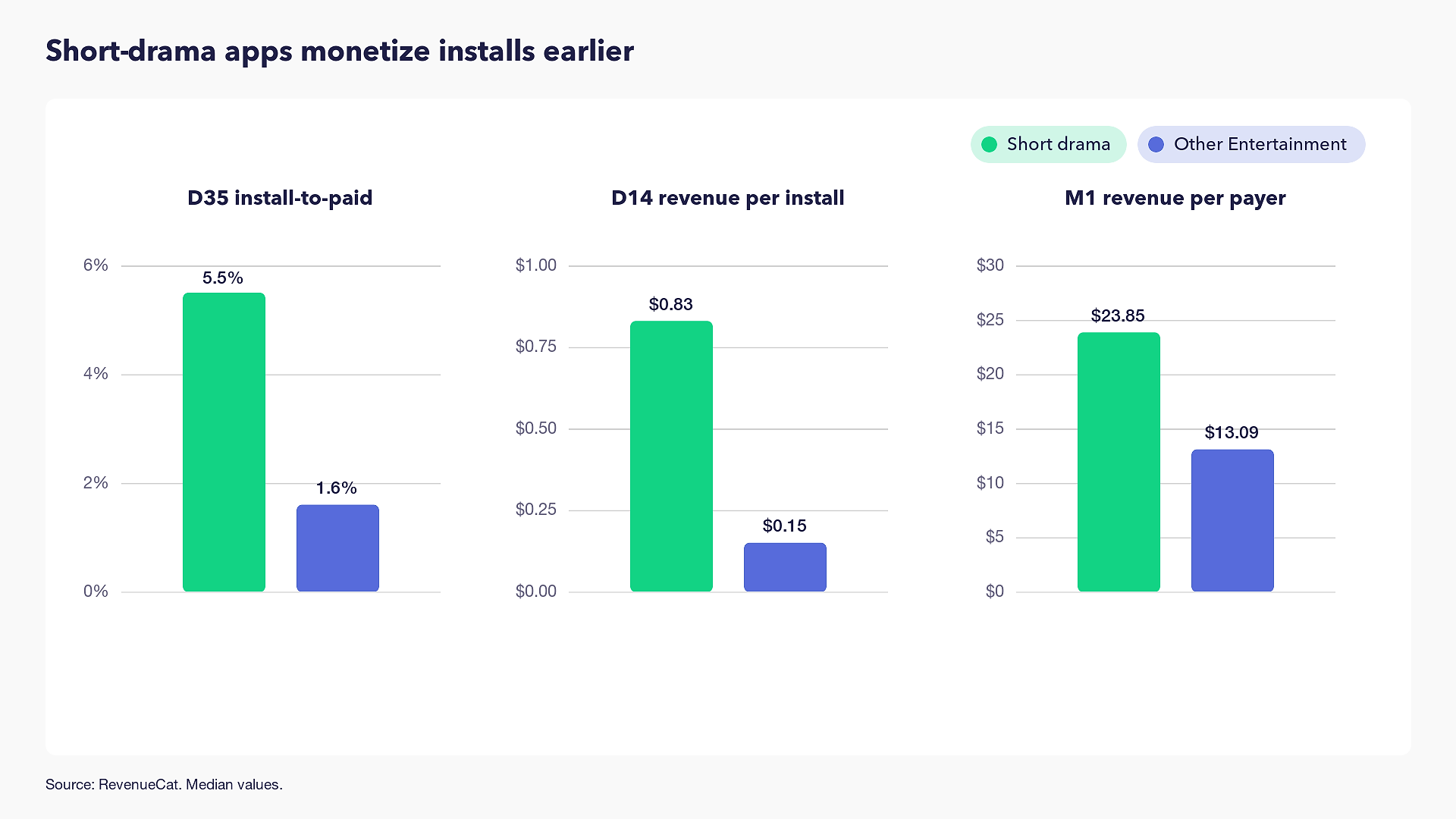
For the median short-drama app, 5.5% of installs became paying customers within 35 days. The median for other Entertainment apps was 1.6%
The same advantage appears in early revenue. Short-drama apps generated a median of $0.83 per install in the first 14 days, compared with $0.15 for other Entertainment apps. First-month realized revenue per paying customer was $23.85, versus $13.09
That’s not (just) a matter of a better paywall. Short-drama apps design the ad, episode, price, and payment moment together to form a cohesive, compelling journey
A typical ad does not introduce the brand and ask viewers to remember it. It drops them into a betrayal, a wedding, an inheritance, or a billionaire-shaped problem. The viewer watches long enough to need the resolution, installs the app, gets several episodes free, and reaches a highly personalized paywall at the moment of maximum curiosity
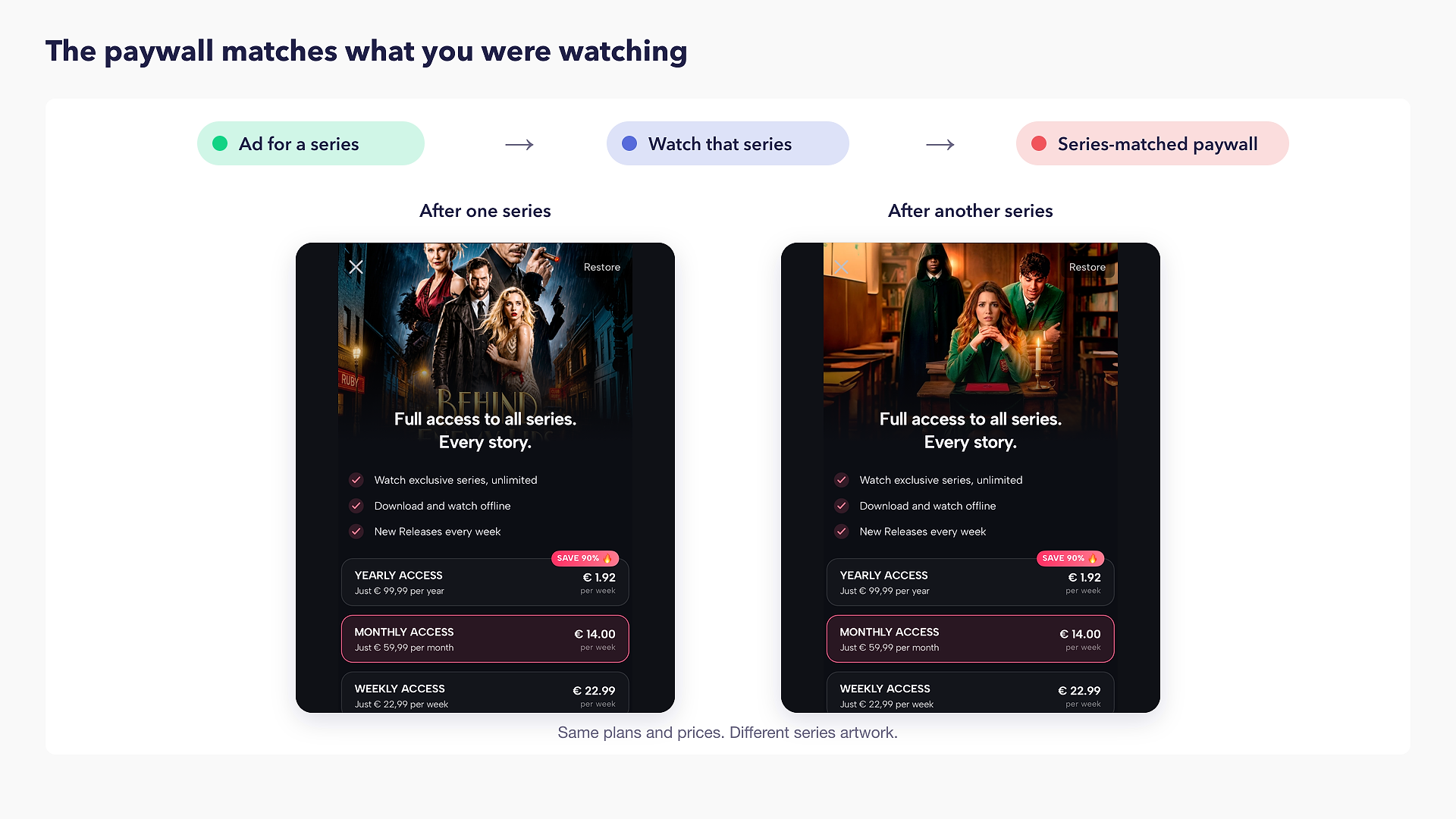
At MIP London, executives told the Associated Press that some of the largest microdrama platforms spend as much as 90% of their budgets on marketing. That sounds extreme through a television lens. It makes more sense in the world of mobile attribution where each piece of creative can be tied to an install, an episode, a payment, and eventually a renewal
This looks more like a mobile game than Netflix
Short-drama apps do not rely on a single monthly subscription. They borrow freely from mobile games: virtual coins, consumable purchases, rewarded ads, limited-time offers, and short subscription periods all sit next to one another
That mixed model is visible in the Appfigures data. Store metadata showed in-app purchases on 93% of short-drama listings, subscriptions on 86%, and advertising on 67%. More than half showed all three, and those apps generated roughly 93% of the short-drama store revenue in our sample
It’s a great example of how apps use mixed monetization to ‘drop the floor’ (make it possible for the masses to generate a little revenue) and ‘raise the ceiling’ (allow highly engaged users to pay again and again)
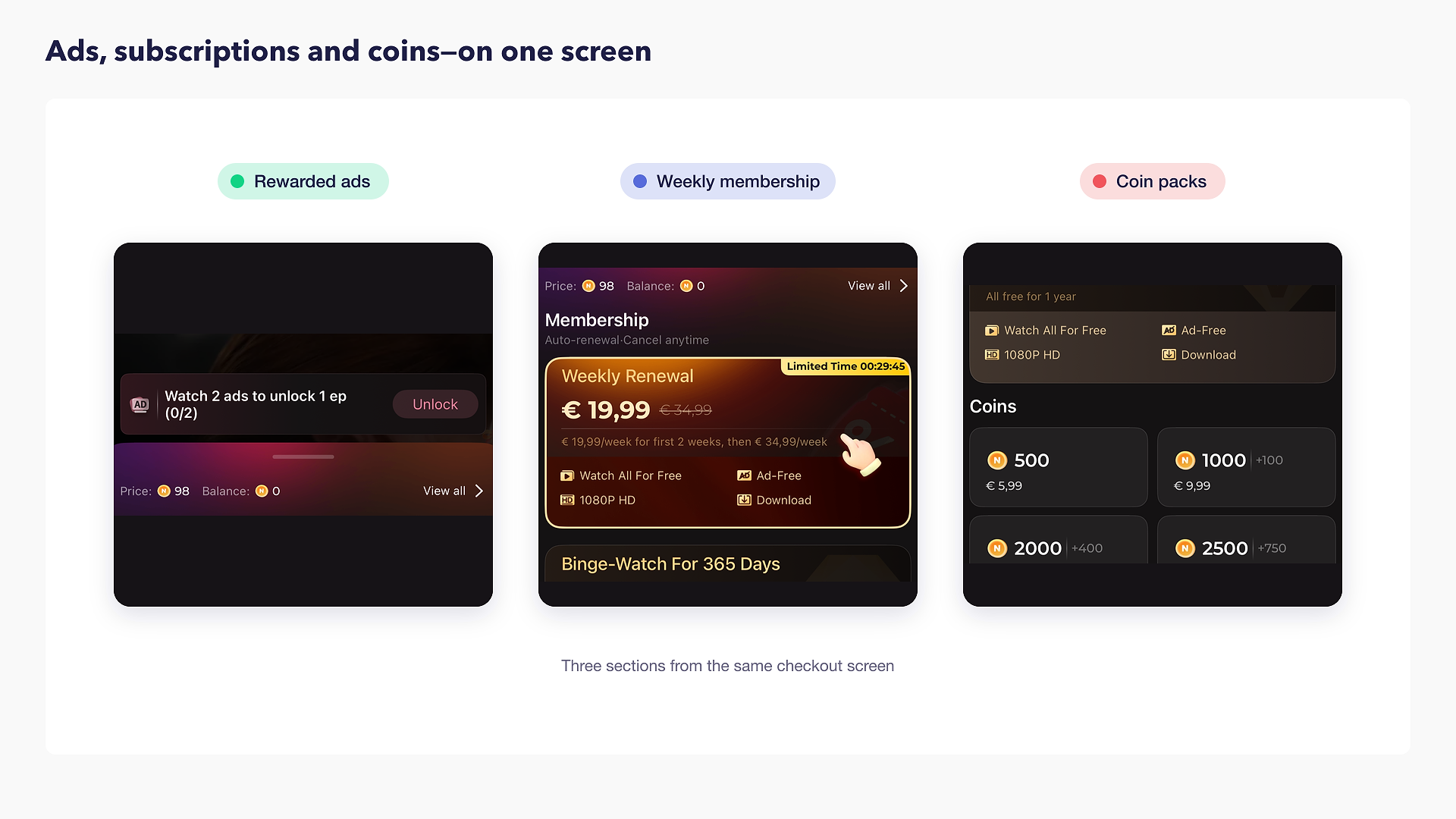
Our own data shows just how strongly the subscription side is built around urgency. For the median short-drama app, weekly plans accounted for 88.5% of recurring revenue, compared with 14.3% for other Entertainment apps. The most common weekly price was $9.99 - about twice the $4.99 that the rest of Entertainment usually charges
In this case, weekly pricing fits. A viewer can discover a series, binge dozens of minute-long episodes, and make a relatively expensive purchase in a single session while also actually experiencing the full value in that same session. The app does not need to convince that person it deserves a permanent place alongside Netflix. It needs to make the next episode feel worth paying for now
Then comes renewal
The first payment comes quickly. The second is harder
The median first-renewal rate for short-drama apps was 31.1%, compared with 44.3% for other Entertainment apps. In the smaller group for which we could measure six-month retention, the gap was wider: 1.8% for short drama versus 8% for the rest of Entertainment
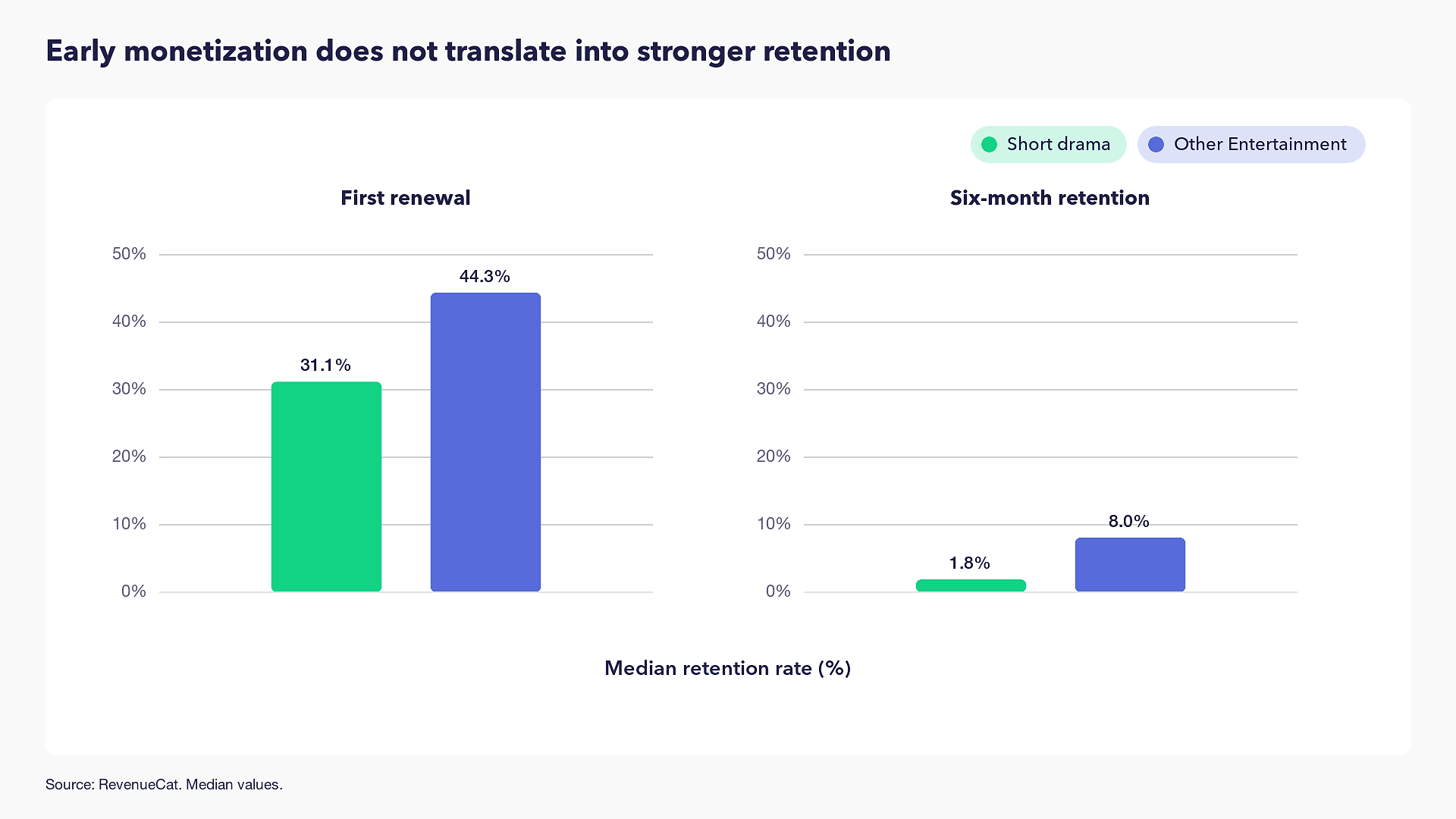
The model works brilliantly in the moment. In our data, it is much less effective once that moment has passed. These numbers do not tell us whether that comes from story completion, weekly pricing, acquisition mix, or something else - but they make the trade-off difficult to ignore
The opportunity is fairly obvious: bring short drama’s mobile speed together with the libraries, franchises, and subscriber relationships traditional media already knows how to build
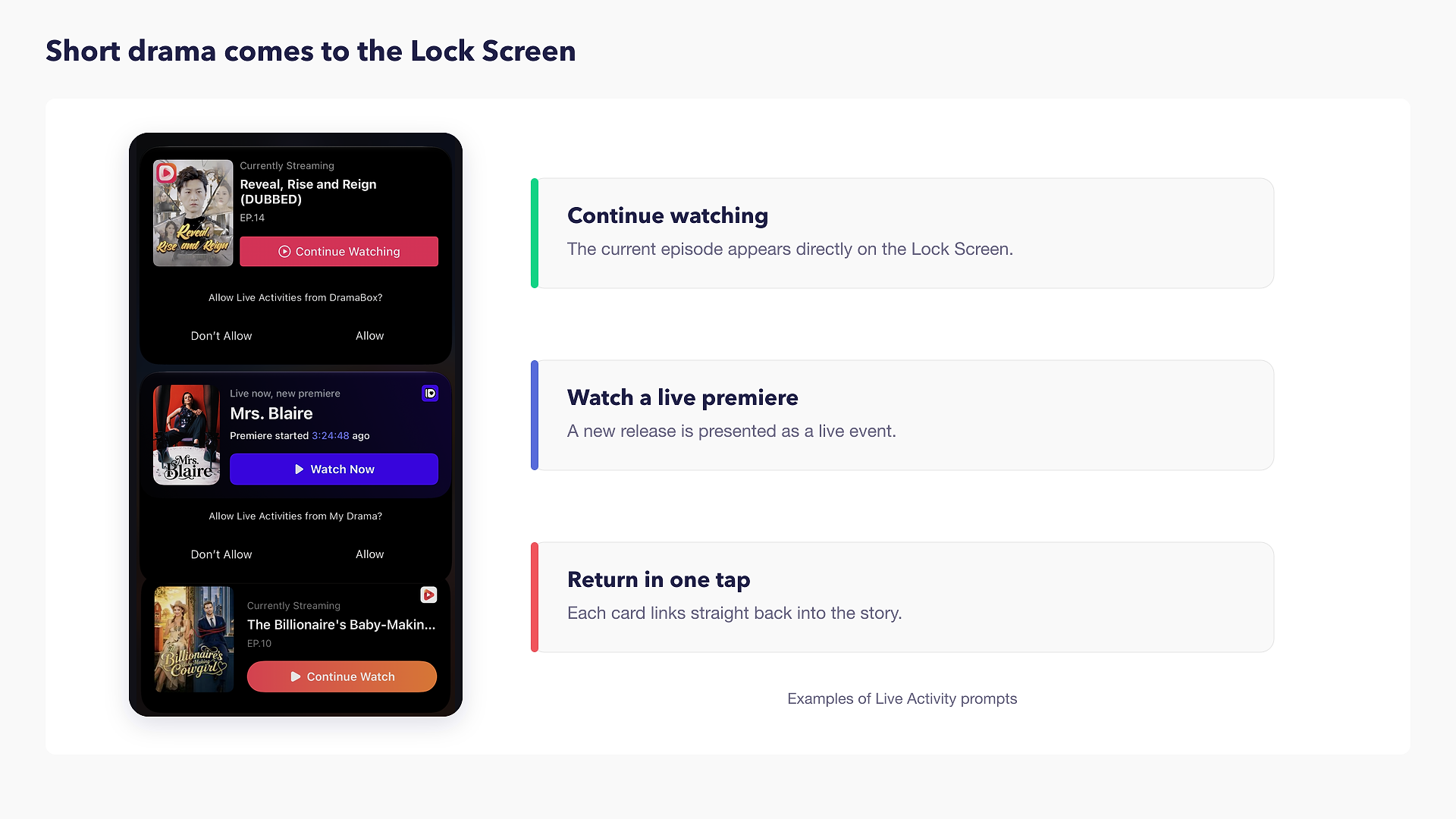
The rest of streaming is paying attention
Traditional media has moved from watching this category to investing in it
In the US, Omdia found that ReelShort users spent an average of 35.7 minutes per day in the app in late 2025, compared with 24.8 minutes for Netflix on mobile. ReelShort’s audience was much smaller, but those viewers spent considerably longer in the app each day
The industry moves are becoming concrete. Disney selected DramaBox for its 2025 Accelerator program. Fox took an equity stake in Holywater, the company behind My Drama, and committed to producing more than 200 vertical titles over two years. Peacock has launched a dedicated microdrama hub, TelevisaUnivision is producing vertical series for ViX, while TikTok is now testing a standalone app called LimeShorts, designed specifically for short vertical series
Not everyone needs to copy these billion dollar investments, or start cropping every show into portrait mode. The lessons that are up for grabs for anyone are on how tightly short-drama companies connect marketing, viewing, payment, and production. They can see which ad brought someone in, where that viewer stopped, what persuaded them to pay, and whether they returned
The weak point is retention. Established media companies already have the libraries, franchises, and programming experience that could help solve it
Quibi may have been early, but timing was not the only difference. The companies that followed rebuilt the idea around the phone - and found a business model that worked
Let us help!
Building a vertical-video product or rethinking mobile growth? Come talk to RevenueCat at IBC 2026 in Amsterdam this September!