
Chapter 8: Measurement for paid web-to-app campaigns
Now you’ve got your funnel and URL parameters ready to go, it’s time to finalize how you’re measuring everything. This differs depending on whether you’re operating with or without an MMP — which we covered in the core setup — both routes are covered below, and you can use our scorecard framework either way to measure success.
TL;DR:
Start without an MMP if web purchase is the primary conversion. AKA, if your team is mostly looking to answer: which campaign generated the web customer, and how valuable did that customer become?
Add in an MMP when that mobile attribution — or deferred deep linking, re-engagement, or cross-channel comparison — will change a decision, rather than just add another dashboard. AKA, use an MMP when your team also needs to answer: what happened between the campaign click, installation, first app open, and later app behavior?
What you can and can’t measure without an MMP
For paid UA specifically, here's what that decision looks like in practice — starting with what RevenueCat alone can and can't tell you:
How to interpret RevenueCat data without an MMP
If you’ve opted to not add an MMP, here’s how to measure your campaign’s impact using just RevenueCat data:
- Start with traffic arrival: compare ad platform landing page clicks with RevenueCat Funnels sessions. A large gap usually points to issues with the link, page load, redirects, consent, or reporting definitions — not the funnel sequence.
- Review initial conversions and initial conversion rate to judge whether the complete web journey turns sessions into trials or purchases.
- Open step-by-step metrics and compare both absolute drop-off and step conversion. Absolute drop-off shows where the most people are lost; step conversion shows which individual step is relatively weak.
- Break results down by consistent UTM values and stable campaign IDs so sources, campaigns, audiences, and creatives can be compared without manual cleanup.
- Monitor purchase redemption to see whether web customers successfully reach app access. Strong purchases with weak redemption indicate a handoff problem, not an acquisition problem.
- Evaluate customer quality using trial conversion, renewals, refunds, cancellations, and revenue at a consistent maturity window. Compare equally mature cohorts rather than mixing recent and older traffic.
- Reconcile ad platform spend and clicks with RevenueCat sessions, conversions, and mature revenue on a regular cadence. Expect differences; investigate changes outside the normal range.
For Meta specifically, validate the distinction between delivery and optimization before spending against the event. RevenueCat sends funnel events to Meta as custom analytics events, and Meta doesn't use those custom events for campaign attribution or optimization. Confirm that the standard subscription event for a new web purchaser is delivered, matched, and eligible for the intended optimization. If the team instead uses Meta Pixel or a web-native Conversions API implementation for the immediate web purchase, designate one authoritative purchase signal and remove or deduplicate the duplicate path.
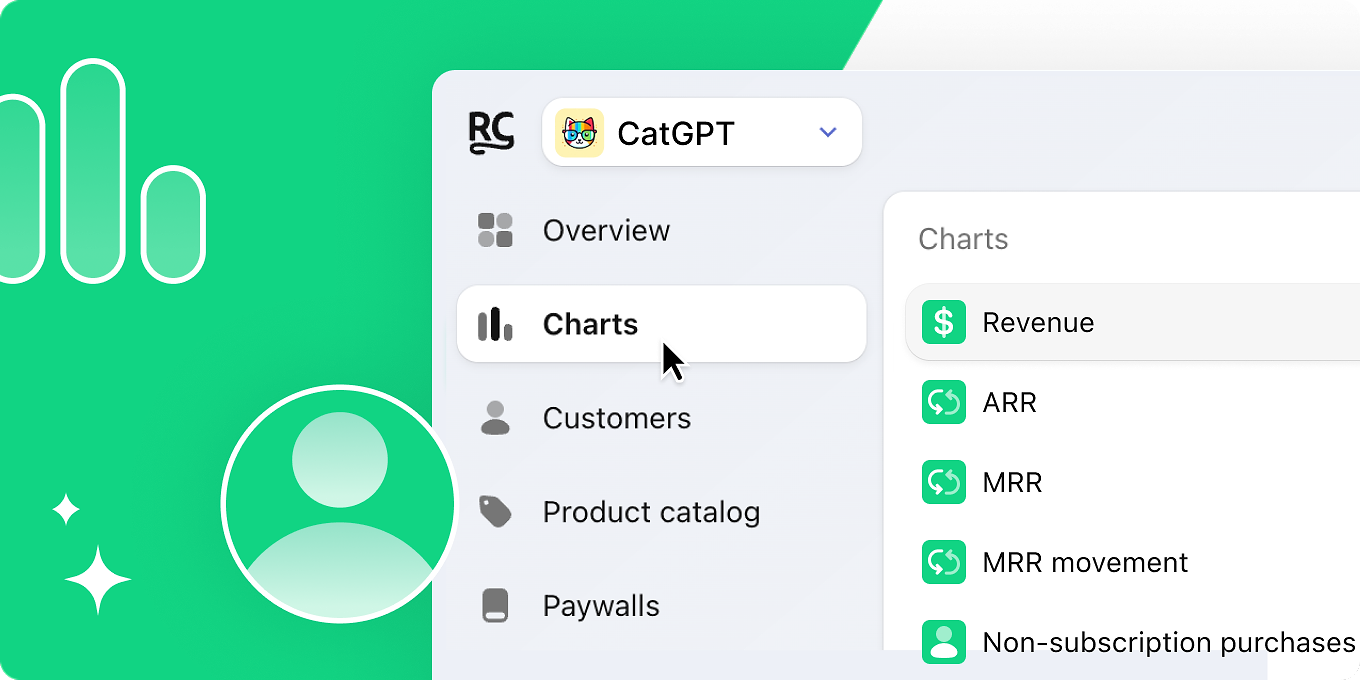
Dissect your campaign performance
Understand the source and volume of new users, dig into the drivers and performance of paid growth campaigns.
Operating with an MMP in RevenueCat Funnels
Use an MMP when your team also needs to answer what happened between the campaign click, installation, first app open, and later app behavior — see connecting an MMP in the core setup for how to connect one. Before scaling spend, verify the setup against your actual live campaign link, not a placeholder.
Scorecard for paid campaigns
Once you know which tools you'll use and how customer identity will move between them, it’s time to create your ‘scorecard’. Think of it as a repeatable framework that quickly answers two questions:
- Does the funnel convert visitors efficiently?
- Do those conversions become valuable customers?
The metrics you’ll want to include are:
- Click-to-session rate: RevenueCat Funnels sessions ÷ ad-platform landing-page clicks
- Initial conversion rate: funnel sessions producing a trial start or immediate purchase ÷ funnel sessions
- Checkout conversion rate: initial conversions ÷ checkout views
- Purchase redemption rate: eligible web purchases redeemed in the app ÷ eligible web purchases
- Customer acquisition cost (CAC): campaign spend ÷ new customers
- Trial-to-paid rate: paid trial conversions ÷ trials whose outcome is known
- Revenue at a fixed maturity window: for example, revenue through day 7 or day 30 for each acquisition cohort
- Return on ad spend (ROAS) or payback: calculated using a documented revenue definition and attribution window
- Guardrails: refunds, chargebacks, cancellations, support contacts, and early retention
Remember to be specific: whether ‘customer’ means trial starter, first payer, or purchaser after refunds. Also note whether revenue is gross, net of estimated taxes, net of refunds, or contribution margin. A metric without a definition is more of a hindrance than a help.