
Chapter 9: Validate, launch, and improve
Finish configuring your campaign with an accelerated soft launch, then use RevenueCat data to diagnose performance. Validation proves that the customer journey works; ongoing analysis tells you where to intervene.
Pre-launch check
Use the final campaign link to test the complete customer journey before increasing spend:
- Open the final campaign URL on a real device and confirm the expected parameters and branch
- Complete a sandbox purchase and verify the customer, product, purchase, and entitlement in RevenueCat
- Install or open the app, redeem the purchase, and confirm access in the intended account
- Confirm the required subscription event reached Meta and, if used, the MMP or product-analytics platform
- Run one controlled production transaction according to company policy, then begin with a small traffic allocation
Don't scale until links, checkout, redemption, event delivery, refunds, and support signals are behaving as expected.
Diagnosing problems with funnel metrics
When a metric looks weak, pause. Don’t rush in and change anything or start redesigning the funnel. Start with the part of the journey most likely to explain that pattern. This keeps the team from redesigning the funnel when the actual problem could be traffic quality, a broken link, the purchase-to-app handoff, or any number of things.
Here’s a quick guide to common problems and how to diagnose their cause:
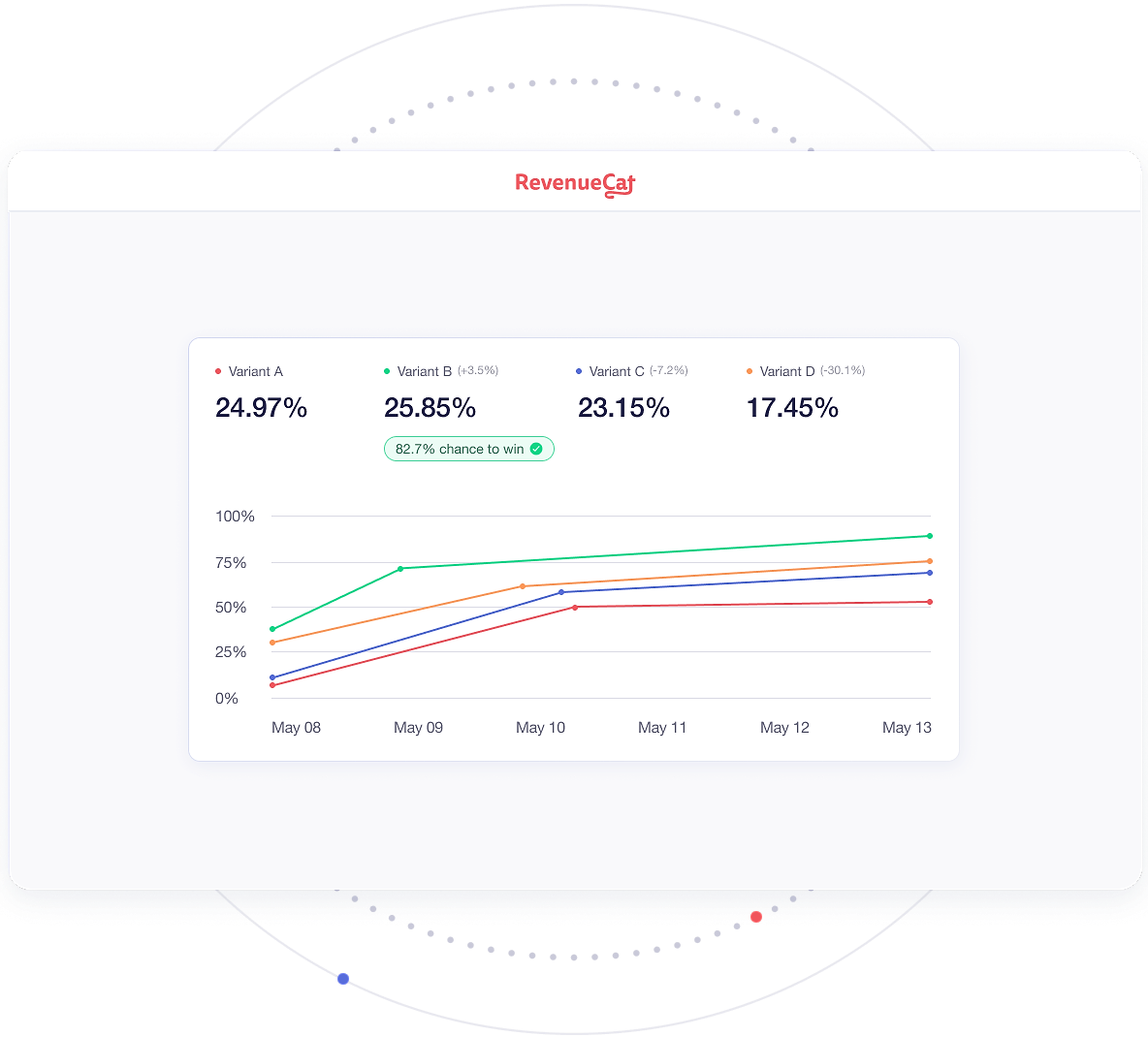
To diagnose your issue, change one meaningful variable at a time. RevenueCat Funnels experiments can split traffic across up to four variants, but start with A/B testing unless traffic volume supports more. Define the hypothesis, primary metric, guardrails, eligible traffic, and decision rule before publishing the experiment. (For more detailed steps, see the Experimenting with Funnels Docs.)
Even if you can clearly see where the problem is, budget and time constraints can sometimes make it simply impossible to adjust only one variable at a time. Since the difference in CVR per screen can be evaluated afterward, there's little reason against adjusting several screens at once in an initial optimization round. Only move to optimizing individual screens or individual variables per screen once the funnel is fundamentally working well.
Test, analyze, win
Shorten time-to-ship for new paywalls and experiments, get the results quickly, and improve your product right away.
Mobile growth agency REPLUG noticed a high drop-off rate on one lean test funnel despite early positive signals — users were leaving right at the start of the journey. App Growth Project Lead, Julia Gädke, explains: "We realized the user was being asked to commit to an app they'd never seen — including payment details and a trial start — before a single screen of the app itself was even visible."
Paying before installing reverses the usual relationship between impression and investment, turning the step into a genuine question of trust, not just a purchase decision. To fix it, the team added more in-app screens to give users a clear picture of the app beforehand, cut the number of onboarding questions to reduce perceived length and effort, and layered in additional trust elements around the payment step — and the result showed up in practically every step of the funnel, a sign the problem had been structural and rooted in trust, not one single weak screen.
Where web funnels hit their limits
For all its potential, a web-to-app funnel doesn't suit every app. For products that explain themselves in seconds — a simple calculator or flashlight app, say — the extra step through a funnel is more likely to hurt than help. The store page is enough on its own, and every additional click is just extra risk for drop-off.
As Nathan Hudson explains, you shouldn’t underestimate the challenges of web funnels: the hit on your ASO rankings, financial complications, and analytical complexities in analyzing customer journeys cross-platform.
The effort involved also deserves a realistic assessment. A funnel isn't a set-it-and-forget-it tactic. Good creatives, clear copy, and a well-thought-out question flow take time — and so does the ongoing evaluation and adjustment at the page level. Skip that, and you give up the format's real advantage: the ability to keep learning from granular data, instead of launching once and never looking again.
Regardless of whether you move every campaign to the web, or just experiment once, web-to-app funnels can be hugely beneficial to apps using web for the right reasons, with a clear campaign strategy, and reliable technical resources.