
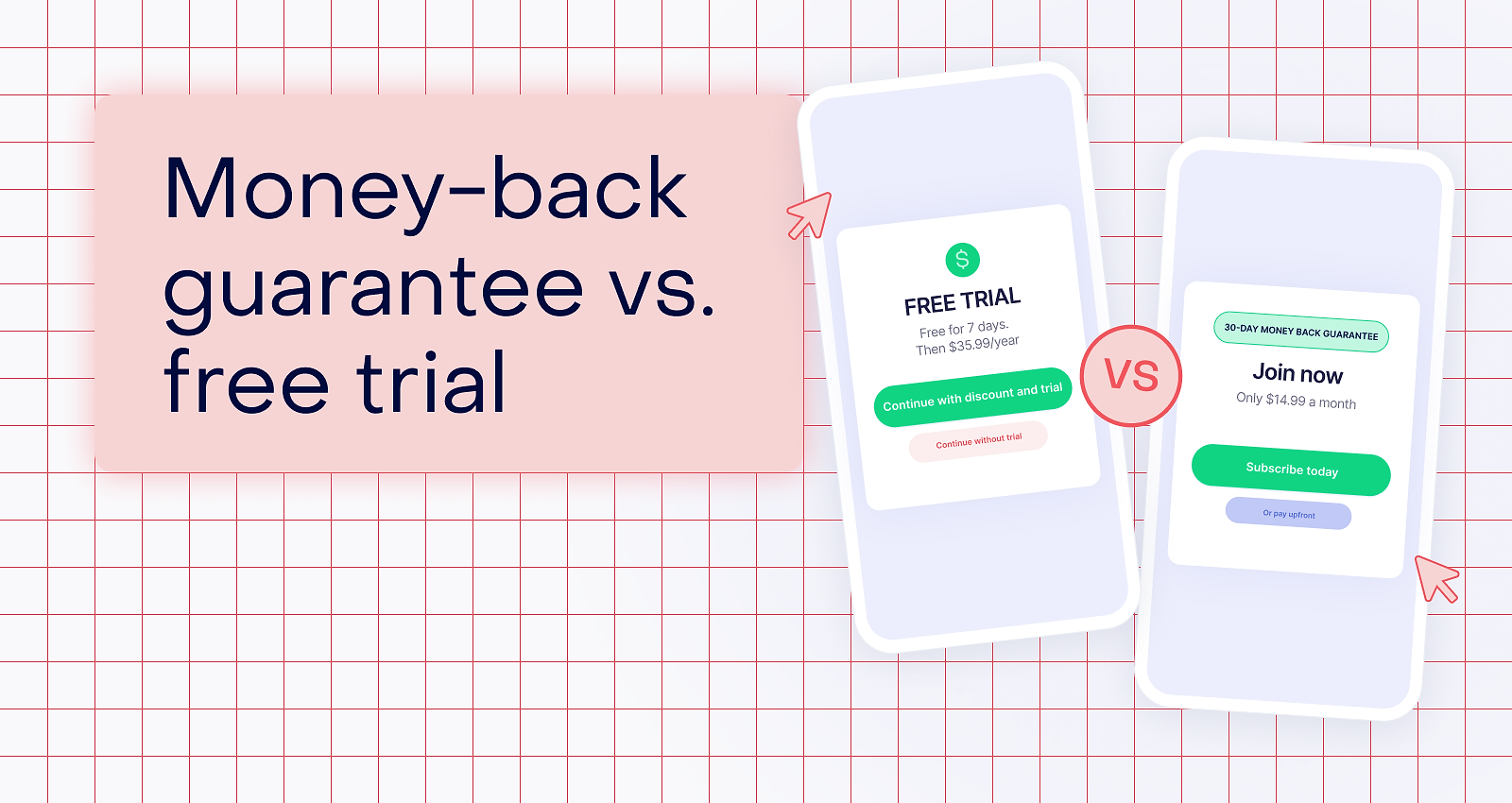

A few weeks ago, I convinced a client to run an experiment I wasn’t completely sure about.
Instead of the free trial they’d always offered, we asked people to pay upfront, with a 30-day money-back guarantee if they changed their mind. I’ll be honest: I was nervous. Free trials are the safe default, and here I was suggesting we ask strangers to hand over money before they’d even experienced the product.
But the questions it raised were too interesting not to explore: how does the length compare? What kind of signal does it send? And could it actually work better for some apps?
When I mentioned the idea in an app expert group Slack, someone replied: “I just don’t think they replace free trials.” They weren’t wrong, exactly. And that’s the point of this piece.
I’ve discovered that a money-back guarantee won’t magically transform your app. But it is a genuinely powerful free trial alternative — and one that far too few companies are using strategically.
So let’s give it a go, and if you’re not convinced by the end, you can have your 10 minutes back (100% time-back guarantee).
Money-back guarantees: free trial alternative or passing trend?
A money-back guarantee lets users pay upfront and claim a full refund (within a set window) if the app isn't right for them. These guarantees haven’t always been used in apps for a simple reason: they’re difficult to offer inside the app itself. But with the rise of web-to-app funnels, they've moved from the SaaS world into subscriptions, and were even highlighted by Nathan Hudson, founder of Perceptycs, as one of the monetization trends to watch last year.
While running this money-back guarantee experiment, I keep coming back to the same questions:
- What's the right length?
- What works well?
- Will it actually make a difference?
- Should it run alongside a free or a paid trial?
When I talk about this with the app community, there’s a lot of skepticism. Does it really work? Does it meaningfully change conversion or retention? I guess we’ll find out…
The case for money-back guarantees
The app industry has long relied on free trials as a way to let people experience an app before committing. But as subscriptions have become more common, users have become increasingly skeptical about signing up, worried they’ll forget to cancel and end up paying for something they no longer want. You can see that hesitation in the data — RevenueCat's State of Subscription Apps 2026 found that 55% of three-day trial cancellations occur on day zero, well before users have had a chance to experience the product’s value.
Cleaner signal for Meta
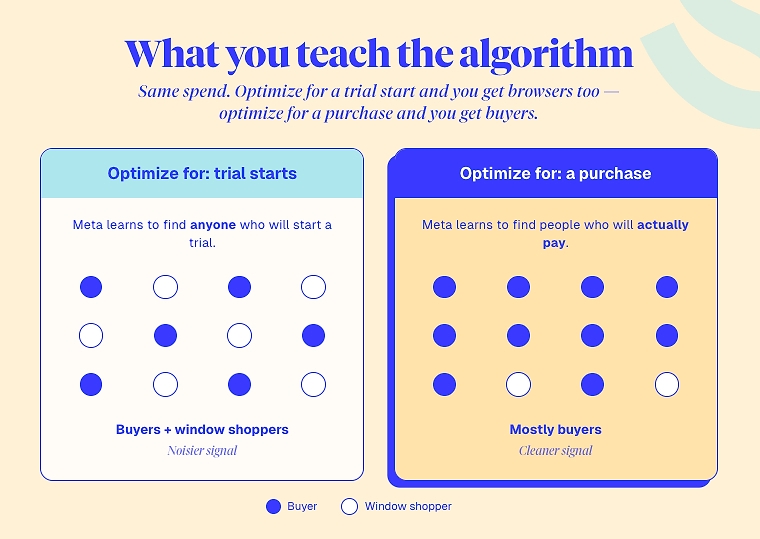
As Meta becomes harder to optimize, many of those trial users are effectively window shoppers. The more of them we chase, the more our cost of acquisition and trial conversion rate suffer.
A money-back guarantee flips that dynamic. On platforms like Meta, you optimize for a direct purchase event, teaching the algorithm to find people who are willing to pay rather than people who are simply willing to start a trial. Same spend, cleaner target.
Nathan captured it well when he highlighted the trend: "By pushing a hard paywall with a money-back guarantee, you can optimize your Meta and TikTok campaigns for the direct purchase event, removing the complexity and opacity of dealing with trial conversions."
There's another advantage, too. When someone takes a free trial and cancels, you've still paid to acquire them. With a money-back guarantee, most customers never claim a refund, so you're only refunding a small subset while keeping the revenue from everyone else. At the same time, the guarantee reduces the fear of committing: customers have paid, but they know they have a safety net if the product isn't right for them.
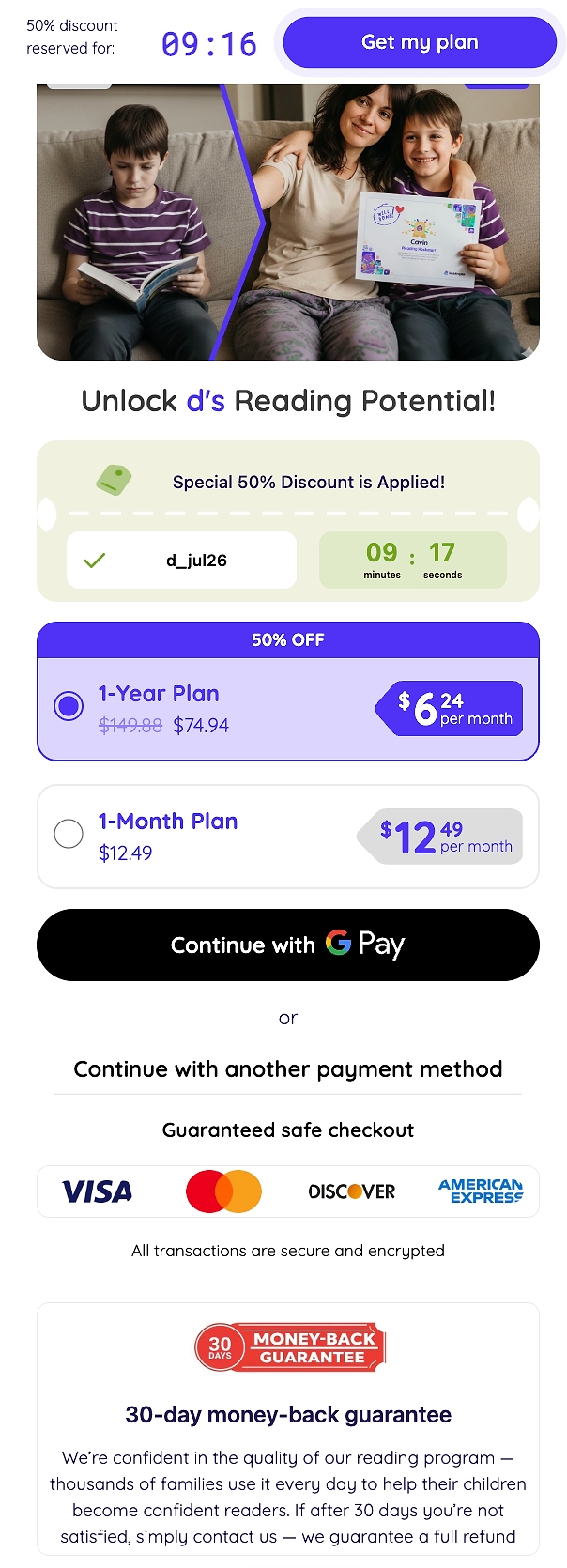
We saw this with Reading.com (owned by Teaching.com), which replaced the free trial on parts of their web-to-app funnel with a 30-day money-back guarantee. Conversion rates fell, but the purchase event gave Meta a much stronger optimization signal. They still use free trials elsewhere, but for these campaigns the guarantee became a powerful way to attract higher-intent users.
As Tim Dikun of Teaching.com shared on Sub Club, very few customers actually claimed the refund, partly because the product delivered on its promise. The lower conversion rate was more than offset by attracting users who were more likely to stick around and become long-term subscribers.
Refund fear is a common reason for not offering a money-back guarantee, but in reality refund rates are often much lower than people expect. I offered a money-back guarantee across a range of courses over five years, and across 100s of sales I had just one refund request. It came from someone who thought the course would focus on something different from what it was actually designed for (and I of course refunded them immediately).
How to run a guarantee
Like I said, we don't tend to see money-back guarantees directly inside apps, and the reason is simple: the app stores control the refund process. With Apple, users request refunds directly through Apple, and Apple takes back your post-commission share, not the full price. With Google, users can request a refund directly through Google Play within 48 hours of purchase. After that, the decision is yours, and you can issue refunds yourself from the Play Console or RevenueCat. Either way, the refund comes out of your proceeds.. Neither platform has a native ‘money-back guarantee’ feature, so there's no way to automatically approve one inside the app.
On the web, though, you don't have these limitations. You have full control over refunds through your payment provider, whether that's Stripe or another web billing tool, and the fees are usually lower too. You can also define your own guarantee policy and rules. Some apps offer a 30-day money-back guarantee, while others go as far as 100 days (typically for web purchases and first-time customers only).
That flexibility is slowly making its way in-app through app-to-web payment flows. While you can't natively configure a money-back guarantee for in-app purchases, you can use an app-to-web payment flow to achieve the same level of control you have in a web funnel.
In practice, offering a guarantee for in-app purchases isn't a setting you simply switch on. You promise the refund in your paywall and marketing copy, then honor it by issuing refunds directly on Google Play, and on iOS by using Refund Control to tell Apple you'd prefer to grant the refund. Apple still makes the final call.
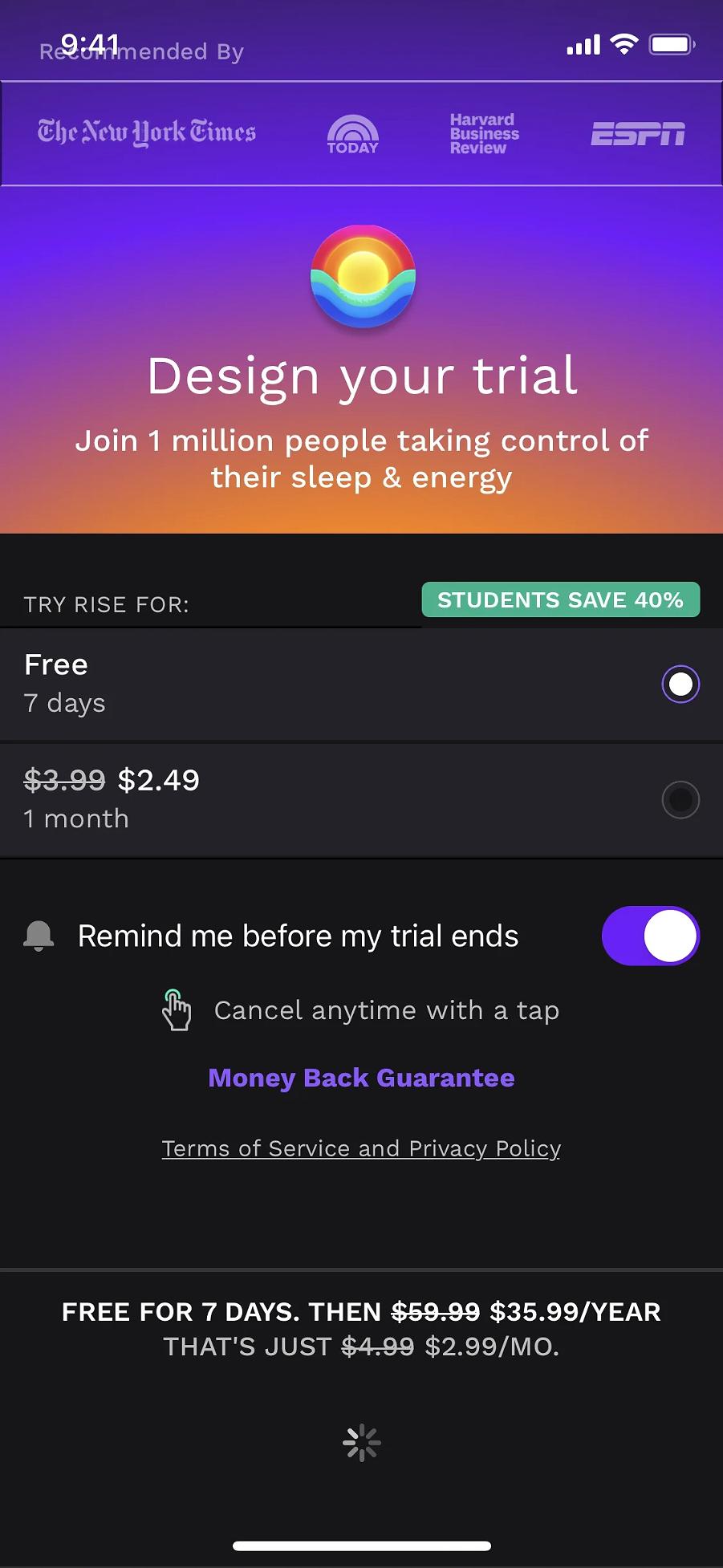
Sidenote: I spotted a few apps on Mobbin promoting in-app money-back guarantees, although I couldn't find the messaging in their App Store listings. I tried reaching out to them but sadly I haven't been able to confirm exactly how, or why, they're implementing those guarantees.
Cristian Rotari, a product growth expert who has designed a lot of subscription paywalls, raised the obvious question here: how do you even run a guarantee on iOS when Apple controls the refund process?
His answer is the one I keep coming back to. You either provide Apple with consumption information to support the refund decision, or you rely on clear terms in your guarantee, something like “use the app at least three times and show that you didn’t get the promised value,” so you have a basis for approving it. It’s less a switch you flip and more a promise you honor case-by-case.
It’s also worth remembering that the app stores already allow users to request refunds, whether or not you offer a guarantee. The platform mechanisms exist; the difference is that most users don’t know about them. The guarantee is really about making the promise visible and removing the fear of committing. It’s like telling someone with an avoidant attachment style that they can leave at any time, only for them to suddenly not really fancy going anywhere.
That’s why the most powerful place to use it is usually in your web funnels, especially if you’re running paid acquisition. So how do you set one up for success? There are a few key things to consider.
The implementation playbook
1. What do you run it alongside?
Alongside a free trial, I don’t think you’ll see much lift from adding a money-back guarantee. People already have the chance to try the product for free, so you’re really just layering free on top of free.
It gets far more interesting with the upfront payments we talked about. There’s also a third option: a paid trial. Here, you offer a lower-cost paid trial upfront and then add the guarantee on top. This helps counteract the drop in conversion you often see when asking people to pay before they’ve experienced the full value.
With one client, the uptake of a paid trial is lower than a free trial, but the overall conversion to paid is higher. Adding a money-back guarantee on top, giving users that extra layer of security and trust, pushes it higher still.
2. What guarantee length should you offer?
The right length should track time-to-value, in the same way trial length does.
Roughly:
- 7–14 days for utilities and products with fast, obvious value
- Around 30 days for habit and health apps, where the benefits take a few weeks to become clear
- Longer periods where trust is lower, or the payoff takes more time to appear
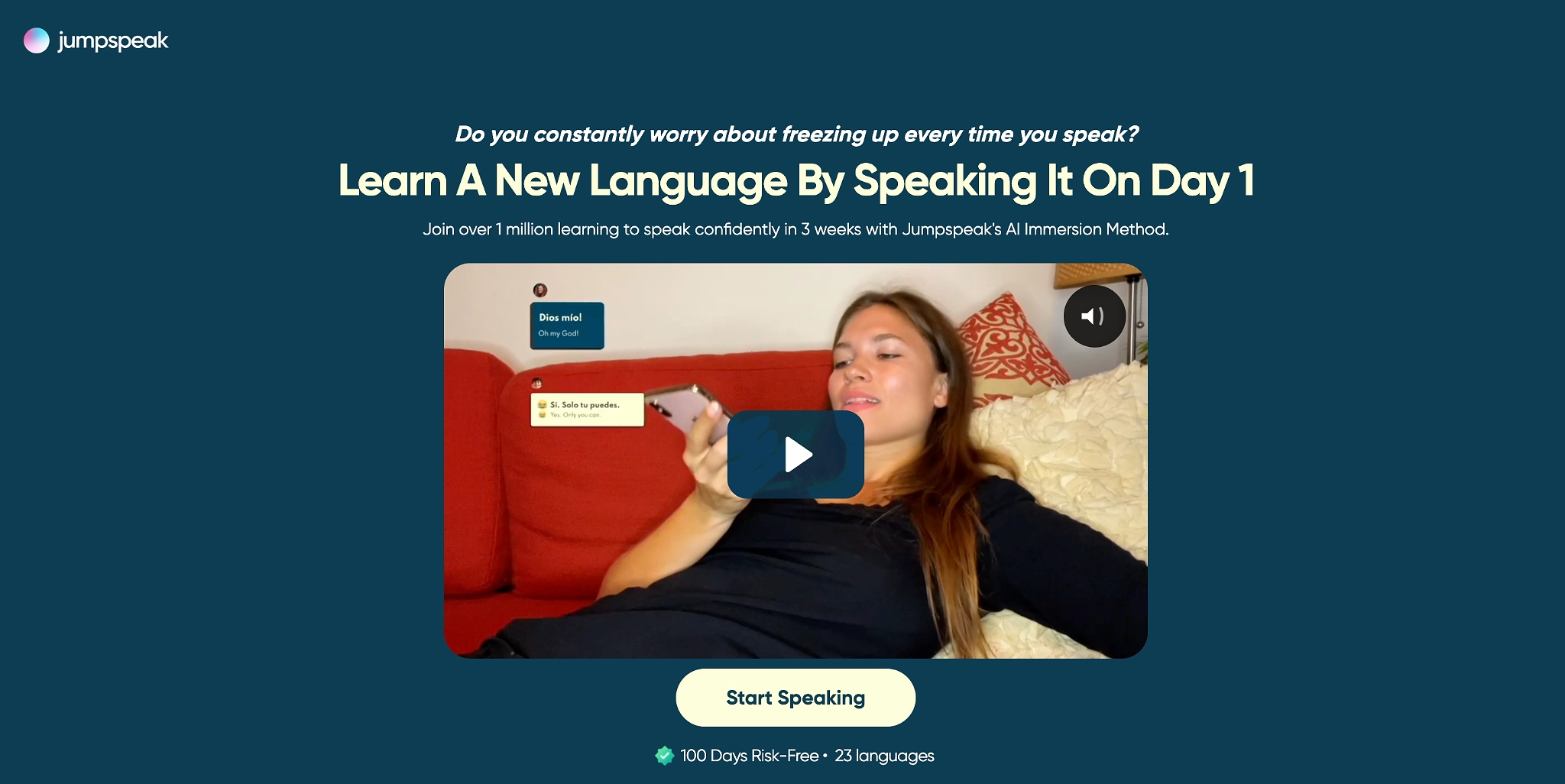
Jumpspeak, operating in the competitive language-learning space, goes as far as offering a 100-day guarantee:
Interestingly, the research points in the opposite direction to what you might expect. A University of Texas meta-analysis of 21 studies (Janakiraman et al., 2016) found that longer, more generous return windows increased purchases without increasing returns. The explanation is the endowment effect: the longer someone owns something, the less likely they are to give it back.
That research is from ecommerce rather than apps, and money-back-guarantee research is still relatively limited, but it’s a good reason not to make your guarantee unnecessarily restrictive.
I tend to start clients around 30 days (I mostly work with health and wellness apps) because it's a familiar, trusted timeframe, then test longer if refund rates stay low. The downside is that guarantees take time to evaluate — you need to wait until the guarantee period has passed to understand the true impact — so starting with a sensible default helps you learn faster.
3. Positioning, design and copy
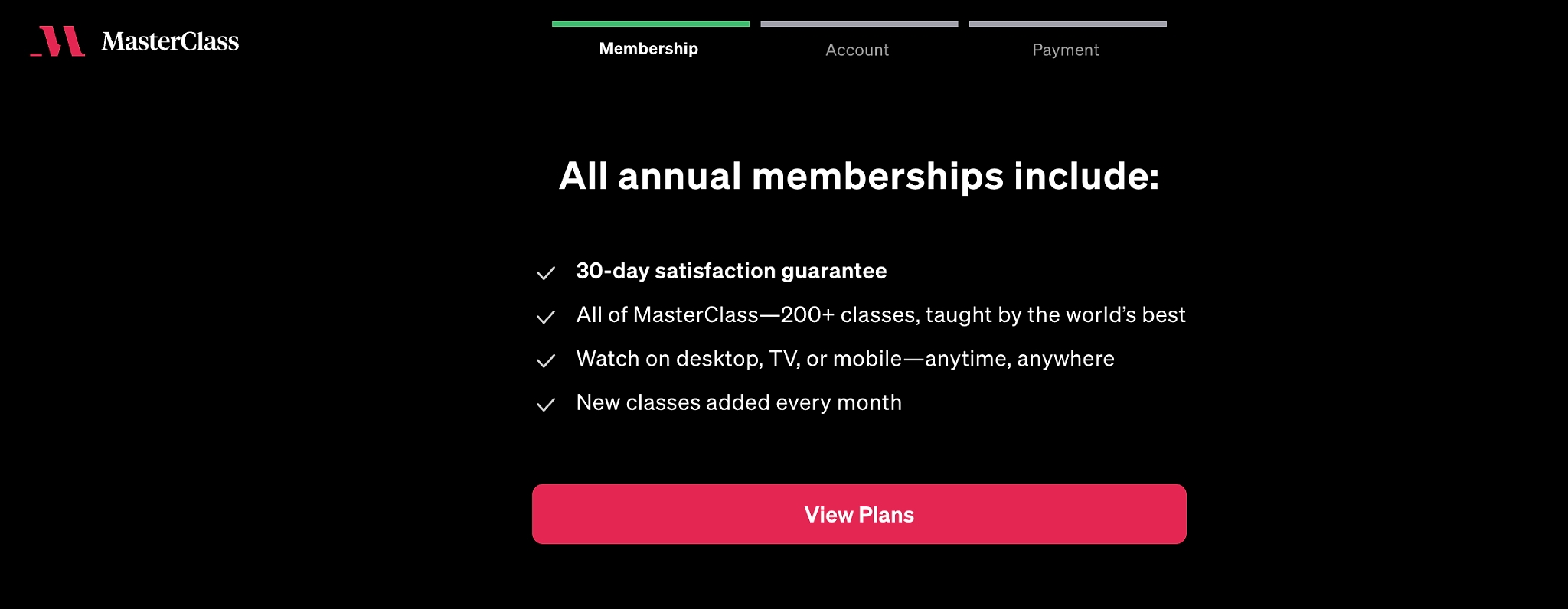
Let’s talk about how you communicate this money-back guarantee. A lot of apps go for the classic "full refund, cancel anytime". I think it's important to keep the policy easy to understand, without too many hidden conditions or contradictions. That allows your landing page messaging also to be simple and clear, like MasterClass:
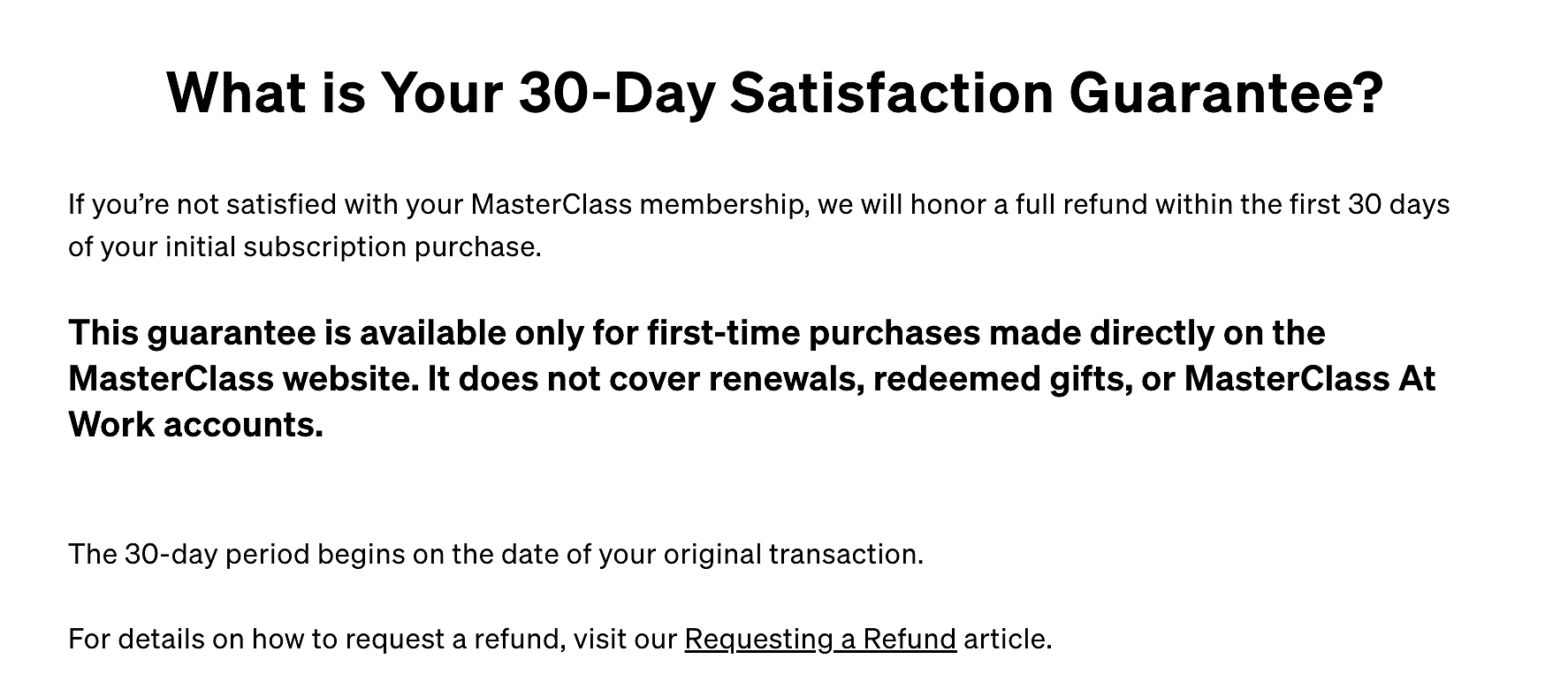
Their FAQs then spell out exactly what the guarantee covers:
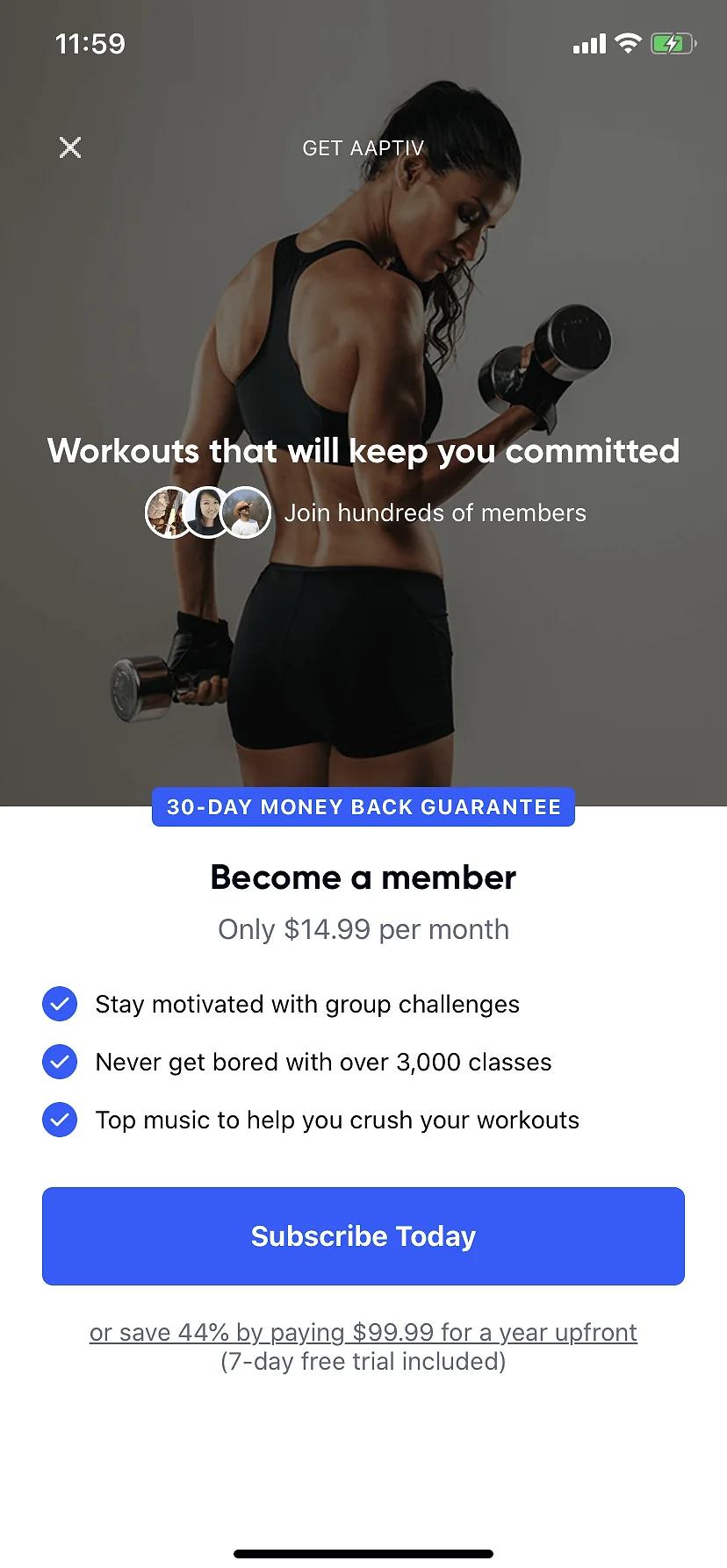
The best examples I see of money-back guarantees keep the messaging simple and usually will repeat it on the paywall (if in-app), often near the CTA:
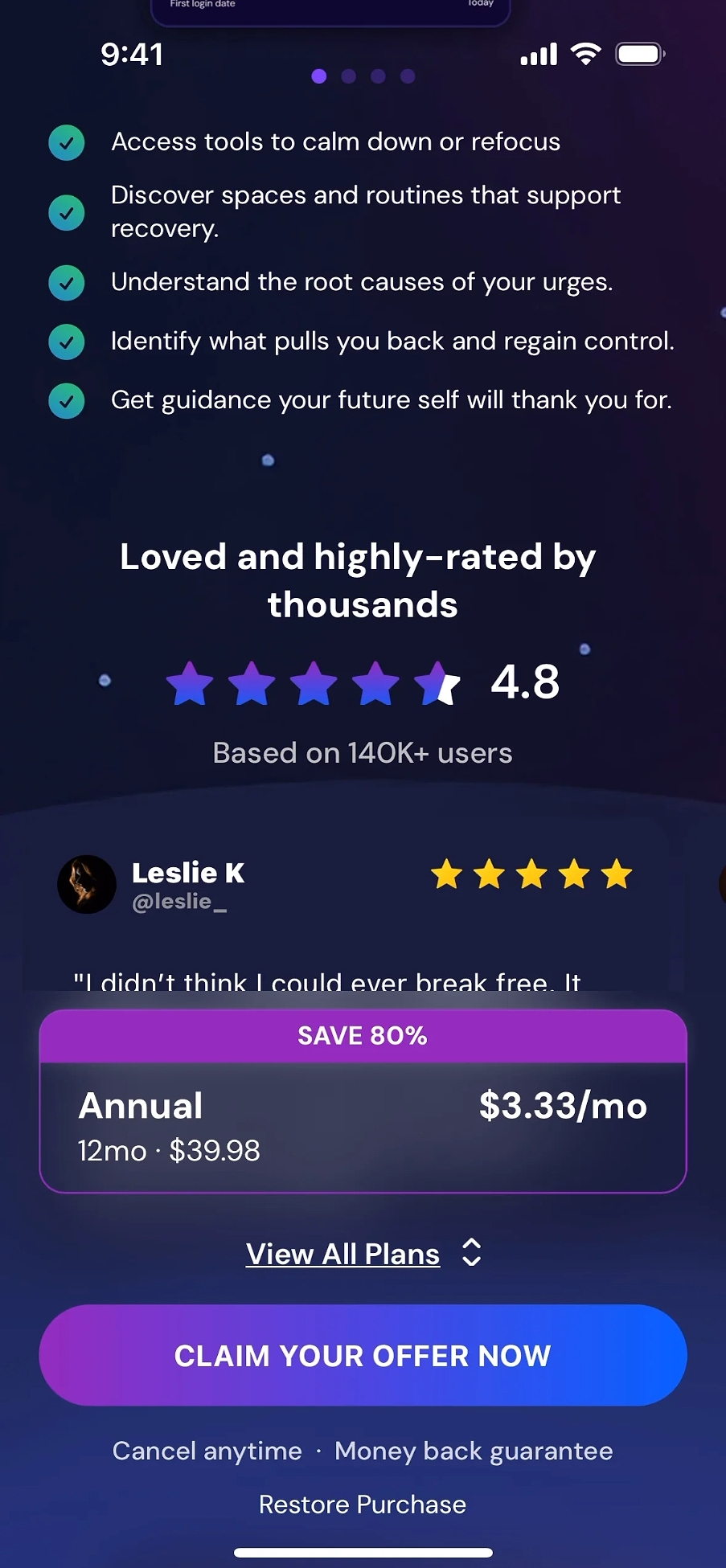
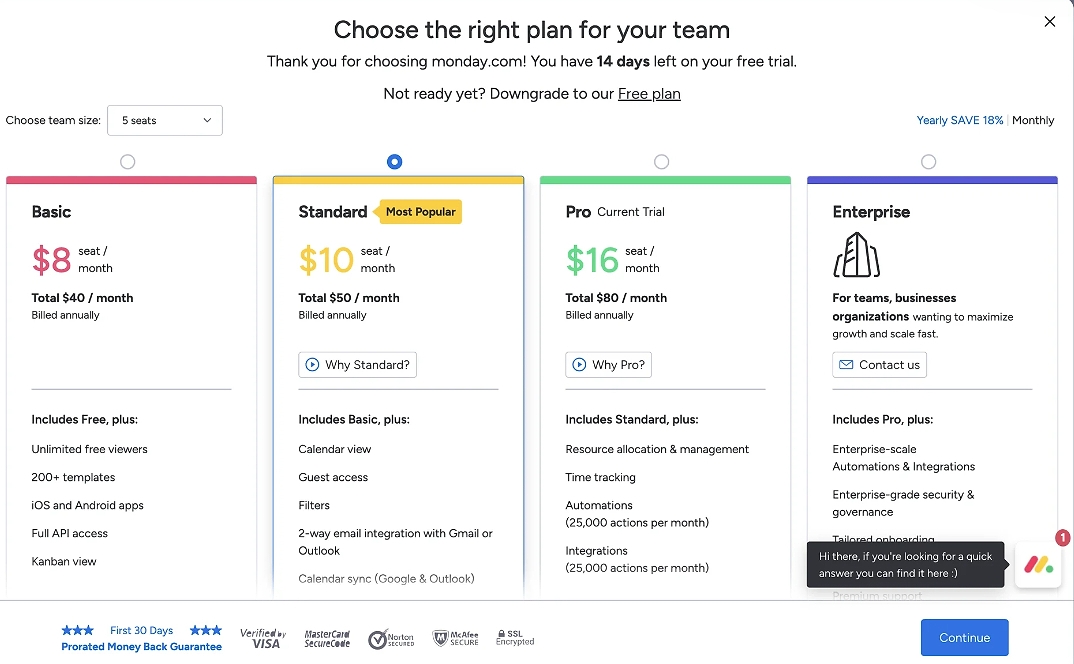
They’ll often use some type of symbol to represent the guarantee and create an official feeling to it, as Monday.com does:
Should everyone be allowed a guarantee?
Maybe we’ve all got a bit of fear of abandonment when it comes to our customers.
If you're worried about abuse, or you've already tested a money-back guarantee and seen high refund rates from people who never even opened the app, you might tighten the rules. For example, you could ask users to try the app at least three times before they're eligible to claim a refund or if they exceed a certain usage (common with AI tools) you don’t get a refund.
But keep the policy simple and clear. The negative reviews and loss of trust that come from an overly complicated or overly restrictive guarantee can easily outweigh the value of offering one in the first place.
4. Preparing operations for it
When you test it, think through your refund logic and the operations around it. Have standard responses ready and a clear process for handling requests.
And yes, you'll still get the occasional person who repeatedly subscribes, claims a refund, and signs up again. They're a bit like the person at the ice cream shop who samples twelve flavors before finally choosing classic strawberry (or not buying an ice cream at all).
I don't think it happens nearly as often as people fear, but those people are out there, so it's worth deciding in advance how you'll handle repeat claims.
A few things make this painless at any volume:
- Write two or three canned responses so your support team isn't drafting every refund from scratch: one that quickly approves a request, and another that asks a qualifying question first if your guarantee has conditions.
- Decide upfront whether you'll automatically approve refunds below a certain amount and only manually review the rest. Fighting a $12 refund often costs more in support time and negative sentiment than simply issuing it.
- Finally, keep a simple log of refund claims. That way, the occasional serial refunder becomes a pattern you can spot and manage, rather than a surprise.
None of it is particularly complicated, but deciding it before you launch means your support team is prepared, your process is consistent, and customers have a better experience when they do request a refund.
5. Run a test and measure the results.
Always run this as an A/B test. And when you analyze the results, wait until the full refund window has closed for the last cohort, because refund requests often come towards the end of the guarantee period.
Treat refund rate as a KPI, but the metric you really care about is net profit. Once you've accounted for refunds and measured the impact on conversion, you can work out which option actually leaves you with more money on the bottom line.
A simple way to think about it: imagine your free trial converts 10 out of every 100 visitors into paying subscribers. Your money-back guarantee might only convert 7. But if just one of those seven claims a refund, you're left with 6 full-price, committed customers — and Meta is optimizing against 7 real purchases instead of a large pool of trial starts.
Whether 6 committed buyers beats 10 trial starts depends on your refund rate, your pricing, and how much stronger the purchase signal makes your acquisition. Which is exactly why you run it as an A/B test and judge it on net profit, not conversion rate alone.
One final caveat: keep an eye on reviews and customer feedback. If the guarantee is hurting word of mouth or driving an unexpectedly high number of refunds, you may decide it isn't the right fit after all.
Pitfalls and when not to offer a money-back guarantee
Just like cilantro or pineapple on pizza, money-back guarantees aren’t for everyone — although Italians would probably argue pineapple on pizza isn’t for anyone (and I’d be inclined to agree with them).
If you're not running any web-to-app or app-to-web payments, and it's worth remembering these still aren't available in every country, I wouldn't fixate on a money-back guarantee right now.
Remember that line from the group chat: "I just don't think they replace free trials"? That was Cristian Rotari. He pushed back on some of the hype, and he’s largely right. As he puts it, a money-back guarantee “can’t sit at the level of a trial or a discounted period; it’s more of a nice-to-have,” — it’s a conversion lever rather than a groundbreaking pricing tactic.
And he had the receipts. Looking through three months of refund tickets at one of the apps he worked with, he found fewer than ten mentions of the guarantee, most from people appealing after a refund had been rejected. Hardly anyone actually uses it, which is exactly why it costs relatively little to offer, and exactly why you shouldn’t expect it to transform your numbers.
There are two more things to weigh. First, app-to-web checkout can feel unfamiliar or untrustworthy to some audiences, especially younger, app-native users. A guarantee won’t fix a payment flow they already don’t trust (Cristian makes this point too).
Second, this all depends on external payments, which have only recently become more available through changes like the Digital Markets Act in Europe and the Epic v. Apple court ruling in the US, and still aren't accessible everywhere.
To be specific about when to skip it: if your app’s value only becomes clear after weeks of use, asking people to pay upfront means asking for commitment before you’ve earned it. If you’re operating at a low price point where volume is everything, upfront payment may cost you more installs than the cleaner signal is worth. And if you’re not running meaningful paid acquisition, the biggest benefit — a stronger ad signal and potential conversion lift — largely disappears, meaning a free trial may do the job with less friction.
Should you offer a money-back guarantee?
So, should you run one? Here’s my honest take: if you’re scaling paid ads through a web or app-to-web funnel, and you have a product that people genuinely stick with, a money-back guarantee is well worth testing. The biggest upside is the signal it gives ad networks, just don’t let yourself believe it will suddenly transform your conversion rate overnight.
If you’re not running paid acquisition, or you’re still figuring out product-market fit, I’d park it for now. A trial will probably serve you better.
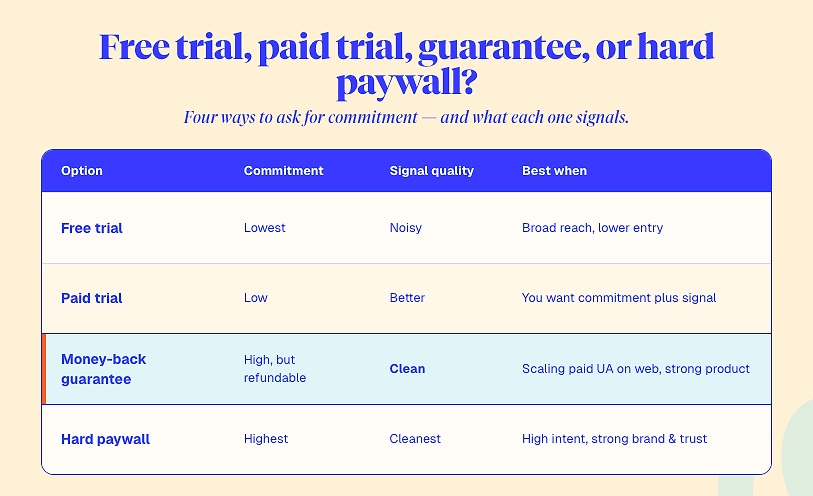
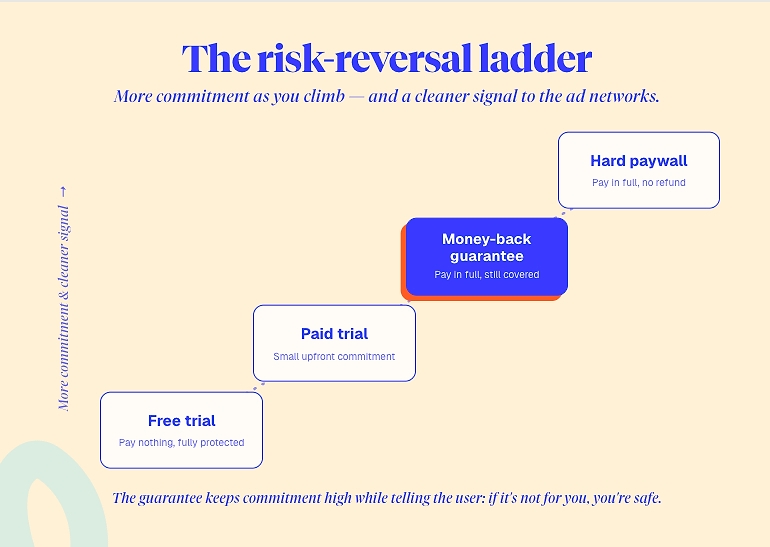
The way I think about it is as a risk-reversal ladder:
- A free trial removes the most risk for the user
- A hard paywall removes the least
- A money-back guarantee sits in the middle: the user pays, but they have protection if it doesn’t work out
It keeps commitment high while still saying: “If this isn’t right for you, you’re safe.”
So start small: pick one segment, one funnel, and one guarantee window — ideally a generous one — and measure two things: your refund rate and whether your ad signal actually. Then judge it on net profit, not conversion rate.
That’s exactly what I’m doing with my client right now. I’ll report back on what the refund rate really looks like, and whether the window shoppers do turn into buyers. (My money’s cautiously on yes.)
Before you test one, run through five quick checks. Try a money-back guarantee if:
- You're scaling paid UA
- You have web or app-to-web payments live
- Your value is clear within the guarantee window
- You can handle refunds operationally
- Your margin can absorb a realistic refund rate
If you can’t tick most of those boxes, a free trial is probably still the better option.