

When setting up your paywall targeting, how do you segment your audience? Naturally, you probably think about who the user is, and what they’re doing before they hit that paywall. But there’s another layer that influences whether they click ‘subscribe’: context.
Demographics say who, behavior says what, but context decides when. A user on the move vs. on the couch has radically different intent when faced with a Runna paywall.
Context is a combination of timing, motion and mentality. It’s about when a user is ready to commit. That timing shapes intent dramatically; the same person can feel ‘not now’ in one moment and ‘I’m ready’ a minute later, all depending on the context.
In a world where attention is shifting constantly, and 82% of trials start on day zero, showing the right message at the wrong moment may be the biggest leak in your funnel.
Learn how to trigger paywalls in those precious milliseconds when attention and intent peaks, and you can turn ‘not now’ into ‘subscribe’.
The cost of mistimed paywalls and the limitations of traditional paywall optimization
Every day, millions of users encounter paywalls at the wrong moment. They’re rushing to catch a train, trying to focus in a noisy environment or simply not in the right headspace to evaluate a subscription. The result? Frustration, negative reviews and lost revenue (that most apps never measure).
That friction pushes people out of the funnel.
To iron out that friction, you probably look to paywall optimization. Typically, paywall optimization means demographic filters, simple behavioral triggers and lots of A/B tests. But this 2018 playbook isn’t working anymore — the State of Subscription Apps report 2025 reveals some striking gaps between average apps and top performers:
Much of that gap comes down to when the paywall appears. Traditional optimization treats all day zero users identically; whether they’re commuting to work, lying in bed or sitting in a coffee shop. It’s ignoring the when.
So how do you serve users paywalls at the right time? Contextual targeting.
While paywall targeting allows you to customize your paywall and offerings to specific segments, adding context lets you also customize to the users’ circumstance, surroundings, and behavior.
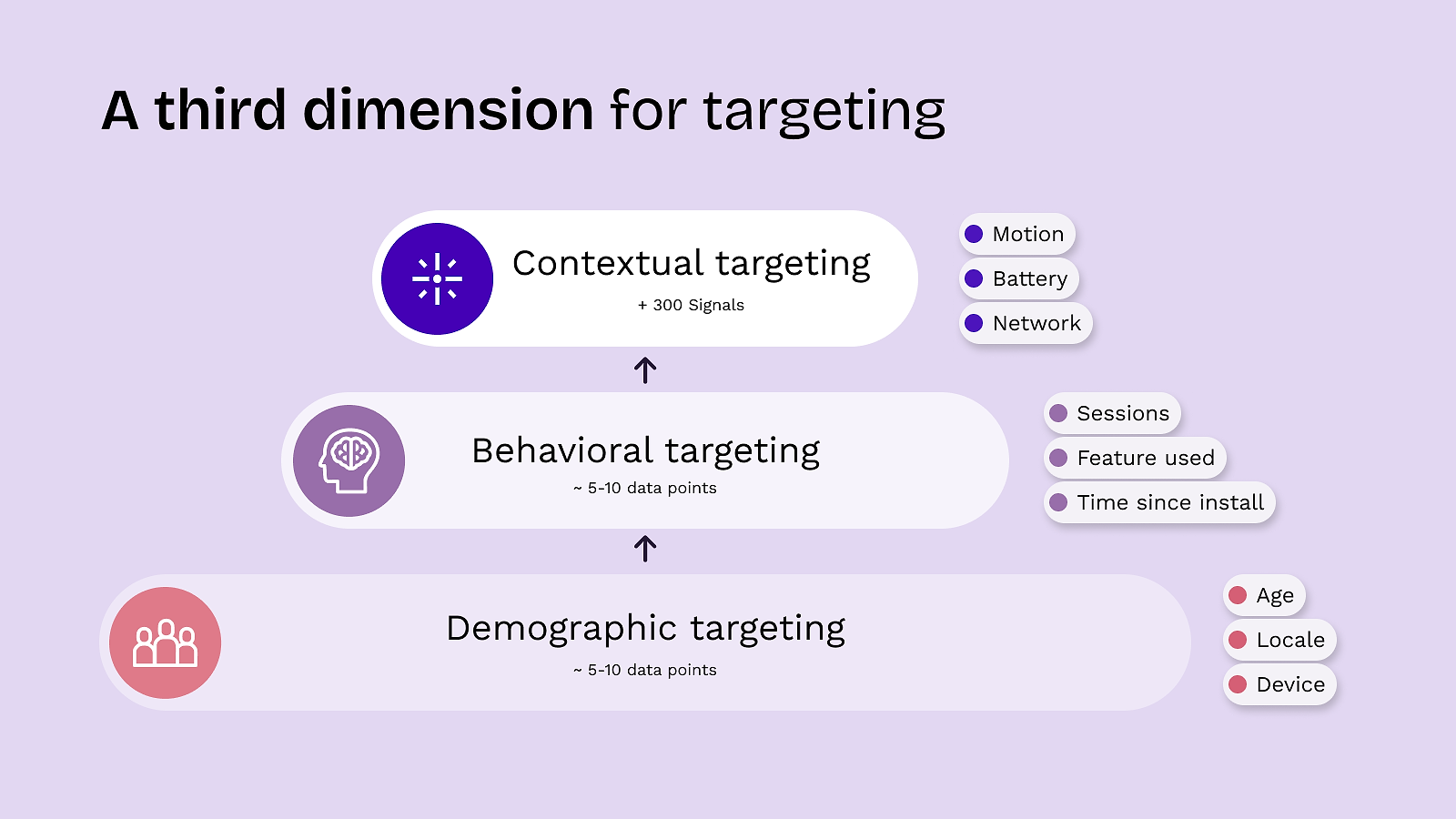
A third dimension for targeting: the user’s context
Traditional paywall optimization relies on roughly five-10 data points, like time-since-install, features accessed, demographic info and basic usage patterns. This data barely scratches the surface of who your user is, what their life is like and how they interact with your app. You need context.
Your smartphone generates over 300 contextual signals every second: motion data, how the user holds their phone, battery level, ambient light, connectivity status and dozens more.
While human analysts can meaningfully process maybe three–four variables simultaneously when making targeting decisions, machine learning models can analyze all 300+ signals in real-time to identify the optimal moment for paywall display. Of course, context-aware machine learning doesn’t replace human intuition — it simply amplifies it, with real-time data that humans can’t process at the same scale.
These additional context signals don’t replace demographic and behavioral targeting; they add a third dimension that can significantly enhance targeting effectiveness. A 25-year-old professional might be your ideal customer demographic, but their conversion likelihood varies dramatically based on whether they’re walking to a meeting whilst on a business call and 5% battery, or relaxing on the couch scrolling TikTok with their phone plugged in.
Mobile gaming makes the impact of contextual targeting visible: immersion is fragile, time is valuable, and heavy-handed offers break flow. But by timing prompts to natural pauses, you can harness users’ engagement and meet them in context. One example is indie puzzle game Blackbox, who recorded a 50% revenue increase during peak periods and a sustained conversion lift over subsequent months — gains achieved by changing when paywalls appeared, not what they said.
9 strategic moves to improve paywall targeting (by role)
Timing of your paywall influences downstream metrics like refunds and early churn. The performance gap between top apps (4.6% download-to-paid) and the median (1.9%) is not only about pricing or features, it’s about whether the prompt arrives when a user is receptive. Used carefully, contextual timing can improve conversion and user satisfaction — the intent is not to show more paywalls, but to show them at better moments.
Contextual targeting strategies for growth teams
Growth teams live in a world of competing priorities: hit this quarter’s numbers, optimize long-term LTV, reduce CAC payback period and still find time to run meaningful experiments. Context-aware timing helps by improving the efficiency of the monetization funnel.
1. Rethink A/B testing: make timing the variable
A/B tests on paywall placement take weeks, and often miss the real driver of lift. Shift focus to when the prompt appears. Run smaller, parallel experiments across moments and segments, keep a true control, and judge outcomes on cohort LTV, refunds and early churn, not just day zero conversion.
2. Choose the right plan for the moment
The State of Subscription Apps report 2025 shows one-year retention differs by plan type (about 44.1% annual vs. 17.0% monthly vs. 3.4% weekly). Why not match which plan users are served to their context?
In high-consideration contexts such as stationary, longer evening sessions with deeper engagement, present annual plans or even lifetime subscriptions. In brief, in-motion sessions, surface shorter options like weekly or monthly. Validate the mix with retention and refund behavior rather than first conversion alone.
3. Hold back to capture more
This might seem counterintuitive, but one of the most powerful moves a growth team can make is holding back monetization prompts. For example, Dating app Wizz found that cutting prompt volume by roughly 50%, while timing offers to receptive contexts, ended with an 81% lift on the primary offer flow.
The lesson is simple: suppress in low-intent states and reallocate to moments instead of increasing total exposures. Users will feel less interrupted and more in control, and cohorts in the experiment above reflected it, with LTV up by roughly 20%.
Contextual targeting strategies for product managers
Product managers own the whole experience. Every monetization choice trades off exploration versus interruption. Treat timing as part of the product, not just a rule, so you can protect flow and still capture intent.
4. Make timing part of the UX
The best product experiences feel like they’re reading your mind; surfacing exactly what you need, exactly when you need it.
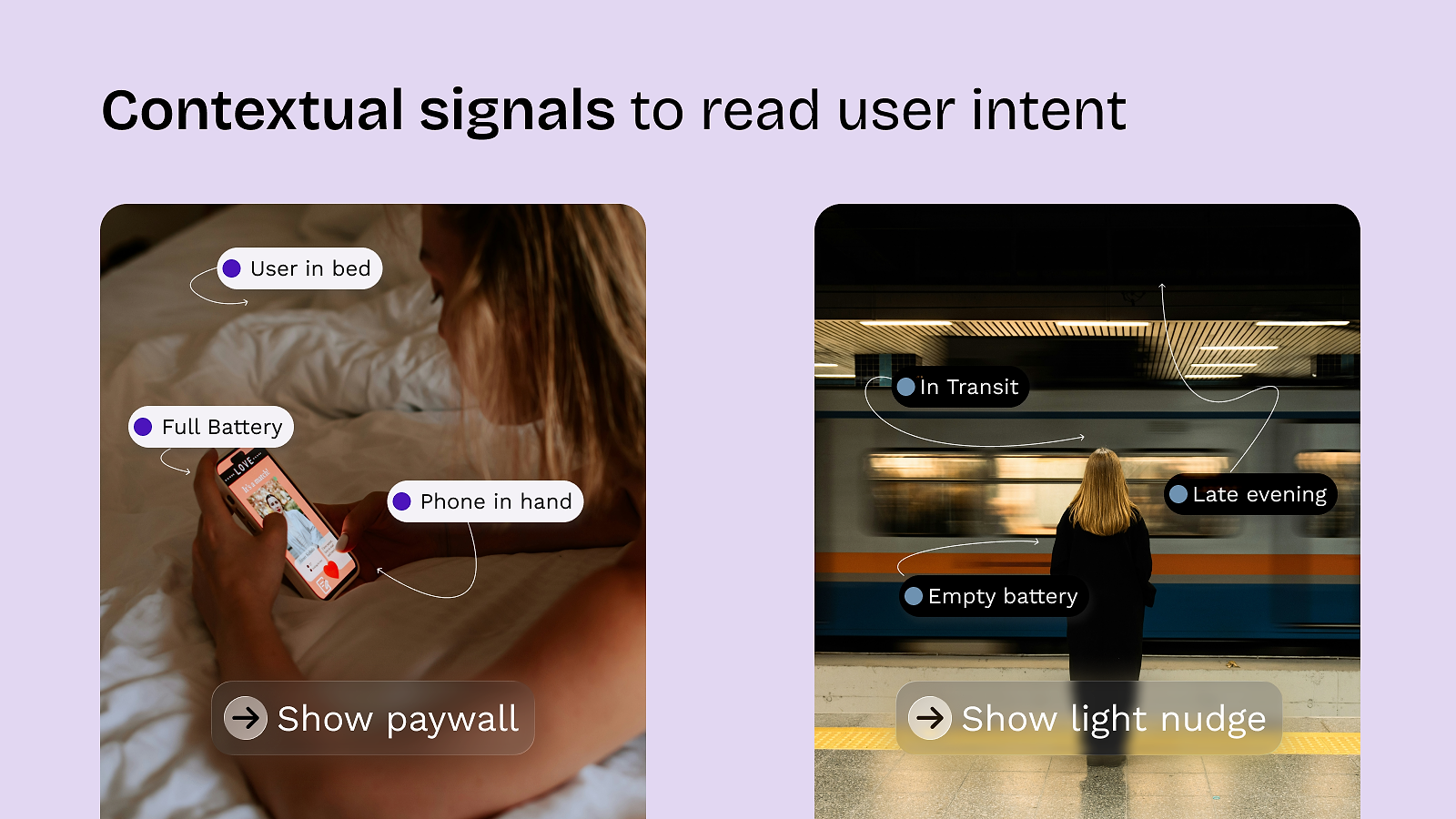
Instead of a single gate, context-aware apps let access and prompts adapt to the moment. One example could be a fitness app recognizing the difference between someone lying in bed in the evening versus someone on a jog. In the stationary moment, show a full upgrade view with plan details. In motion, allow the workout with a light ‘upgrade to save x%’ nudge. Same feature, different timing, less friction.
5. Progressive disclosure that respects context
Surface decisions when users have the attention to make them. Hold back in obvious low-consideration states (in Apple’s driving focus, during phone calls, or while abroad etc.) and follow up when the session lengthens, motion drops, or engagement deepens. You’re not showing fewer opportunities; you’re placing them where they fit.
6. Design for ‘it gets me’ moments
The holy grail of product experience is creating moments where users think “This app just gets me”. These moments build loyalty, drive word-of-mouth, and increase lifetime value. For example, a meditation app that offers a five minute session at 7am during their morning routine, and a sleep track at 10pm when the user lies in bed, feels tuned to the user’s life. Like it just fits.
But time is only one signal: combine session depth, motion, battery and connectivity to decide when to ask and what to ask for. Over time, these small, well-timed choices build trust and make upgrade prompts feel like part of the experience rather than interruptions.
Contextual targeting strategies for tech leadership
Engineering leaders don’t just ask “Does this work?”, they ask “Is it reliable, can it scale and can we maintain it?”.
Context-aware targeting adds real value, but remember to evaluate new capabilities through multiple lenses: implementation complexity, maintenance burden, scalability, privacy implications and strategic alignment.
7. Use existing device signals and minimize prompts
Many useful signals are available via standard APIs without new permission prompts: time of day, battery level, device orientation, network type, screen state.
Where a platform does require consent for certain motion or fitness data, respect that boundary and degrade gracefully. You can get meaningful context without expanding your permissions surface.
8. On-device inference for latency, cost and reliability
Running models on-device with Core ML or ML Kit keeps decisions close to the user. Latency drops to milliseconds, so timing can adapt within a session. Server costs are lower because phones do the work rather than a central service. Reliability improves because decisions do not depend on a network round trip and continue to work on WiFi, cellular or offline.
9. Decouple releases from experiments
Shipping timing changes through app releases create a bottleneck: engineering implementation, QA, review, store approval and adoption can turn a simple test into weeks.
Use remote configuration or paywall management to ship timing rules and model updates over-the-air, with rollback if metrics dip. This way underperforming models can be detected and corrected within 24 hours, without an app update. The effect is practical: product teams keep building core features, while monetization experiments iterate safely in configuration.
Beyond intuition: context is standard
The traditional approach of manual paywall optimization has reached its performance ceiling. When even the best-performing apps convert less than 5% of downloads to paid users, there’s enormous room for improvement — contextual intelligence could be the solution.
35% of apps now mix subscriptions with consumables and lifetime purchases, and AI apps already outperform other categories. The future of apps is hyper-personalization, and the trajectory for paywall targeting is clear:
- 2020–2022: Basic A/B testing of paywall copy and placement
- 2023–2025: Behavioral and demographic targeting
- 2026+: Real-time, contextual optimization via machine learning
As hyper-personalization becomes standard, the success of paywall optimization shifts from what you show to when you show it. In a crowded mobile environment where sessions are short and acquisition costs are high, timing your paywall to match user intent matters more than tweaking the design or copy.