


Despite the fact many app developers dream of selling their app, the world of app buying is still rather uncharted territory. Much like job interviews or talking about personal finance, people seem to shy away from frank conversations.
Luckily, we don’t. And it seems about time someone demystified these questions.
Questions like:
- What’s my app worth?
- Do I need to stay after the acquisition?
- Can I stay after the acquisition?
- Do buyers prefer organic or paid traffic?
- How good does my retention need to be?
- What’s a multiplier and how do I get it/do it/be it?
Answering those (and some others) is the goal of this article. Currently most app acquisition advice floating around the internet is either outdated, generic, or coming from people who’ve never actually bought an app.
For various reasons, many buyers keep their perspectives private; but just as job interviews are getting more transparent in what to prepare, we think founders deserve reliable acquisition guidance. So, we went straight to the source!
This is the real state of industry acquisitions, straight from the people shaping the vertical: buyers.
If you’re a founder looking for an exit, or even just a newbie planning ahead, we promise you this is worth 10x the hours you’ll spend watching interviews, listening to podcasts, and in 1:1 conversations.
Featured app buyers
Evelin Herrera is Founder of EHVM App Capital, the mobile app M&A firm working with high-growth app founders on exits and strategic acquisitions. Every day, Evelin is in the field working directly with founders and buyers, facilitating deals. So who better to get the real answers from buyers on what they’re looking for?
After scouring her network, Evelin interviewed ten experienced, international buyers on everything from valuation to founder status post-acquisition. We’ve taken those interviews, and unpicked the answers to all those questions you haven’t had ticked off yet (or are too afraid to ask).
Here’s who Evelin spoke to:
- 🇺🇸 Dan Novaes, Co-Founder & CEO at Mode Mobile
- 🇫🇷 Guillaume Larrieu, VP of Business Development at Quiet
- 🇨🇦 Jon Walsh, Managing Partner at Kodeon and Partner at Push Capital
- 🇸🇰 Matej Lancaric, Independent User Acquisition & Marketing Consultant
- 🇪🇸 Michael McPhee, Head of Business Development and M&A at Leadtech Group
- 🇵🇱 Paweł Pochowski, Head of Business Development at Nova Sphere
- 🇬🇧 Ryan Thorpe, Director of Growth at Reflective Apps
- 🇺🇸 Tom Kenney, CEO & Co-founder at LOYAL
- 🇹🇷 Yalçın Özdemir, Founder & CEO at AppNation
- 🇺🇸 Zach Tobin, Founder of Product Growth LLC
These are the people acquiring, integrating, and scaling apps today, spanning app categories like gaming, health & fitness, productivity, utilities, and lifestyle. Read on for a peek into their world…
TL;DR: the real state of app acquisitions (according to the people writing the checks)
If you’re just here for the quickfire facts, we’ve got you covered. From 10 hours of interviews, here are the highlights you need to know if you’re interested in selling your app.
- The majority of buyers prefer keeping original talent (including the founder) in place post-acquisition: they benefit from product knowledge, quick iteration, and being able to scale without delays.
- The starting point for valuing your app is 3–5x EBITDA (earnings before interest, taxes, depreciation, and amortization), provided your app is older than two years and has four plus months of subscriber retention.
- Strategic acquisitions (not purely financially-motivated) do happen, but they’re rare and require a lot of matchmaking.
- Most companies offer 100% upfront cash as standard, but some offer variants like earnouts or equity. Consider these options carefully, as they can increase/decrease your overall valuation.
- Different buyers favour more organic or more paid traffic; organic builds reliable growth, but paid user acquisition (UA) drives scale. Try targeting a 50/50 mix to show strong metrics and reduce the risk of algorithmic reliance.
- Why are buyers looking to acquire in the first place? Buyers have seen double revenue in 12–18 months for <$500k acquisitions, so financial incentives are high. Many acquirers also prefer buying versus building from scratch to reduce risk, accelerate growth, and start with apps that benefit from proven product-market fit (PMF).
- The top green flags for acquisition are: high retention, low running costs, organic compounding, domain authority, proven PMF and market momentum.
What actually drives app valuation, and the truth about multipliers
This is the first question developers always have: how much can I get for my app business? But valuation is tricky — you have to reflect potential future growth, stickiness > trends, technology moats (if any), and multiple other factors.
The best way to answer the crux of this question is by hearing it from the folks who put the capital on the table. But, before we dive in, let’s cover a couple of basics: acquisition types and multipliers.
Strategic vs. financial acquisitions
Believe it or not, not all apps are bought just for financial gain. In fact, most are a mix of strategic moves, financial motivation, and passion projects. But broadly-speaking, there’s two types of acquisition: financial and strategic.
Financial acquisition are valuations are solely based on the financial performance of the company:
“Financials are the priority, but if something lines up strategically with what we’re building, we’ll go there too.” — Dan Novaes, Co-Founder & CEO at Mode Mobile
Strategic acquisitions consider the strategic value (e.g. a gap in their app portfolio, or particularly strong market value) an acquisition is bringing to the business — typically these come with a premium price:
“We’re always looking for acquisitions that help us advance our strategy of building a portfolio of high-quality life improvement-focused apps. We then base our valuation on a number of factors.” — Jon Walsh, Managing Partner at Kodeon and Partner at Push Capital
Are multipliers the defining factor in an acquisition?
In the world of mobile app acquisitions, multipliers are tossed about left, right, and centre. Along with all the wonderful acronyms that come with them.
In short, a multiplier is a simple way buyers estimate a business’ value, based on core financial metrics. It’s about saying “we value your app at X times what it earns”, aka thinking about what it could earn.
Most acquisitions use a core metric like monthly recurring revenue (MRR), annual recurring revenue (ARR), or EBITDA as the baseline. A multiple is the price per unit. So if an app makes $100k EBITDA, and buyers typically pay 3-5X EBITDA, then the app is worth $300-$500k. Buyers anchor value on these metrics because they’re disciplined, and it minimizes risk of overpaying.
“Valuations are always based on multiples. If you’re not disciplined, you’ll overpay which makes it that much more difficult to succeed. Valuations need to create a win/win for all parties, including the buyer.” — Tom Kenney, CEO & Co-founder at LOYAL
Many founders obsess over multipliers and assume they’re the be-all and end-all for getting acquired. But the reality Evelin heard from every buyer was that multipliers are a starting point, not a golden rule. The real valuation moves up or down depending on a number of factors (which we’ll get into shortly) like retention, scalability, growth, team etc.
For example, Yalçın Özdemir, Founder & CEO at AppNation, explained how, for the right app, valuations can be flexible:
“When we identify opportunities where our strengths can quickly improve the revenue, we’re willing to stretch valuations. In these cases, we see the real value in the match between what the founder has built and what we can contribute.” — Yalçın Özdemir, Founder & CEO at AppNation
When multipliers don’t tell the full story
As Yalçın says, multipliers aren’t the sole deciding factor in whether a buyer is interested. The big picture matters too, and certain industries, like gaming, can be less rigidly-reliant on multiples:
“Multipliers are a useful tool, but they’re not the only method we rely on — and certainly not always the most accurate. For example, games often experience revenue decline once user acquisition spend is reduced. In these cases, a valuation based solely on the past 12–24 months might not reflect the true potential.” — Paweł Pochowski, Head of Business Development at Nova Sphere
Early-stage apps or products in emerging niches can also be poorly reflected by multiples alone. Paweł explained that these categories may not have had a chance to prove their value through performance metrics yet: “In these scenarios, we look beyond historical data and consider market trends, strategic fit, and growth potential. If we see strong momentum or a unique positioning, we’re open to offering above-standard valuations.”
“We start with financial performance, then dig deeper into the performance metrics, and build a comprehensive model that allows us to understand an app’s history, its current place in the market and value to current and past users.” — Jon Walsh, Managing Partner at Kodeon and Partner at Push Capital
Jon Walsh, Managing Partner at Kodeon and Partner at Push Capital, also says many buyers factor in their current app portfolio when valuing new apps: “We consider how complimentary it is to our overall portfolio and ultimately determine what price we are able to pay. We can, and do, pay higher multiples for assets that accelerate our overall plan, but within a range that is based on financial discipline.”
How to hack the high-multiple tier
So what’s the secret to your app sitting in that magic high-multiple tier?
Typically, valuations are a multiplier range e.g. 3–5x EBITDA. Different factors make apps lower or higher, and a handful of buyers will stretch beyond standard ranges when an app unlocks something bigger for their app portfolio.
These reasons could be:
- Cross-sell potential
- Category expertise
- Shared users
- Proven PMF in a target market
- A feature set they lack internally
This is why founders should talk to multiple buyers. Your best valuation may come from the buyer who sees the most synergy between your app and their current portfolio, not the highest revenue multiple.
Across every buyer Evelin spoke to, there was an unmistakable pattern. If you want the upper end of the multiplier range, you need these three things:
- Strong retention: this signals undeniable product-market fit, and is the best predictor of long-term cash flow
- Low operational burden + clean architecture: buyers want to scale quickly and easily — they can’t do that if there’s missing documentation, inconsistent analytics, or messy code
- Organic or compounding distribution: this equals an efficient growth engine; think untapped markets, clear opportunities to expand features, early traction in a category etc.
Not much to ask, right?
Takeaway: valuation + multipliers
While multipliers are simple to understand and have a quick potential for evaluating your app, it’s more important to find a buyer that’s the right fit. If your app helps a buyer advance faster towards their goal, offers a strategic or portfolio fit, or has growth momentum, you’re far more likely to get a much higher multiplier.
Likewise, if a buyer can clearly see where they’ll create value, the app becomes more attractive — and more expensive. Early trajectory and category dynamics also influence valuation almost as much as financials. But remember: financial responsibility still holds out. Most buyers put stock in EBITDA/MRR multiples, and won’t take a big financial risk.
The app buyer wishlist: what founders should optimize before acquisition
While multipliers play a part in getting that offer, there’s a lot of factors that influence whether buyers move a deal forward. Evelin asked about the top three things buyers look for in an app, and do you know how many said the same top three factors?
Yup, zilch. There’s no one-size-fits-all approach.
But just like the signals influencing your multiplier, there were frequent recurring factors that all buyers put as priorities. Primarily, everyone mentioned retention and having ‘sticky’ users.
“Ultimately, the lower the price of the acquisition, the better. And the faster the return-on-investment, the better. But we look at so many factors and how they relate to each other.” — Ryan Thorpe, Director of Growth at Reflective Apps
Here’s what our buyers are looking for:
- Retention
- Organic growth
- Monetization potential
- Valuation and ROI
- Technical infrastructure
- Product-market fit
- Familiarity with the vertical and/or strategic/portfolio fit
- Market momentum
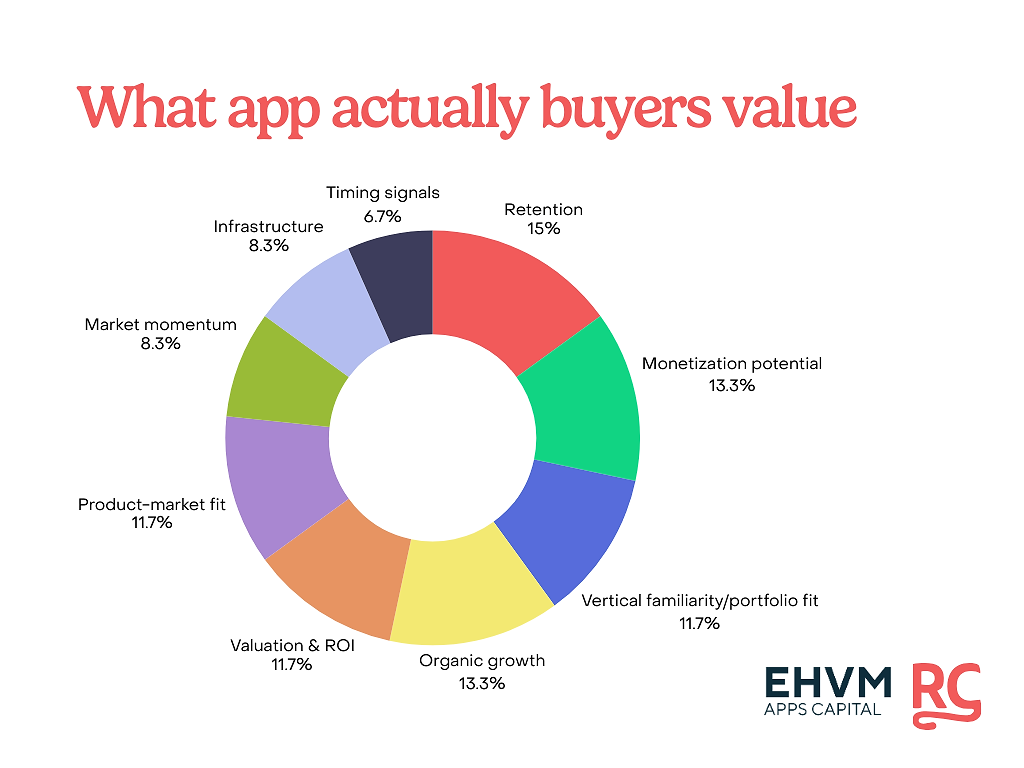
Let’s break these down.
Almost no one values pure revenue alone. High multiples and desired apps come from alignment, across retention, distribution, monetization, and personal buyer fit.
Above all, everyone was looking to see an app that has found its place with strong audience and market fit. If it slots into a strategic or portfolio gap, even better. The recurring theme is this app works, but we can make it work much better.
Okay, we know that multipliers don’t always tell the full story, and we know what buyers look for — let’s dig a little deeper into how you can illustrate these points when your app’s being assessed.
Retention signals that tell buyers your app is ‘healthy’
Retention is a crucial point for many buyers — and it makes sense; if you’re paying years in advance of the business’ success, you want to retain paying users for a considerable time. Buyers consistently ranked retention as one of their top three valuation drivers, but how can founders prepare a retention story that clearly demonstrates stickiness, and reduces perceived risk?
Based on Evelin’s conversations, retention signals fall into three buckets:
1. Retention matches category benchmarks: Buyers aren’t looking at universal stats, they’re evaluating retention relative to category norms, price point, subscription length, frequency of use etc.
“I look at who’s the biggest player in the category? How much revenue are they earning? What kind of UA channels do they run? This then serves as a benchmark for the app I’m considering. All this comes into my decision matrix.” — Matej Lancaric, Independent User Acquisition & Marketing Consultant
The State of Subscription Apps report shows how drastically retention shifts between categories. Make sure you know your industry, what competitors are doing, and how you hold up.
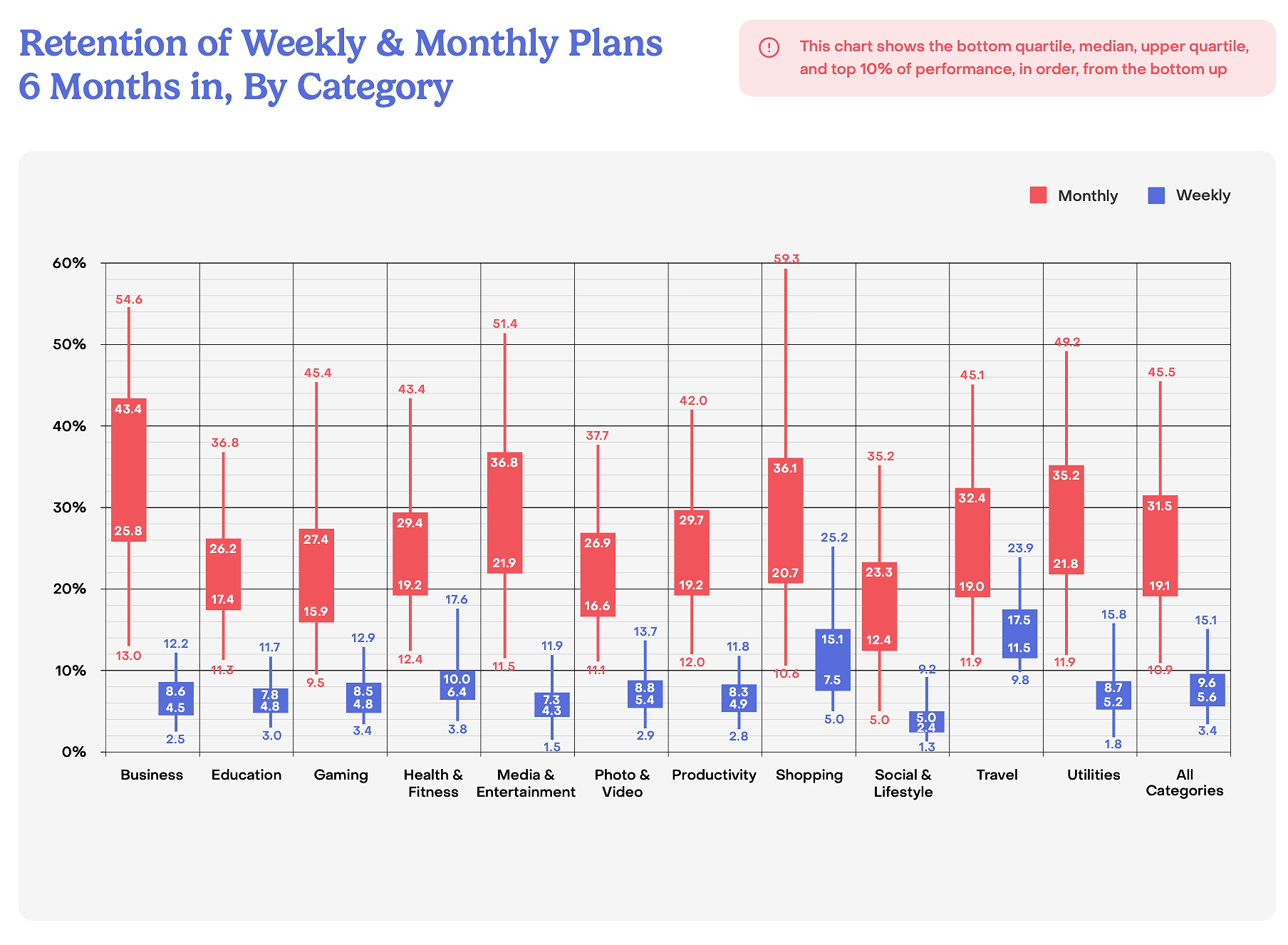
2. Clear stories behind early churn: With 30% of subscriptions cancelling in the first month, churn doesn’t mean an automatic ‘no’ from buyers. But you need to show that you understand why the churn happened, and have used it as a lesson to course-correct. If you can explain churn, you can defend your valuation.
3. Cohorts that stabilize over time: Even if churn is high, you can still gather evidence that the most important long-term users stick. Create a holistic view of your retention, across different subscription plans, user segments, and attribution sources.
Now, if you’re looking at your RevenueCat dashboard and panicking about your retention rate, hold on a moment. The threshold considered ‘strong retention’ varies considerably between buyers:
Ryan Thorpe, Director of Growth at Reflective Apps, said “We have some apps as low at 25%, others as high at 60% on yearly subscriptions. It massively depends on what you class as ‘healthy’, and the kind of subscription model you’re running.”
Meanwhile, Jon Walsh, Managing Partner at Kodeon and Partner at Push Capital, said: “Generally, I would say 60–70% is a decent range for annual subscription retention, depending on the app category and age. But there are a number of factors that can impact retention (like pricing strategy). It’s just one of many metrics we look at to determine whether an app is a fit for us and what its value is.”
Takeaway: retention signals
This is a breath of fresh air for developers: it’s not all about subscriber retention — all the other signals we outlined on the app buyer wishlist matter too. Consider payback periods, your pricing model, and LTV/CAC ratio; all of these add up to tell your retention story. And even then, ‘good’ retention can be anywhere between 25–70%, depending on who you’re asking.
Make sure you understand your app’s metrics, know your category benchmarks, and can explain (or defend) any questions that may be thrown at you. Resources like the State of Subscription Apps report are a great place to start when comparing what ‘good’ looks like. You can also use tools like RevenueCat’s Subscription App Healthscore calculator to see how you measure up to competitors.
Paid or organic? Buyer preferences on traffic and UA
Another question Evelin gets all the time is whether organic traffic or scaling paid user acquisition (UA) matters more in valuations. This was one of the most polarizing questions in her interviews — some buyers want pure organic, others want pure paid. Most fall somewhere in between.
Buyers who strongly prefer organic growth
Organic traffic is seen as lower risk and higher value for money. Zach Tobin, Founder of Product Growth LLC, prefers organic: “It’s less effort to maintain, though it carries risk of algorithm changes. Ideally we want 100% organic, but I’ll invest in paid up until the breakeven point, which usually works out to an 80/20 split.”
Ryan Thorpe, Director of Growth at Reflective Apps, agreed: “Organic traffic is more reliable in distribution, predictable in its yearly returns, and has no additional high marketing costs.”
These buyers value defensibility, and compounding growth. Organic growth is perceived as a sign of quality and secure product-market fit; making it an indicator for future reliability.
“The higher the organic traffic, the better. High organic traffic that is compounding is what we’re looking for: a predictable trend, where distribution is effectively free with product-market fit attained and momentum accelerating.” — Ryan Thorpe, Director of Growth at Reflective Apps.
Buyers who prefer paid user acquisition
But for other buyers, paid UA is seen as more predictable and thus scalable:
“Paid traffic is the backbone of our strategy… We’ve seen way too many examples of young apps rapidly showing growth through pure organic activities, but being unable to sustain that for the long run. Long-term profitability and scalability means paid UA.” — Guillaume Larrieu, VP of Business Development at Quiet
Tom Kenney, CEO & Co-founder at LOYAL, explained that paid traffic can be a tactic to “break through the app store noise”, while other buyers preferred paid UA for its clearer insight into CAC, ROAS, funnel performance, and channel trends — helping prevent costly future mistakes.
Buyers who want a balance of organic and paid traffic
While some buyers said solely paid or organic traffic would turn them off an app, the majority of buyers said they wouldn’t be closed off to a split traffic mix, with many buyers actually preferring this for its balanced growth potential.
Guillaume Larrieu, VP of Business Development at Quiet, said 75/25 paid/organic is a good mix for his acquisitions: “It’s even better if organic installs are driven by organic activities, like viral videos or social content, rather than ASO implementations.”
Other buyers, like Dan Novaes, Co-Founder & CEO at Mode Mobile, were happy with a more even split:
“I like paid traffic with a strong organic multiplier. Paid is predictable and scalable if you know what you’re doing. Algorithms change, so you can’t just rely on organic. A perfect world is 50/50 organic/paid.” — Dan Novaes, Co-Founder & CEO at Mode Mobile
Takeaway: organic vs. paid traffic
Both types of traffic are relevant, but it’s clear that having paid UA is useful for buyers wanting to see metrics, profitability, or avoid old mistakes. While organic tells a story of pure growth, paid is seen as more predictable.
You don’t need a perfect traffic mix before selling, but you need to be able to back your traffic split:
- If organic is your strength, quantify defensibility
- If paid is your strength, present UA profitability + failed experiments + learnings
Make sure you can offer buyers clarity on what channels work, what channels don’t work, why, and where you’ve built efficiency.
“We don’t have a preference for type of traffic, but if the app is doing paid acquisition then we really need to understand the UA metrics and what’s driving paid user performance, so we can determine how sustainable and scalable it is.” — Jon Walsh, Managing Partner at Kodeon and Partner at Push Capital
Closing the deal: how to find (and actually talk to) a buyer
So you know what buyers are looking for, you’ve cleaned up your numbers, and coordinated the story of your app’s success. Now you just need to get in front of a buyer.
Sometimes a buyer may approach you, but if you’re ready to go right away, here’s how to get started.
- Research different types of buyer: individuals and businesses acquire apps for many reasons, and these different buyer types will look for different things. Spend some time familiarizing yourself with who buys apps, and where your app would fit best.
- Find your buyers: once you know the type of buyer you’re looking for, it’s time to network. There are websites and marketplaces where you can advertise your app, or you can speak to an M&A expert. Your best bet is typically networking in-person and LinkedIn. You’ll normally be looking for folks with business development, M&A, or partnership in their job title.
- Build a target list: after identifying your buyers, start tracking everyone in a spreadsheet. Record buyer info, typical deal size, recent acquisitions, and how to contact them. You can use this to document your outreach progress, too.
- Reach out via channels that don’t waste time: warm intros (founders, angels, lawyers, accountants, UA consultants) will always outperform cold calling/emailing. If you can’t find a mutual connection, direct outreach can work through the proper channels. You can also check out founder or buyer forums or marketplace websites, where buyers may be discreetly lurking. And don’t forget in-person networking opportunities!
- Lead with a message, not your life story: your first message shouldn’t be a pitch. It’s a qualifier. Keep it simple, straightforward, and factual. Add top compelling metrics (think MRR, margin, growth), any relevant info (like similar apps they’re acquired, mutual connections etc.) and ask for a follow-up call.
Once you get to the first call, your next moves will depend on who you’re talking to and what they’re looking for. Remember to lead with a combination of facts and storytelling, and keep momentum up in your conversations.
Quickfire who’s who of app buying:
Apps can be bought by individuals and businesses. Each tend to fall into one of three categories:
- Roll-ups and portfolio buyers want predictable cash flow and clean operations
- Growth studios typically want scalable paid acquisition and clear monetization levers
Strategic buyers are looking for category fit, cross-selling opportunities, or a missing feature
What does receiving an acquisition offer look like?
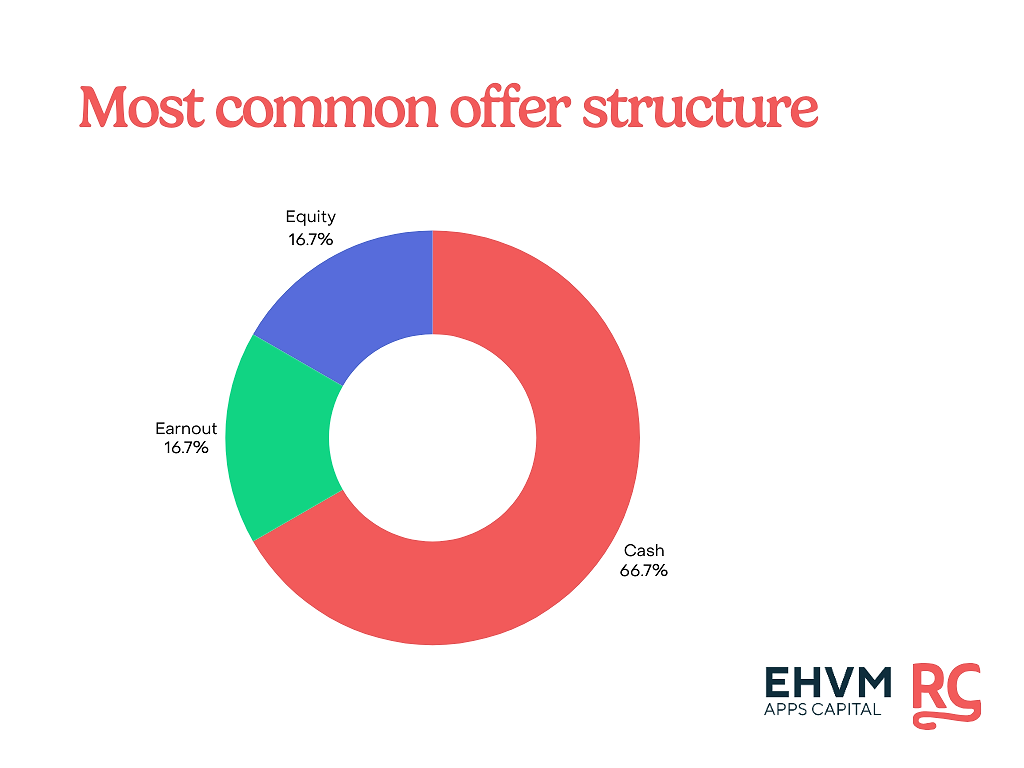
You know how job ads frame ‘compensation packages’ versus individual salaries? Well, acquisition offers are similar. Typically, there’s three main structures to offers:
- Cash: fixed purchase price, paid upfront when the deal closes — this is the lowest risk for sellers, and most common kind of offer
- Equity: part (or all) of the price is paid in shares of the buyer’s company; tying your payment to their growth
- Earnout distribution: a portion of the price is paid only once hitting agreed revenue, profit, or growth targets post-acquisition
Of the buyers Evelin spoke to, 66% do cash offers, with the remainders doing a mix of cash and equity or earnouts. While cash offers won’t necessarily pay out in one chunk (most buyers do 50% at a time, sometimes 6/12 months after the deal), they’re typically the best outcome for sellers, though equity can be valuable if being acquired by a successful company.
What makes a deal close fast?
This section answers one of founders’ biggest questions: What makes a buyer say ‘yes’ quickly?
Across interviews, buyers described what makes a deal feel ‘clean’ and easy, opposed to risky or slow. Here’s what speeds up decisions:
- Clean, consistent financials: speed requires all the numbers to be in order. No messy revenue classifications. No unexplained cliffs. No ‘miscellaneous’ line items. Anything but clear numbers will add a red flag and significantly slow down the process.
- Clear handover documentation: buyers moving quickly need to know they can pick up the new app and keep it ticking over without any trouble. This means getting access to: architecture overviews, data taxonomies, analytics events, roadmap history, experiment logs, growth playbooks, and anything else you have lurking in your Google Drive!
- A transparent founder: yes, fast-closing deals rely on a solid business, but they’re also impacted by trust. Buyers who click with a founder and feel they’ve made a trusted connection will overlook imperfections and move faster.
- A believable growth story: quite simply, buyers want to clearly be told what happens after they buy the app. Help plot their success, and they’ll be eager to sign on the dotted line.
The talent taboo: Do app buyers want founders to stay?
Most founders assume a buyer will want them gone immediately. But in reality, the answer is more nuanced — and varies depending on the buyer’s operating model.
Across all interviews, we noticed three things:
- Historical learnings can be very useful to support product scale
- Developers bring product and vision, then acquirers add marketing and monetization expertise
- Acquirers are interested in long term relationship-building
Buyers value product knowledge more than headcount
Many acquirers prefer the original team to remain during the transition (or longer) for the undeniable reason that they deeply understand the product’s history, vision, and technical decisions.
“We like the teams to stick around as long as they’re still committed. The history of what they’ve tried is useful context, and we can build on that. Where they’re weaker, we plug in our expertise.” — Dan Novaes, Co-Founder & CEO at Mode Mobile
Michael McPhee, Head of Business Development and M&A at Leadtech Group, said they ‘absolutely’ want founders to stay: “We always try to keep the team behind the app engaged after the acquisition. They know the product best, and their expertise is crucial for continued development and fast iterations.”
Paweł Pochowski, Head of Business Development at Nova Sphere, agreed: “From a practical standpoint, having the original developer onboard ensures smoother maintenance and faster implementation of changes.”
For many buyers, acquisition is about combining skillsets of the founding team and the new owner. Michael explains: “At Leadtech, we focus on scaling marketing, monetization, and UA, while the original team focuses on product enhancements. This balance builds strong long-term partnerships and is one of the keys to our success.”
Buyers don’t want to relearn the product from scratch. They want continuity, and to capitalize on existing success.
Founder involvement signals belief and influences valuation
Some buyers also explicitly said that a founder wanting to stay post-acquisition can influence higher valuation. Paweł Pochowski, Head of Business Development at Nova Sphere, said the team prefers original creators to remain involved:
“Their continued commitment is a strong signal they believe in the product and are motivated to see it evolve.” — Paweł Pochowski, Head of Business Development at Nova Sphere
Founders wanting to stay part of the team not only indicates belief in the product, but a level of passion and commitment that’s desirable of any team member. Rather than wanting to grab the cash and jump ship, founders who stay involved can support future growth, and enable smooth handovers when (or if) the time comes to part ways.
Some acquisitions are structured to absorb the product
Despite the benefits of creators remaining involved, large app studios or portfolio operators — particularly those with their own internal product, engineering, and UA teams — are less dependent on founders staying. However, this doesn’t mean they’re kicking you out of the door.
As Yalçın Özdemir, Founder & CEO at AppNation, puts it:
“We don’t expect founders to stay on after an acquisition. As a large app studio, our in-house teams, systems, and expertise allow us to integrate products efficiently and unlock value independently. That said, in rare cases where founders are deeply embedded in the product and critical to its continuity, we may ask them to remain for a transitional period of a few months.”
This is why it’s crucial to talk about your future as a founder with any potential buyers — wanting to leave or stay with the app won’t necessarily impact the sale, but it’s vital you’re all on the same page.
Takeaway: closing the deal
Once your numbers and story are tight, closing the deal is primarily about:
- Finding the right buyer
- Making it easy for them to say yes
Get to know your buyer types, build a focused list of targets and start networking. Deals move fastest when financials are clean, handover docs are ready, and founders are transparent. You don’t need to commit years of your life post-acquisition, but you do need a clear transition plan. If you’re hoping to exit, consider how you can still convey confidence and historical product context to the new owners, be it through roadmaps, documentation, or a new advisory role.
Checklist: founder prep-list for getting acquired in 2026
If you’re simply looking for a to-do list that answers “What do I need to do to get my app acquired?” then your wish is our command.
Below is a foolproof checklist, distilled from Evelin’s app buyer interviews, ready for you to take the next steps towards acquisition. Think of this as ongoing prep for any founder looking to exit, be it today or five years from now.
1. Prepare your metrics
Metrics are the evidence buyers need to decide whether your app is worth their time. Prioritize clarity and consistency — confusing or contradictory metrics slow deals more than ‘bad’ metrics.
Top-level data points to prepare:
- LTV by cohort and LTV/CAC ratio
- Retention curves (D7, D30, D90+ where possible)
- Churn reasons (voluntary vs. involuntary)
- Organic vs. paid traffic split
- UA profitability (by channel + key experiments)
- Revenue breakdown (subscription vs. IAP vs. ads)
- % of users on annual plans (if applicable)
2. Prepare your product
Think of yourself as a salesperson: for the highest valuation, you need to make it as simple and appealing as possible for buyers to pick up the product and make money.
Remember: Buyers aren’t looking for perfection, they’re looking for low friction.
- Clean up any messy code paths or one-off hacks
- Reduce reliance on fragile third-party dependencies
- Improve onboarding clarity
- Tighten paywalls and pricing logic as necessary
- Grow your organic traffic where possible (ASO, reviews, SEO)
3. Prepare your financials
Messy or unclear financials are one of the fastest ways to kill a deal. If a buyer has to infer what’s going on with your numbers, they’ll assume the worst. Make sure they don’t need to guess.
Before talking to buyers:
- Review and cut non-essential costs (this will improve EBITDA and optics)
- Clean and reconcile your profit and loss statement
- Clearly document add-backs and one-off expenses
- Prepare MRR breakdowns (country, store, plan, platforms)
- Be ready to explain any revenue spikes, anomalies, or drop-offs
4. Prepare your team
Buyers care less about headcount, and more about continuity and protected knowledge. Make sure you have conversations with your team before speaking to buyers.
You need to decide:
- Who’s staying post-acquisition, and for how long?
- What knowledge or responsibilities need to be transferred?
- Whether you’re open to staying involved, and in what capacity
- Updated contracts, NDAs, and IP assignments
5. Prepare your handover
Deals move faster when buyers can clearly see how they’ll run the app without you. Document things only you currently know, or product decisions and historic context that may be helpful for the team:
- Current and historic product roadmaps
- Feature gating logic
- Paywall logic and pricing history
- Onboarding flows and funnels
- Architecture overview (simple is fine)
- Brand assets and press kit
- A master doc of tools, SDKs, dashboards, logins
Bonus tip
Don’t forget to document experiments, distribution tests, and product learnings. It doesn’t have to be fancy, just section out information by channel or tactic and add bullet points. This will motivate the buyer knowing there’s learnings built, and documented, that they can benefit from. Evelin has created this template you can use.
6. Prepare your deal
Don’t wait until an offer appears to think about what you want, how you’ll approach acquisition conversations, and who else needs to know.
Here’s what you should think about:
- Decide your minimum accepted offer and structure (cash vs. earnout vs. equity)
- Identify your ideal buyer type (studio, roll-up, strategic)
- Build a target buyer list
- Talk with at least five potential buyers before choosing
- Prep your first message and practice your pitch
- Be honest with yourself about timing, motivation, and trade-offs
You don’t need to tick off every item on this list at once, it’s a big job. But each checkmark is something prepared ahead of time, so when the right buyer shows up you can move forward quickly.
Final thoughts: the reality of selling apps in 2026
After speaking to buyers, and having spoken to many founders over the years, Evelin says the biggest misconception founders have about acquisitions is that buyers are looking for perfection.
They’re not.
They’re looking for:
- Predictable revenue
- A product with real PMF
- Retention that holds
- A growth story that makes sense
- A clean, transparent business
Founders who can clearly communicate these signals, both in narrative form and in hard data, are going to consistently earn higher valuations and close deals faster. So if you’re wanting to sell in the next 12–24 months, start preparing now. You don’t need a perfect app or perfect pitch — you need a clear story, transparent figures, and the right buyer.
Related tools and resources
Looking for more? Here are some related readings and tools to help you on your path to acquisition.
- Interview transcripts: read the full interview questions and answers
- RevenueCat’s subscription healthscore calculator
- Report: State of Subscription Apps (perfect for industry benchmarking!)
- Blog: How to sell an app, lessons from David Barnard
- Podcast: What makes an app worth buying? Lessons from BlueThrone’s shift from volume to value
- Podcast: How real demand turned a hobby app into a business
- Evelin’s template: App learnings and experiments documentation
- Evelin’s template: Profit and loss statement