

Going freemium is supposed to unlock organic growth. You give away the core product, users fall in love, and they tell their friends. But for many apps, it doesn’t play out that way. The free tier feels like a stripped-down trial, users churn before forming a habit, and the word-of-mouth engine never starts.
The standard freemium diagnostics don’t help much here. Conversion rate, paid penetration, and LTV — they all measure what your paying users are doing. None of them tell you whether your non-paying users are an asset or dead weight.
On a recent episode of the Sub Club podcast, Opal CEO Kenneth Schlenker shared the question he uses instead: would a non-paying user recommend the app to a friend?
If the answer is no, you need to give away more.
Why this question matters more than conversion rate
“If you want the freemium dynamic to really pay out, you need to make sure that the free users are recommending the app,” Kenneth says. “Otherwise, that doesn’t work.”
Freemium works only if free users stick around long enough to build a habit and recommend the app. If your free tier is too restrictive — it’s missing core features to achieve users’ job-to-be-done, or it just feels like a countdown to a paywall rather than a useful product — then neither happens. You get a small percentage converting to paid and zero organic pull.
That’s the trap. A free tier designed to demo the product instead of be a product.
How to actually answer the question
The recommendation question is a heuristic, not a metric. But you can triangulate toward an answer by watching two things in parallel:
- LTV of installs
- Overall retention across both free and paid users
When Opal tested how much to give away in their core ‘blocks’ feature — the scheduled restrictions that block distracting apps during specific times — the team tried everything from one block (very restrictive) to several, measuring these two metrics at every step.
The goal was to find the point where both metrics were moving up. Rather than focusing on just paid conversion, or free-to-paid funnel efficiency, this would show the combined health of the user base.
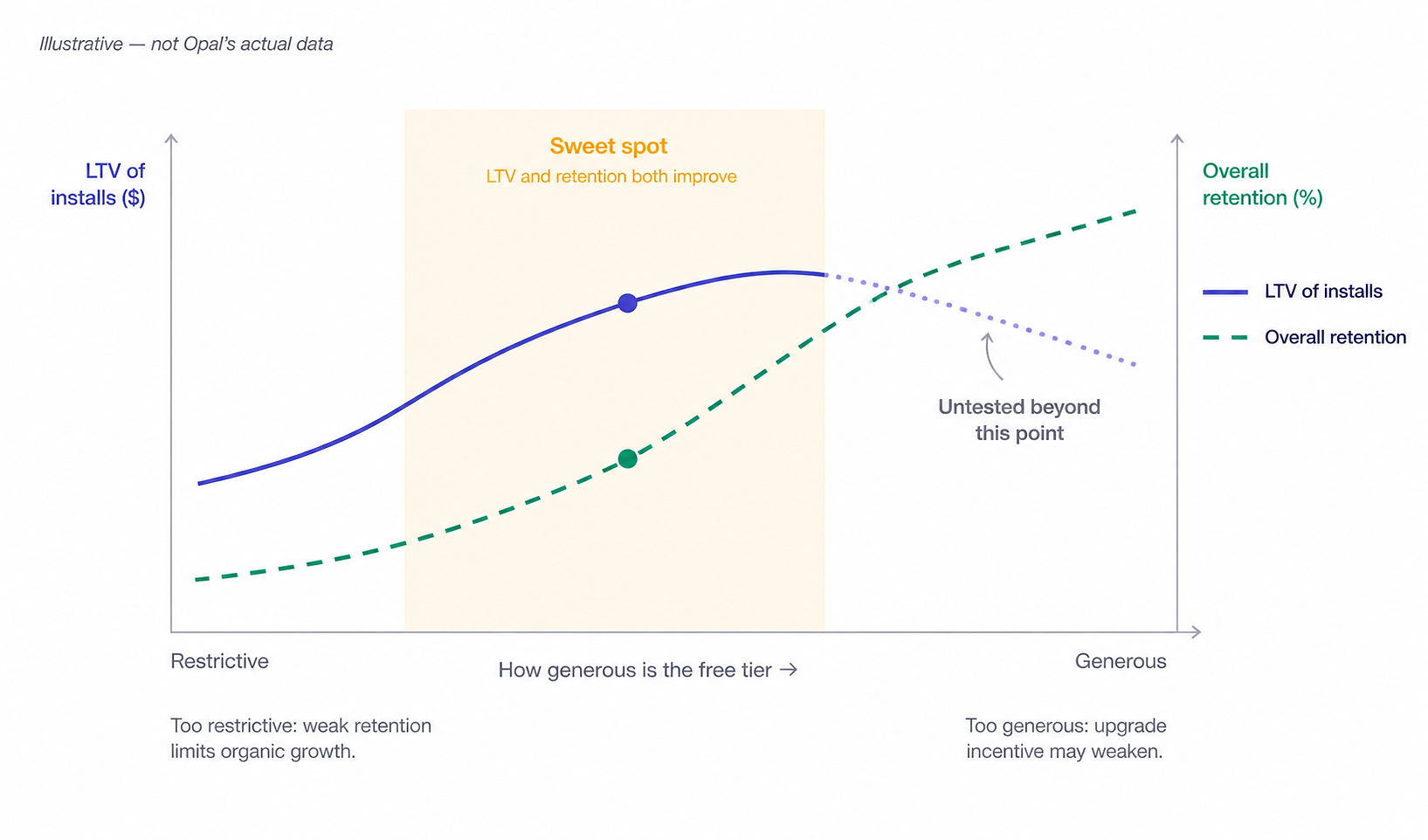
“Turns out that three [blocks] is enough for free users to get a great experience,” Kenneth explains. “They can actually really use the app, try out a few different things, and then also really power users that are convinced will pay because they want more.”
Three blocks gave non-payers enough utility to build a habit — and recommend the app. It also left enough headroom that committed users still had a reason to upgrade. If LTV and retention don’t both improve as you adjust your free tier, you’re optimizing one segment at the other’s expense.
What ‘yes’ actually unlocks
When Opal moved from a hard paywall to a genuinely generous free tier, their pay penetration — the share of monthly active users on a paid plan — dropped from 20% to 9%. That sounds like a disaster, but it wasn’t.
The free tier unlocked a segment Opal couldn’t reach behind a paywall: high school and college students, who now make up two-thirds of Opal’s DAUs. These users dragged pay penetration down — but they were doing something more valuable: telling their classmates, then telling their schools. Students recommending the app to administrators created Opal for Schools, now a contracted B2B revenue line. That distribution channel didn’t exist when there was only a hard paywall.
Overall, the shift pushed Opal past one million daily active users. “It’s a short-term, scary drop, but what happens in the long-term is that it pays back tenfold,” Kenneth says.
The takeaway
If your non-payers wouldn’t recommend the product, you don’t have freemium — you have a trial in disguise.
The fix isn’t always to give away more. Sometimes it’s to give away differently — more of one feature, less of another, restructured so the free experience is genuinely useful rather than a teaser. But the recommendation question is the compass. Pair it with parallel tracking of LTV and overall retention, and you have a way to find the line for your own product.
Think about:
- Does it unlock enough utility to build a habit or progress towards their goal?
- Does it unlock enough to make them recommend the app?
- Does it keep enough back to give users a reason to upgrade?
Most teams optimize their free tier to maximize conversion. The teams that win optimize it to maximize recommendation, and let conversion follow.